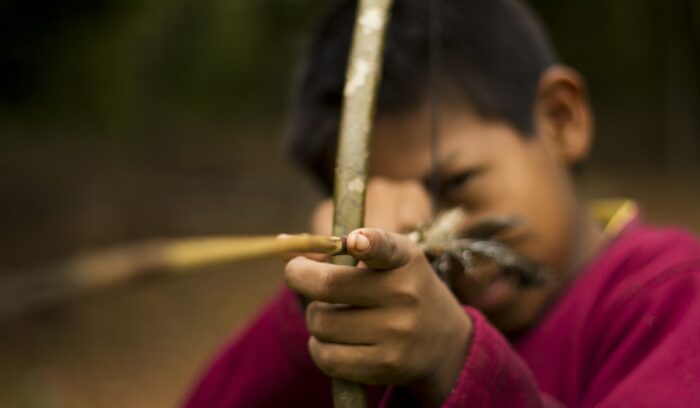
Long before Spanish ships reached the Río de la Plata, a people called the Guaraní had already shaped one of the most linguistically and culturally rich civilizations in South America. They farmed manioc and maize in communal longhouses, told stories about sacred waterfalls, and built a society held together not by conquest but by shared language and kinship — a society that, in many forms, endures to this day.
What the evidence shows
- Guaraní civilization: By the time Europeans arrived in the early 1500s C.E., the Guaraní numbered an estimated 400,000 people spread across what is now Paraguay, Argentina, southern Brazil, Uruguay, and Bolivia.
- Guaraní language: Communities were organized by dialect, with language serving as the primary bond of identity — a bond so durable that Guaraní remains one of Paraguay’s two official languages today, spoken by roughly 90% of the population as of 2012 C.E.
- Guaraní society: Villages were built around communal longhouses called malocas, each sheltering multiple families under the guidance of a chief, with larger tribal groupings formed through shared interest and speech.
A civilization shaped by the land
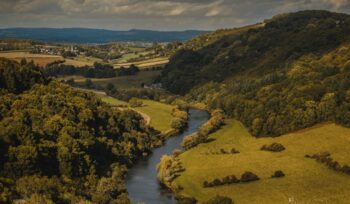
The Guaraní homeland stretched between the Paraná River and the lower Paraguay River — a landscape of river systems, forest, and wetland that shaped how they lived, traveled, and traded. Their agriculture centered on manioc and maize, supplemented by wild game and honey. They were sedentary farmers, not wanderers, and their settlements reflected a deep relationship with specific places.
Among the most sacred of those places was the Iguazú Falls, which the Guaraní understood as a site of spiritual power. Their mythology held that the falls revealed the sounds of ancient battles at certain times, and that spirits moved through the mist and the swallows that nested there. That sense of the sacred — animistic, pantheistic, woven into the natural world — shaped Guaraní belief for centuries and survives today in rural folklore across Paraguay and Argentina.
Before European contact, the Guaraní referred to themselves simply as Abá — “people.” The name Guaraní was applied later, first by Jesuit missionaries to distinguish those who had accepted conversion, then more broadly by Spanish colonizers who associated it with the word for “warrior” in the Tupi-Guaraní dialect. It is a name that came from outside, even as the identity it described was ancient and self-generated.
Community, language, and the ties that held
What made Guaraní civilization distinctive was its horizontal structure. There was no imperial center, no single ruling city. Instead, kinship groups connected by dialect and common interest formed the basic unit of political life. Chiefs led communal households, but authority was earned through relationship and trust, not imposed from above.
This structure made the Guaraní remarkably adaptive. Their territory spanned thousands of miles across multiple ecological zones. Different communities developed different oral traditions, mythologies, and agricultural practices while remaining recognizably part of the same broad civilization. The linguistic unity of the Guaraní across this vast territory is considered one of the most striking features of pre-Columbian South American history.
Their mythological tradition was equally rich. Stories of the Iguazú Falls, of spirits called I-Yara, of sacred journeys and cosmic creation, were passed down through generations. Much of this tradition was eventually compiled and published — first in Argentina in 1870 C.E., and translated into English in 1906 C.E. — giving outside readers their first systematic window into a world that had existed for centuries without needing their attention.
Lasting impact
The Guaraní left an imprint on South America that no amount of colonial disruption has erased. Their language did not recede in the face of Spanish — it absorbed it, persisted alongside it, and eventually was recognized as equal to it. Paraguay is one of the only countries in the Western Hemisphere where an Indigenous language holds full official status alongside a European one, used not just by rural communities but by the urban population, taught in public schools, and spoken in daily life by people of every background.
The Guaraní also shaped the genetic and cultural makeup of Paraguay itself. When Spanish colonizers arrived in the 1500s C.E., the first governor of the Spanish territory of Guayrá encouraged intermarriage between European men and Guaraní women. Their descendants became the foundation of the Paraguayan nation. Today, “Guaraní” is used colloquially in Spanish to mean any Paraguayan national — a remarkable sign of how completely this Indigenous identity has been absorbed into national consciousness, even as the people themselves have sometimes been marginalized within it.
Guaraní mythology, oral tradition, and ecological knowledge continue to influence literature, religion, and land stewardship across the region. The Guaraní people’s relationship to the land — their understanding of rivers, forests, and sacred sites — has become increasingly relevant in contemporary debates about environmental protection and Indigenous rights in South America.
Blindspots and limits
The historical record of Guaraní civilization before European contact is thin. Most of what we know was filtered through Jesuit missionaries and Spanish colonial administrators — observers with their own agendas, who documented what they found useful or alarming and ignored much else. Practices like cannibalism of captives, noted in colonial sources, are reported without sufficient context to understand their full cultural meaning, and the internal diversity of Guaraní communities across their vast territory is largely lost to us.
European colonization also brought catastrophic population loss. The slave trade centered in São Paulo targeted Guaraní communities throughout the 1600s C.E., and the commensurate rise of mestizo populations — while a sign of cultural fusion — also reflected coercion and dispossession. Contemporary Guaraní communities in Paraguay, Argentina, and Bolivia continue to fight for land rights and recognition, which means the story of this civilization is not finished, and not without ongoing injustice.
Read more
For more on this story, see: Wikipedia — Guaraní people
For more from Good News for Humankind, see:
- Indigenous land rights win at COP30 protects 160 million hectares
- Ghana establishes marine protected area at Cape Three Points
- The Good News for Humankind archive on Paraguay
About this article
- 🤖 This article is AI-generated, based on a framework created by Peter Schulte.
- 🌍 It aims to be inspirational but clear-eyed, accurate, and evidence-based, and grounded in care for the Earth, peace and belonging for all, and human evolution.
- 💬 Leave your notes and suggestions in the comments below — I will do my best to review and implement where appropriate.
- ✉️ One verified piece of good news, one insight from Antihero Project, every weekday morning. Subscribe free.