
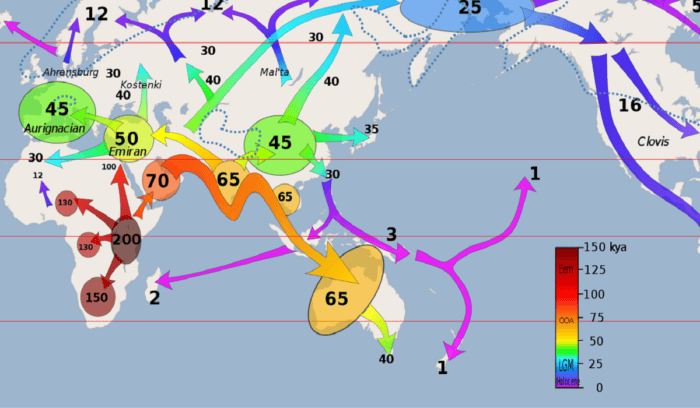
Eight million years of climate secrets were locked in the limestone caves of central Saudi Arabia — and when scientists finally cracked them open, the story they told reshaped everything we thought we knew about how humans left Africa. Arabia, long treated as a footnote in maps of early human dispersal, turns out to have been one of the most important corridors in our species’ history.
Key findings
- Green Arabia migration: Stalagmites from seven caves at As Sulb, northeast of Riyadh, reveal at least six confirmed humid phases over the last eight million years — periods when Arabia’s now-barren interior held rivers, lakes, and spreading grasslands that made large-scale animal and human movement possible.
- Uranium-lead dating: A cutting-edge technique comparing uranium isotopes to their lead decay products allowed researchers to date cave formations as far back as 7.44 million years ago — far beyond the 600,000-year limit of older uranium-thorium methods, producing the most detailed climate record Arabia has ever yielded.
- Orbital forcing: The humid phases correlate with periodic variations in Earth’s orbit around the sun — the same mechanism that drove wet periods across the Sahara and deserts east to India’s Thar, suggesting a single vast climate system that periodically opened and closed a corridor between Africa and Eurasia.
A land between worlds
Arabia sits at one of the planet’s great crossroads — wedged between Africa, the Levant, and South Asia. For most of deep prehistory, it was forbidding terrain: vast sand seas, scorching heat, almost no surface water.
But Earth’s orbital cycles are patient. Every 20,000 years or so, shifts in axial tilt and orbital path nudged the monsoon belt northward. Rainfall surged across what is now Saudi Arabia, Yemen, and Oman. Lakes appeared in basins that today hold only dust. Grasslands spread where dunes now roll. Fauna moved in. Early humans followed.
The new study, published in Nature and based on 22 rock samples retrieved from As Sulb caves in 2019, provides the strongest evidence yet that this was not a rare anomaly but a repeating pattern across geological time. “The sand seas that we are used to seeing have not always been the case,” says archaeologist Michael Petraglia of Griffith University, a senior author of the study. “That has had a huge effect on human evolution.”
What the evidence shows about human movement
The case for human dispersal through a green Arabia is built from two converging lines of evidence. The new climate data establishes the conditions. Archaeological finds fill in the human presence.
Stone tool assemblages at Jebel Faya in the UAE show technological traditions consistent with African Middle Stone Age industries — strong evidence of direct human dispersal into Arabia rather than independent local development. Alluvial fan deposits in the Rub’ al Khali, the vast Empty Quarter, show that river systems were active during specific epochs, providing the water and ecological productivity that made large-mammal populations viable. Where the animals went, the hunters followed.
Around 90,000 B.C.E., one of the best-evidenced of these humid pulses may represent one of the earliest confirmed presences of anatomically modern humans outside Africa. Researchers continue to refine the precise timing — the debate is ongoing — but the directional conclusion is now robust: Arabia was not a barrier. It was a bridge.
“These findings have been spectacular,” Petraglia says. “This is an entirely new source of climate information, not only for Arabia but for many places around the world.”
A corridor hiding in plain sight
One of the study’s quieter revelations is how thoroughly Arabia was overlooked. Petraglia notes that Arabia is often simply absent from diagrams purporting to show the routes animals and early humans used to disperse from Africa — as if the peninsula were an obvious dead end rather than a potential throughway.
The Nature paper now changes that. When Arabia was humid, the climate record suggests the Sahara and the deserts stretching east to India would have been humid too — a connected system of periodically green corridors linking Africa to South Asia and beyond. The humid phases lasted from tens of thousands of years to more than a million years at a stretch: more than enough time for successive waves of primates, megafauna, and Homo sapiens to move through, establish populations, and set the stage for further dispersal.
Paul Wilson, a palaeoclimatologist at the University of Southampton who was not involved in the study, described being “blown away” by the detail of the reconstructed record. His own deep-sea sediment research had shown less Saharan dust during several wet periods over the last 11 million years — correlating with the same orbital variations. “This is a really powerful validation of some of the things that we’ve long expected,” he said.
Lasting impact
The implications ripple outward in multiple directions. For human evolutionary biology, a confirmed Arabian corridor rewrites the dispersal map — suggesting that the movement of Homo sapiens and earlier hominins out of Africa was not a single narrow event through the Sinai or the Horn of Africa, but a broader, recurring process across a system of periodically open corridors.
For climate science, the As Sulb stalagmites demonstrate that uranium-lead dating can now give researchers an eight-million-year window into regional climate — a method with applications far beyond Arabia. Scientists working in similar cave systems across the Middle East, Central Asia, and the Horn of Africa are already taking note.
For the Arabian Peninsula itself, the study opens a new chapter of archaeological investigation. Research on Saudi Arabian caves has been ongoing for years, Petraglia notes, but virtually none of it had been published until now. Expeditions to retrieve samples from northern Arabia are already underway. “We’re just at the beginning of cave work in Saudi Arabia,” he says — which means the record will only grow richer.
There is something worth sitting with in all of this: the idea that the human story out of Africa was shaped not just by courage or curiosity, but by rain. By orbital mechanics operating over tens of thousands of years. By a peninsula that turned green just long enough — again and again — to let us through.
Blindspots and limits
The climate evidence from As Sulb is compelling, but it comes from one site in central Saudi Arabia — and extrapolating a regional or continental pattern from a single location carries real uncertainty. The study identifies at least six confirmed humid phases and possibly two more, but the geographical extent of each phase, and whether all of them were simultaneously green from the Sahara to the Thar, remains to be established.
The archaeological record inside Arabia also remains thin relative to Africa and the Levant — a function partly of where researchers have looked, and partly of how difficult it is to find and excavate sites in remote desert terrain. The ~90,000 B.C.E. human presence is plausible and supported by converging evidence, but the full picture of who moved through, in what numbers, and what happened to them when the land dried again remains largely open.
Read more
For more on this story, see: National Geographic — Green Arabia
For more from Good News for Humankind, see:
- Uranium dating confirms Spanish cave art is at least 40,800 years old
- Oghuz Turks build a steppe state across Central Asia’s vast grasslands
- The Good News for Humankind archive on prehistory
About this article
- 🤖 This article is AI-generated, based on a framework created by Peter Schulte.
- 🌍 It aims to be inspirational but clear-eyed, accurate, and evidence-based, and grounded in care for the Earth, peace and belonging for all, and human evolution.
- 💬 Leave your notes and suggestions in the comments below — I will do my best to review and implement where appropriate.
- ✉️ One verified piece of good news, one insight from Antihero Project, every weekday morning. Subscribe free.


