
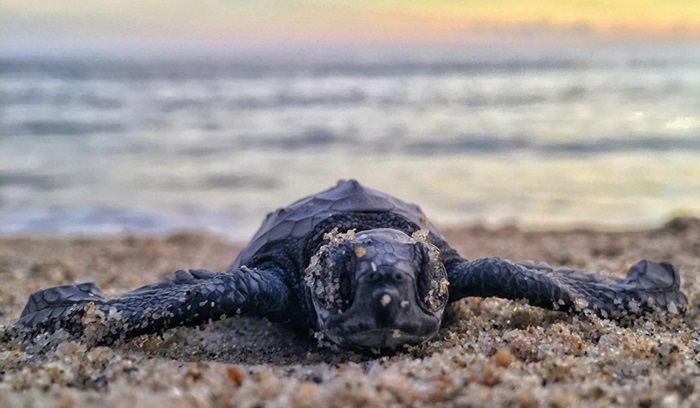
For the first time in recorded history, Greece has logged more than 10,000 Caretta caretta loggerhead sea turtle nests in a single year — a milestone that conservationists say reflects decades of painstaking protection work finally paying off. The turnaround is most dramatic on Zakynthos, where the beach at Sekania alone recorded more than 1,200 nests this season, one nest for every 50 centimeters of sand. Scientists, advocates, and lifelong campaigners are calling it one of the most encouraging wildlife recoveries in Mediterranean history.
- Greece hosts 60% of all Caretta caretta nesting sites in the Mediterranean, and annual nest counts have jumped from an average of 5,000–7,000 to more than 10,000 since 2023.
- Only one in 1,000 sea turtle hatchlings survives to adulthood, making the scale of this population rebound all the more remarkable.
- Loggerhead sea turtles have existed for more than 100 million years and are considered vital to marine ecosystems and regional biodiversity.
Greece’s loggerhead sea turtle population rebounds after years of decline
Just a few decades ago, conservationists were watching Greece’s loggerhead sea turtle numbers fall. Throughout the 2000s, researchers at Archelon, the Sea Turtle Protection Society of Greece, were registering annual nest declines of around 6% on Crete alone. Today, that trajectory has reversed sharply. Dr. Aliki Panagopoulou, Archelon’s research coordinator, describes the change as “a dramatic increase in nest numbers, the result of decades of conservation efforts.”
The recovery has a poetic dimension built into the biology of the species itself. Female loggerheads return to nest on the same beach where they hatched, typically 20 to 25 years after birth. Turtles that were tagged by Greek conservationists a quarter-century ago are now reappearing as breeding adults — a living record of the work done to protect them. Charikleia Minotou, who coordinates the WWF Greece programme at the Sekania protected area on Zakynthos, has spent nearly 25 years watching this beach. “The message sea turtles are sending is very clear,” she said. “The measures we have taken over the past 25 years to ensure conditions are right for the marine turtles to nest here are working.”
Advances in monitoring technology have also helped. The installation of CCTV cameras along nesting beaches now allows rangers to deter seagulls, ghost crabs, and other predators before they can destroy nests — a low-cost intervention with measurable results. Archelon’s core strategy has remained consistent: maximize the number of hatchlings that reach the water and successfully join the breeding population.
Decades of advocacy turned the tide for sea turtles in Greece
The recovery did not happen by accident. It is the product of sustained pressure from a generation of campaigners who fought for legal protections when few government officials were paying attention. Lily Venizelos founded the UK-based Mediterranean Association to Save the Sea Turtles (Medasset) in the 1980s and spent years lobbying successive Greek governments to address threats posed by tourism, speedboat propellers, beach furniture, and unchecked development in turtle habitats. Now in her 90s, Venizelos says the record nest counts are “the most wonderful news” she could have received — but she is not ready to declare victory. “It’s crucial protective measures continue to be enforced,” she said. “One false move and everything could be lost.”
Her concern is well-founded. Greece aims to attract 40 million tourists by 2028 — nearly four times the country’s population — and the pressure that puts on coastal ecosystems is real. Some travel companies are marketing so-called “last-chance tours” to threatened natural sites, including sea turtle nesting grounds, a practice Venizelos calls “catastrophic.” The tension between conservation goals and the demands of a tourism-dependent economy remains unresolved.
Medasset’s programmes and policy officer, Nadia Andreanidou, echoes the warning against complacency. Climate change, overfishing, plastic pollution, and discarded fishing gear all continue to threaten sea turtle survival across the Mediterranean. “The threats are still very much there, and it could all so easily unravel,” she said. The organization is pushing governments to go beyond passing protective laws and to actually enforce them — a distinction that has historically made the difference between recovery and relapse.
A model for what sustained conservation can achieve
The Greece story is now being watched closely by turtle conservation groups from Spain to Cyprus, Turkey to Libya. Medasset’s Athens office has become a coordination hub for NGOs across the region, and its scientific research and public education programs have expanded to reach both schoolchildren and elderly residents in care homes. The goal is not just to protect the species through policy, but to build the kind of public affection for sea turtles that makes enforcement politically sustainable over the long term.
What Greece demonstrates, above all, is that wildlife recovery at scale is possible — but it requires consistency across generations. The nests appearing on Sekania beach today are the direct descendants of decisions made 25 years ago. The decisions made today will determine what conservationists find on that beach in 2050. Archelon, WWF Greece, and Medasset are all united in one message: the loggerhead sea turtle remains a vulnerable species, and the work is not finished.
More recoveries worth watching
The loggerhead’s comeback is part of a broader pattern of wildlife and ocean conservation wins emerging from sustained, community-driven effort. In West Africa, Ghana’s establishment of a new marine protected area at Cape Three Points shows how coastal communities can lead the way in protecting marine biodiversity — the same principle that made Zakynthos’s nesting ground recoverable in the first place. On land, Uganda’s reintroduction of rhinos to Kidepo Valley National Park demonstrates that even species brought to the brink can return when political will and conservation science align. For more stories tracking what’s working in the fight to protect the natural world, visit the Good News for Humankind archive, sign up for the daily newsletter, or explore the Antihero Project for deeper context on how change actually happens.
Sourcing
This story was generated by AI based on a template created by Peter Schulte. It was originally reported by The Guardian.
More Good News
-

Marie-Louise Eta becomes first female head coach in men’s top-five European leagues
Marie-Louise Eta made history on April 13, 2026, when Union Berlin appointed her as interim head coach, making her the first woman ever to lead a club in any of men’s top five European football leagues. Eta takes charge for the final five games of the Bundesliga season after the club sacked Steffen Baumgart following a 3-1 defeat to bottom-side Heidenheim. Union Berlin remains in a relegation battle, giving Eta one of the highest-pressure debuts in coaching history.
-

Renewables hit 49% of global power capacity for the first time
For the first time in history, renewable energy accounts for nearly half of all installed power capacity on Earth. The International Renewable Energy Agency confirmed that global renewable energy capacity reached 49.4% of total global power by end of 2025, after the addition of 692 gigawatts — the largest annual increase ever recorded. Solar drove the surge, adding 511 gigawatts in a single year. Africa and the Middle East both posted their fastest renewable growth rates on record. The direction of the global energy system is no longer in question — only the pace.
-

Global suicide rate falls 40% since 1990 in major public health win
The global suicide rate has fallen by roughly 40% since 1990, according to Our World in Data. The decline reflects expanded mental health care, means restriction policies, and rising public awareness. Despite real progress, suicide still claims more than 700,000 lives each year, making continued investment in prevention essential. The trend represents one of the largest sustained improvements in global mental health outcomes ever recorded — and proof that deliberate public health action works.
