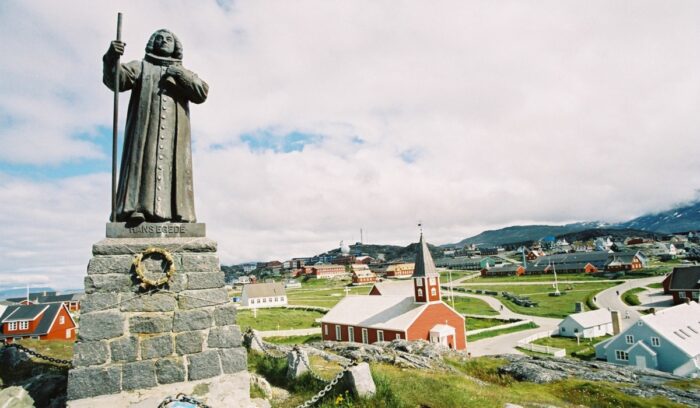
When Danish-Norwegian missionary Hans Egede and royal governor Claus Paarss relocated their struggling Arctic colony to a new mainland site in 1728 C.E., they planted a European fort on land that had been home to Indigenous peoples for more than four millennia. That small outpost — named Godthåb, meaning “good hope” — would eventually grow into Nuuk, the world’s northernmost capital city and today one of the most distinctively Indigenous urban centers on Earth.
Key facts
- Godthåb founding: In 1728 C.E., Governor Claus Paarss relocated Hans Egede’s Hope Colony from Kangeq Island to the Inuit settlement of Nûk on Greenland’s southwestern mainland, establishing the fort that became the city.
- Nuuk settlement history: The area had already been continuously occupied for roughly 4,000 years — first by the Saqqaq culture around 2200 B.C.E., later by the Dorset culture, and then by Norse settlers from approximately 1000 C.E. until the 15th century.
- Inuit cultural identity: Today, roughly 90% of Greenland’s population is Inuit, and Nuuk is widely recognized as one of the most Indigenous capital cities in the world by both proportion and cultural authority.
A colony built on ancient ground
Long before any European ship appeared in the fjords of southwestern Greenland, people had made this place home. The Saqqaq culture — a pre-Inuit, Paleo-Eskimo people — lived in the area around what is now Nuuk as far back as 2200 B.C.E. After them came the Dorset culture, and then Norse settlers who arrived around 1000 C.E. and persisted until their settlement disappeared, for reasons still debated by scholars, sometime in the 15th century.
Hans Egede arrived in Greenland in 1721 C.E. with a dual mission: to find the descendants of those Norse settlers and to bring Christianity to the Inuit. He found no Norse survivors. He stayed anyway, establishing a mission colony on Kangeq Island that struggled against cold, illness, and isolation.
Seven years later, in 1728 C.E., Governor Claus Paarss relocated the colony to the mainland at the Inuit settlement of Nûk, on the eastern shore of the Labrador Sea. The new fort was named Godt-Haab — “good hope.” It sat at the mouth of what is now called Nuup Kangerlua fjord, backed by the dramatic peak of Sermitsiaq mountain, which rises to 1,210 meters and can be seen from nearly everywhere in the city today.
A brutal early chapter
The colony’s first years were grim. Paarss’s contingent included mutinous soldiers, convicts, and people with few choices — and within the first year, most died of scurvy and other diseases. The hardships were extreme even by the standards of 18th-century Arctic exploration.
In 1733 C.E. and 1734 C.E., a smallpox epidemic killed most of the native Inuit population in the region, as well as Egede’s wife. The human cost of this colonial enterprise fell overwhelmingly on the Indigenous people already living there. Egede himself returned to Denmark in 1736 C.E. after 15 years in Greenland, leaving his son Poul to continue the missionary work.
In 1733 C.E., Moravian missionaries received permission to establish their own mission, and by 1747 C.E. a formal mission settlement called New Herrnhut had taken root near Godthåb. This became a gathering point for Greenlanders from the southeastern coast, and it formed the nucleus of what would eventually become the broader city.
Identity reclaimed
For much of its colonial history, Godthåb was a place where Greenlandic culture was suppressed rather than celebrated. That began to shift in the mid-19th century. In 1861 C.E., Danish administrator Hinrich Johannes Rink — struck by how thoroughly Indigenous culture had been pushed aside — helped found Atuagagdliutit, Greenland’s first newspaper, with a native Greenlander as editor. The paper became an enduring symbol of Greenlandic identity and is still published today.
During World War II, Greenlandic national identity experienced a further awakening. Written Greenlandic expanded in use, and local councils gained new relevance. When Greenland achieved home rule in 1979 C.E., the city was officially renamed Nuuk — the Greenlandic word for “cape” — replacing the Danish name Godthåb that had stood for 251 years.
The transformation wasn’t only symbolic. As a 2016 C.E. article in The Guardian observed, Nuuk may be the most Indigenous capital city in the world by proportion and cultural authority, with nearly 90% of Greenland’s population being Inuit and the city actively celebrating Inuit culture and history.
Lasting impact
The establishment of Godthåb created the administrative and geographic center that Greenland still uses today. Nuuk is the seat of the Government of Greenland and home to more than a third of the territory’s population — around 20,000 people as of early 2025 C.E. Its position at 64°11′ N makes it the northernmost capital city in the world, a few kilometers farther north than Reykjavík.
The city’s growth has also been a vehicle for Greenlandic cultural resilience. The Government of Greenland, based in Nuuk, has steadily expanded self-governing authority since 1979 C.E., with broader autonomy legislation passed in 2009 C.E. The Sermitsiaq mountain that frames the city’s skyline now lends its name to a major national newspaper — a small but telling sign of how thoroughly Greenlandic identity has reclaimed this space.
The city’s story is also part of a global conversation about Indigenous land rights and self-determination. Nuuk’s trajectory — from colonial fort to Indigenous-majority capital — offers an unusually concrete example of what cultural reclamation can look like at the scale of a city.
Blindspots and limits
The 1728 C.E. founding of Godthåb is, by any honest accounting, a colonial act — one that brought devastating disease, displacement, and cultural suppression alongside its modest administrative legacy. The smallpox epidemics of 1733–1734 C.E. alone reshaped the demographic and cultural landscape of southwestern Greenland in ways that cannot be undone. Greenland’s path toward greater autonomy is ongoing and unfinished, with questions of full independence and resource sovereignty still actively debated.
The historical record of Nuuk also centers European actors — Egede, Paarss, Rink — while the Inuit and pre-Inuit peoples who shaped this landscape for thousands of years before 1728 C.E. remain far less documented by name in mainstream sources.
Read more
For more on this story, see: Wikipedia — Nuuk
For more from Good News for Humankind, see:
- Indigenous land rights recognized across 160 million hectares at COP30
- Ghana establishes marine protected area at Cape Three Points
- The Good News for Humankind archive on Greenland
About this article
- 🤖 This article is AI-generated, based on a framework created by Peter Schulte.
- 🌍 It aims to be inspirational but clear-eyed, accurate, and evidence-based, and grounded in care for the Earth, peace and belonging for all, and human evolution.
- 💬 Leave your notes and suggestions in the comments below — I will do my best to review and implement where appropriate.
- ✉️ One verified piece of good news, one insight from Antihero Project, every weekday morning. Subscribe free.