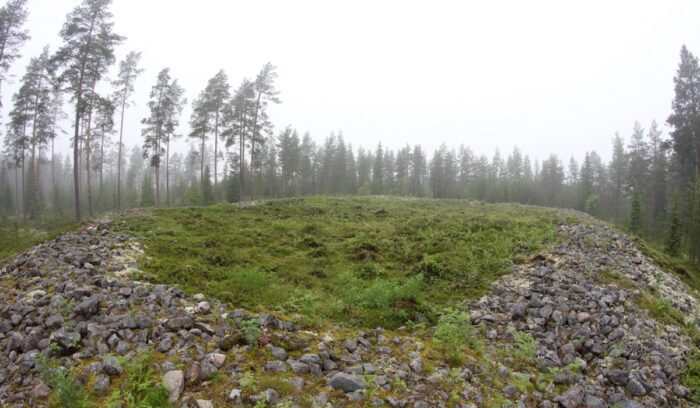
Along a 400-kilometer stretch of what is now Finland’s northwest coast, people who hunted seals and gathered from the land were also doing something unexpected: stacking boulders into large, carefully shaped enclosures that archaeologists would eventually call Giant’s Churches — some of the earliest monumental architecture known from Northern Europe.
What the evidence shows
- Giant’s Churches Finland: Around 40 stone enclosures have been identified along the Ostrobothnia coast, stretching roughly from Kokkola to Kemi, with the densest concentration near Raahe and Oulu.
- Subneolithic construction: The sites date to approximately 3500–2000 B.C.E., a transitional period when Mesolithic hunter-gatherers were beginning to adopt Neolithic tools and practices without fully shifting to farming.
- Boulder embankments: The enclosures are rectangular or oval in shape, built from large boulders. The largest known site, Kastelli Giant’s Church, encloses an area of roughly 60 by 35 metres.
Who built them — and how
The builders were not farmers. They were mobile hunter-gatherers, likely moving seasonally across the landscape in pursuit of seals, fish, and other resources. The Finnish name jätinkirkko — “giant’s church” — is a later folk label, reflecting how dramatically out of place these structures seemed to the people who encountered them centuries afterward.
That hunter-gatherers built monumental stone structures at all challenges a long-held assumption in archaeology: that large-scale construction required agriculture, surplus food, and settled populations. The Giant’s Churches suggest something more complex — that mobile peoples could and did organize collective labor and leave permanent marks on the landscape.
One leading theory holds that the enclosures were used by seal hunters during spring ice hunts, when groups would travel away from their usual dwelling places and may have needed a shared gathering point or ceremonial space. But this remains a hypothesis. Archaeological evidence for the specific function of the enclosures has not been found.
A window into subneolithic life
The term “subneolithic” describes a transitional phase that doesn’t fit neatly into the older Stone Age categories. These were people who used some Neolithic tools — polished stone axes, ceramics — while maintaining a fundamentally hunter-gatherer way of life. They were not simply “primitive” versions of later farmers. They were adapted, skilled, and clearly capable of sustained communal effort.
The Finnish Heritage Agency recognizes the Giant’s Churches as among the most significant prehistoric monuments in Finland. The sites cluster so densely around the Raahe and Oulu region that archaeologists believe this area may have been a particular hub of activity — perhaps a place where different groups converged seasonally, trading, gathering, and building together.
The original coastal setting matters here. Today, the enclosures sit inland. But due to post-glacial land uplift — the slow rebound of the Scandinavian land mass after the weight of the last ice age — the coastline has shifted dramatically since 3500 B.C.E. When the structures were built, they likely stood right at the water’s edge. That placement, at the threshold between sea and land, may have been deliberate and meaningful.
Lasting impact
The Giant’s Churches don’t belong to a civilization that left written records, trade goods across continents, or architectural descendants in later building traditions. Their impact is subtler — and perhaps more important for that reason.
They are evidence that the impulse to build, to mark space, to gather and shape the land collectively, is not the exclusive property of settled agricultural societies. Hunter-gatherers across the world — from the builders of Göbekli Tepe in modern-day Turkey to the communities behind these Finnish enclosures — were doing something that modern archaeology is still recalibrating its frameworks to explain.
For Finland specifically, the Giant’s Churches represent the earliest known monumental architecture on the land now called Finnish — a reminder that human presence here runs far deeper than written history, and that the people who lived here before farming arrived were not simply waiting for civilization to begin. They were already building it, in their own terms.
The sites were abandoned by around 1500 B.C.E. What prompted that abandonment — whether ecological shifts, cultural change, or the continued rise of the coastline — is not known.
Blindspots and limits
The function of the Giant’s Churches remains genuinely unknown. Without organic material suitable for detailed analysis, or artifacts clearly tied to specific activities, the seal-hunting hypothesis and the ceremonial-gathering hypothesis sit roughly equal in terms of evidence. It is also worth acknowledging that around 40 confirmed sites along a 400-kilometer stretch likely represents only a fraction of what was originally built — the rest lost to land uplift, erosion, later construction, and the limits of archaeological survey. The voices, beliefs, and intentions of the builders are inaccessible to us in any direct way.
Read more
For more on this story, see: Wikipedia — Giant’s Church
For more from Good News for Humankind, see:
- Indigenous land rights recognized at COP30
- Ghana establishes marine protected area at Cape Three Points
- The Good News for Humankind archive on prehistory
About this article
- 🤖 This article is AI-generated, based on a framework created by Peter Schulte.
- 🌍 It aims to be inspirational but clear-eyed, accurate, and evidence-based, and grounded in care for the Earth, peace and belonging for all, and human evolution.
- 💬 Leave your notes and suggestions in the comments below — I will do my best to review and implement where appropriate.
- ✉️ One verified piece of good news, one insight from Antihero Project, every weekday morning. Subscribe free.