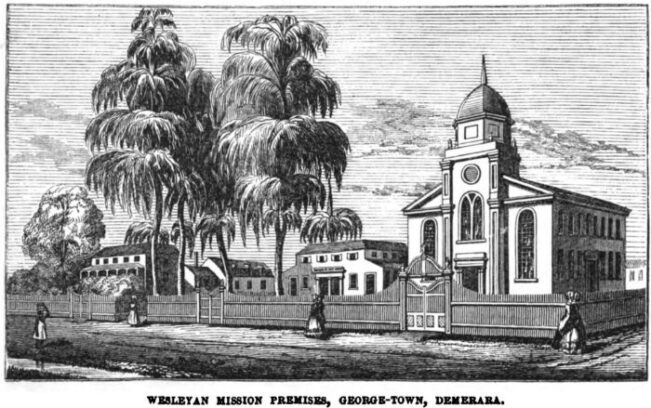
A simple wooden guard post at the edge of a river delta didn’t look like much. But when Dutch Governor Laurens Storm van ‘s Gravesande ordered it built at the mouth of the Demerara River in 1748 C.E., he set in motion a chain of events that would, over the following century, produce one of South America’s most architecturally distinctive capital cities.
What the evidence shows
- Dutch Demerara settlement: Governor van ‘s Gravesande established a guard post at the Demerara River mouth in 1748 C.E., around which English planters soon began building homes, forming the nucleus of the future city.
- Georgetown founding: The town was formally established in 1782 C.E. during a brief French occupation of the Dutch colony of Demerara, and renamed Stabroek in 1784 C.E. after the President of the Dutch West India Company.
- Demerara River canal system: The Dutch engineered an intricate network of canals and sluices — called kokers — to drain a city sitting nearly a meter below high-tide level, a feat of hydraulic engineering that still keeps Georgetown functional today.
A settlement born from colonial rivalry
The story of Georgetown’s founding is inseparable from the overlapping colonial ambitions of three European powers — the Dutch, the French, and the British — all operating in the same stretch of South America’s Atlantic coast in the 18th century C.E.
The Dutch had long held the colony of Demerara, cultivating sugar and other crops on its low-lying coastal plains. Van ‘s Gravesande’s guard post in 1748 C.E. was a strategic move as much as an administrative one — a way to assert Dutch presence at a river mouth that served as a gateway to the interior. English planters, already active in the region, began settling near the post, blurring the line between Dutch administration and British-inflected commerce from the beginning.
When French forces briefly occupied Demerara in 1782 C.E., the town that had grown around the guard post was formally named Longchamps. Two years later, in 1784 C.E., the Dutch reasserted control and renamed it Stabroek — honoring Nicholaas Geelvinck, Lord of Stabroek and then-President of the Dutch West India Company. The name Georgetown came only in 1812 C.E., when Britain took permanent control and renamed the city in honor of King George III.
Engineering a city below sea level
Georgetown’s location presented an immediate and serious problem. The flat coastal plain where the settlement stood sat as low as two meters below high-tide level. Flooding wasn’t a risk — it was a near-certainty without intervention.
The Dutch brought with them centuries of experience managing water in the Low Countries of Europe. They applied that expertise to the Demerara coast, constructing a system of drainage canals interlaced throughout the city grid, controlled by kokers — sluice gates that regulated water flow. A long seawall was built to hold back the Atlantic.
This infrastructure is not a relic. Georgetown still depends on the canal and koker system today. The city’s grid of north-south and east-west streets, many of them lined with canals, reflects the Dutch hydraulic logic embedded in the city’s original design. When Georgetown floods — and it does — the system is what prevents catastrophe from becoming routine.
A city shaped by many hands
The settlement that grew from that 1748 C.E. guard post was never a Dutch city in any simple sense. The people who built and sustained it were overwhelmingly African — enslaved men and women forcibly transported to work the sugar plantations of Demerara under Dutch and later British rule. The drainage canals, the plantation infrastructure, and much of the physical fabric of early Georgetown were constructed through their forced labor.
Indigenous Amerindian peoples, including the Wai-Wai, had their own deep history on this land long before any European arrived. The Umana Yana — a conical thatched structure built by Wai-Wai Amerindians using traditional techniques for a 1972 C.E. international conference — still stands in Georgetown’s northern district near the Atlantic coast, a reminder that Indigenous knowledge and craft have always been part of the city’s story.
East Indian, Portuguese, and Chinese communities also shaped Georgetown’s demographic character over the 19th and 20th centuries C.E., arriving in many cases as indentured laborers after the abolition of slavery. The 2002 C.E. census found the city to be majority Black/African (53%), with significant mixed, East Indian, and Amerindian populations.
Lasting impact
Georgetown today is more than Guyana’s largest city. It is the seat of the Caribbean Community (CARICOM), an international organization linking 15 member states across the Caribbean and parts of South America and Central America. Hosting the CARICOM Secretariat gives Georgetown a regional political weight that few cities of its size elsewhere in the world can claim.
The city’s colonial-era architecture — tall painted-timber churches, cast-iron market halls, neo-Gothic civic buildings — earned Georgetown its nickname, the “Garden City of the Caribbean.” St. George’s Anglican Cathedral, one of the tallest wooden buildings in the world, draws visitors from across the region. Stabroek Market, whose cast-iron clock tower dominates the skyline, traces its origins to 1792 C.E.
Georgetown received official city status on 24 August 1842 C.E. under Queen Victoria. By then, the population had grown from roughly 780 people in 1789 C.E. to thousands — a trajectory that continued through the 19th and 20th centuries. The 2022 C.E. census recorded 125,683 residents.
The city is now at the center of Guyana’s economic transformation. Offshore oil discoveries in the 2010s C.E. have made Guyana one of the fastest-growing economies in the world, and Georgetown — as the country’s administrative and financial hub — sits at the heart of that change. The Guyana Office for Investment operates from the capital, managing a surge of international interest.
Blindspots and limits
The historical record of Georgetown’s early settlement is shaped largely by Dutch and British colonial documentation, which centers European governors and company officials while leaving the lives of enslaved Africans and Indigenous peoples largely in the margins. The guard post of 1748 C.E. was built on land with its own prior history — one that colonial records did not consider worth preserving in detail.
Georgetown also continues to face significant infrastructure challenges. The canal system, however ingenious, requires constant maintenance, and flooding remains a serious risk in a city built below sea level in a region of heavy rainfall. Climate change is making that risk harder to manage, not easier.
Read more
For more on this story, see: Wikipedia — Georgetown, Guyana
For more from Good News for Humankind, see:
- Ghana establishes a new marine protected area at Cape Three Points
- Indigenous land rights recognized across 160 million hectares ahead of COP30
- The Good News for Humankind archive on the early modern era
About this article
- 🤖 This article is AI-generated, based on a framework created by Peter Schulte.
- 🌍 It aims to be inspirational but clear-eyed, accurate, and evidence-based, and grounded in care for the Earth, peace and belonging for all, and human evolution.
- 💬 Leave your notes and suggestions in the comments below — I will do my best to review and implement where appropriate.
- ✉️ One verified piece of good news, one insight from Antihero Project, every weekday morning. Subscribe free.