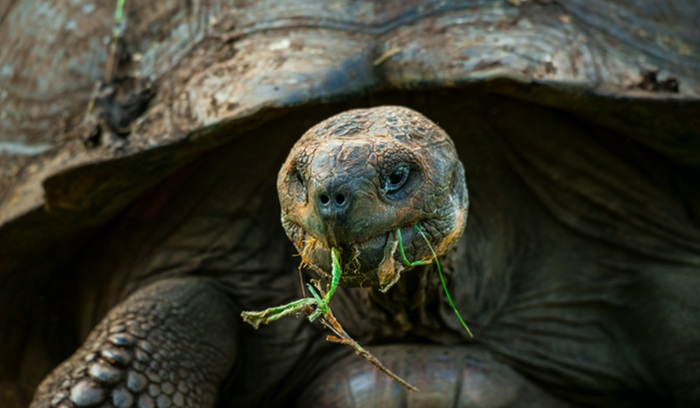
For the first time in roughly 180 years, giant tortoises are roaming a Galápagos island they once called home. Conservationists have successfully reintroduced Chelonoidis nigra — Galápagos giant tortoises — to Pinta Island, marking one of the most symbolically powerful Galápagos giant tortoise restoration efforts in the archipelago’s long conservation history.
At a glance
- Galápagos giant tortoise restoration: Tortoises were reintroduced to Pinta Island after the species was declared locally extinct following the death of “Lonesome George” in 2012 C.E., the last known purebred Pinta tortoise.
- Pinta Island: Invasive goats stripped the island’s vegetation for decades, making it uninhabitable for tortoises — a multi-year eradication campaign cleared the way for this return.
- Rewilding timeline: The reintroduction draws on captive-bred tortoises with close genetic ties to the original Pinta population, raised at the Galápagos National Park’s breeding center on Santa Cruz Island.
Why Pinta Island matters
Pinta Island became a symbol of extinction loss when Lonesome George died in 2012 C.E. at an estimated age of over 100. He had been the last confirmed survivor of his subspecies, and his death drew international attention to the fragility of island ecosystems.
But the story didn’t end there. Genetic research — including work by Yale University scientists — identified tortoises on Isabela Island carrying significant Pinta ancestry, likely descendants of animals that escaped or were released from passing ships centuries ago. That discovery opened a path forward.
The Galápagos giant tortoise is what ecologists call an ecosystem engineer. As tortoises graze, they clear brush, disperse seeds, and create pathways through dense vegetation that other species depend on. Removing them from Pinta didn’t just eliminate a species — it unraveled an entire web of ecological relationships that had evolved over millions of years.
The long road back
Restoring Pinta required solving two problems at once: removing what didn’t belong, and returning what did.
Feral goats, introduced by fishermen in the 1950s C.E., had eaten the island nearly bare. By the 1970s C.E., their population had grown to an estimated 40,000 animals. The Charles Darwin Foundation and Galápagos National Park launched a sustained eradication effort using aerial hunting and detection dogs. By 2003 C.E., the goats were gone — and the island’s native plants began returning on their own.
The tortoise reintroduction builds on that recovery. Hybrid tortoises with strong Pinta genetic heritage were selected from the breeding program and transported to the island, where they now graze freely. Researchers monitor their movements and health as the population works to establish itself.
The Galápagos Conservancy has described this as a multigenerational project — the tortoises alive today are laying the foundation for a population that may one day be fully self-sustaining.
An imperfect but meaningful return
The reintroduction is not a perfect resurrection. The tortoises on Pinta today are not purebred descendants of Lonesome George’s subspecies — they are hybrids, chosen for their genetic closeness to the original population. Whether they will fill the same ecological niche as precisely as their ancestors remains a question researchers are still working to answer.
There are also broader pressures the Galápagos faces: invasive species continue to threaten native ecosystems across the archipelago, and climate change is altering the ocean temperatures and rainfall patterns that the islands’ food webs depend on. The tortoise’s return is a genuine win — but the work is far from finished.
Still, the sight of giant tortoises moving slowly across Pinta’s restored landscape after 180 years of absence carries a meaning that goes beyond biology. It is evidence that ecosystems can recover, that extinction is sometimes a slower process than it appears, and that patient, science-led conservation can reverse trajectories that once seemed irreversible.
Read more
For more on this story, see: Good News for Humankind
For more from Good News for Humankind, see:
- Ghana establishes a major marine protected area at Cape Three Points
- Alzheimer’s risk cut in half by drug in landmark prevention trial
- The Good News for Humankind archive on wildlife conservation
About this article
- 🤖 This article is AI-generated, based on a framework created by Peter Schulte.
- 🌍 It aims to be inspirational but clear-eyed, accurate, and evidence-based, and grounded in care for the Earth, peace and belonging for all, and human evolution.
- 💬 Leave your notes and suggestions in the comments below — I will do my best to review and implement where appropriate.
- ✉️ One verified piece of good news, one insight from Antihero Project, every weekday morning. Subscribe free.
More Good News
-
Doctors hail first breakthrough in asthma and COPD treatment in 50 years
Benralizumab, a single injection given during an asthma or COPD attack, cut treatment failures fourfold over 90 days compared to the steroid pills doctors have relied on since the 1970s. In a trial of 158 patients arriving at UK emergency departments, the shot eased coughing, wheezing, and breathlessness more effectively than steroids — and could eventually be given at home or in a GP’s office. Because it targets the specific inflammation behind roughly half of asthma attacks, it could spare millions of people from the diabetes and bone-loss risks that come with repeated steroid use. After a 50-year wait for…
-

Mexico launches universal healthcare for all 133 million citizens
Mexico universal healthcare is now officially a reality, with the country launching a system designed to cover all 133 million citizens through the restructured IMSS-Bienestar network. Before this reform, an estimated 50 million Mexicans had no formal health insurance, with rural and Indigenous communities bearing the heaviest burden of untreated illness and medical debt. The new system severs the long-standing tie between employment and healthcare access, providing free consultations, medicines, and hospital services regardless of income. If implemented effectively, Mexico’s move could serve as a powerful model for other middle-income nations still navigating fragmented, inequitable health systems.
-

Ghana declares its first marine protected area to rescue depleted fish stocks
Ghana’s marine protected area — the country’s first ever — marks a historic turning point for a nation gripped by a quiet fisheries crisis. Established near Cape Three Points in the Western Region, the protected zone restricts or bans fishing activity to allow severely depleted fish populations to recover. Ghana’s coastal stocks have fallen by an estimated 80 percent from historic levels, threatening food security and the livelihoods of millions of small-scale fishers. The declaration also carries regional significance, potentially inspiring neighboring Gulf of Guinea nations to establish coordinated protections of their own.