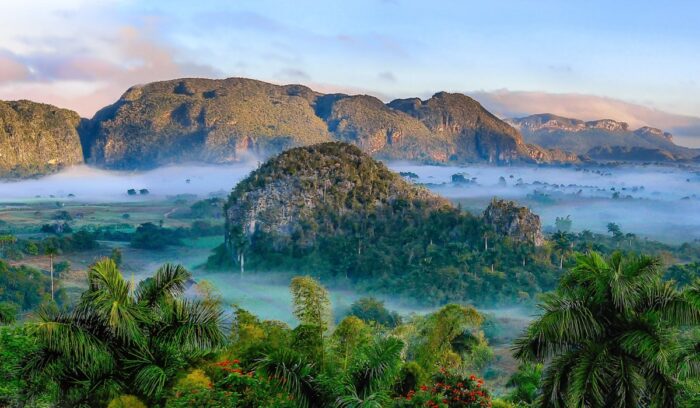
Long before any European ship appeared on the horizon, human beings had already found their way to Cuba — paddling through warm Caribbean waters, navigating by stars and current, and establishing communities that would endure for millennia. The story of Cuba’s first peoples is one of ingenuity, adaptation, and a deep relationship with the sea.
What the evidence shows
- Cuba’s first settlers: Archaeological evidence places the earliest known human presence in Cuba in the 4th millennium B.C.E., consistent with a date of around 3750 B.C.E.
- Levisa site: The oldest confirmed Cuban archaeological site, Levisa, dates to approximately 3100 B.C.E., providing physical evidence of early habitation on the island.
- Neolithic Caribbean cultures: Later cultures, including the Cayo Redondo and Guayabo Blanco of western Cuba, used ground stone and shell tools and sustained themselves through fishing, hunting, and plant gathering.
A journey across the Caribbean
Cuba sits at the northwestern tip of the Caribbean island chain, close enough to the North American mainland that early peoples could make the crossing in stages. But reaching Cuba was no accident.
The earliest inhabitants of Cuba were skilled maritime peoples who moved northward through the Caribbean over generations. They brought with them the knowledge to read wind, wave, and season — the kind of accumulated wisdom that doesn’t leave behind written records but shows up in tools, middens, and the bones of fish eaten thousands of years ago.
The Guanajatabey were among the earliest identifiable groups on the island, and they eventually occupied the far western reaches of Cuba. After them — or alongside them in different regions — came the Ciboney and later the Taíno, both part of the broader Arawak cultural world rooted in northeastern South America. These were not random wanderers. They were farmers, fishers, traders, and builders of social worlds complex enough to sustain populations of hundreds of thousands by the time Europeans arrived.
The Taíno, in particular, developed sophisticated agricultural systems, cultivating yuca root to make cassava bread, growing cotton and tobacco, and tending maize and sweet potatoes. Spanish clergyman Bartolomé de las Casas estimated the Taíno population of Cuba alone had reached 350,000 by the end of the 15th century C.E.
The world they built
Cuba’s first peoples did not live in isolation. The Caribbean island chain functioned as a connective corridor — ideas, people, crops, and languages moved through it across thousands of years. The settlement of Cuba was part of a larger pattern of human expansion into island environments that required extraordinary navigational skill and ecological adaptability.
Communities organized themselves around caciques — chiefs — and maintained complex social structures. They developed distinctive art forms, spiritual practices, and systems of governance. The Taíno language left a permanent mark on the world: words like tobacco, hurricane, canoe, and the name Cuba itself all entered English from Classic Taíno. The name Havana shares the same root.
That kind of linguistic legacy — absorbed into dozens of global languages — is a quiet testament to the depth and influence of these civilizations, even as formal historical records from outside the Caribbean largely ignored them for centuries.
Lasting impact
The settlement of Cuba set in motion thousands of years of Indigenous Caribbean civilization. The agricultural knowledge developed by Taíno and earlier cultures — particularly around root crops and tropical horticulture — influenced not only the Caribbean but, through the Columbian Exchange, eventually the entire world. Cassava today is a staple crop for hundreds of millions of people across Africa, Asia, and Latin America.
Cuba’s Indigenous peoples also shaped the island’s ecology, its languages, and its social geography in ways that outlasted colonization. Modern DNA studies have identified genetic traces linking Cuban populations to Amazonian Indigenous groups, suggesting a biological continuity that survived centuries of colonial violence. An estimated 400 Taíno terms and place names survive in Cuban Spanish today.
The maritime traditions that brought people to Cuba in the first place also speak to a broader human capacity: the willingness to cross open water into the unknown, carrying seeds, skills, and the memory of home. That impulse — to explore, adapt, and build — is one of the most consistent threads in human history.
Blindspots and limits
The archaeological record for pre-Columbian Cuba remains incomplete. The date of ~3750 B.C.E. represents one plausible estimate within the 4th millennium B.C.E. range cited by current scholarship, but actual first arrival may have been earlier — and future excavations could revise that picture significantly. What is certain is that when Christopher Columbus arrived in 1492 C.E., he encountered civilizations with thousands of years of history — civilizations that were, within decades, largely destroyed by disease, forced labor, and violence. The story of Cuba’s first peoples is also, unavoidably, a story of what was lost. Indigenous descendant Taíno families do persist in parts of eastern Cuba today, and Taíno cultural revival movements continue across the Caribbean.
Read more
For more on this story, see: History of Cuba — Wikipedia
For more from Good News for Humankind, see:
- Ghana establishes a marine protected area at Cape Three Points
- Indigenous land rights: 160 million hectares recognized ahead of COP30
- The Good News for Humankind archive on prehistory
About this article
- 🤖 This article is AI-generated, based on a framework created by Peter Schulte.
- 🌍 It aims to be inspirational but clear-eyed, accurate, and evidence-based, and grounded in care for the Earth, peace and belonging for all, and human evolution.
- 💬 Leave your notes and suggestions in the comments below — I will do my best to review and implement where appropriate.
- ✉️ One verified piece of good news, one insight from Antihero Project, every weekday morning. Subscribe free.
More Good News
-
Renewables hit 49% of global power capacity for the first time
Renewable energy capacity crossed a landmark threshold in 2025, with global installed power surpassing 5,100 gigawatts and representing 49% of all capacity worldwide for the first time in history. The International Renewable Energy Agency reported a single-year addition of 692 gigawatts, led overwhelmingly by solar power, which alone accounted for 75% of new renewable installations. Clean energy now represents 85.6% of all new power capacity added globally, signaling that the transition has moved from aspiration to economic reality. The milestone carries implications beyond climate — nations with strong renewable bases demonstrated measurably greater energy security amid ongoing geopolitical instability.
-
Global suicide rate has dropped nearly 40% since the 1990s
Global suicide rates have dropped nearly 40% since the early 1990s, falling from roughly 15 deaths per 100,000 people to around nine — one of modern public health’s most significant and underreported victories. This decline was driven by expanded mental health services, crisis intervention programs, and proven strategies like restricting access to lethal means. The progress spans dozens of countries, with especially sharp declines in East Asia and Europe. Critically, this trend demonstrates that suicide is preventable at a population level — making the case for sustained investment in mental health infrastructure worldwide.
-
Rhinos return to Uganda’s wild after 43 years of absence
Uganda rhino reintroduction marks a historic milestone: wild rhinoceroses are roaming Ugandan soil for the first time in over 40 years. In 2026, rhinos bred at Ziwa Rhino Sanctuary were released into Kidepo Valley National Park, ending an absence caused entirely by poaching and political collapse during the Idi Amin era. The release represents decades of careful breeding, conservation funding, and community engagement. For local communities, conservationists, and a watching world, it proves that deliberate, sustained human effort can reverse even the most painful wildlife losses.