When a group of English colonists stepped ashore on Antigua in 1632 C.E., they were not the first people to know the island. Indigenous Arawak and Carib peoples had lived across the Caribbean for centuries before European contact. But the English settlement that took root that year would eventually grow into something that outlasted its colonial origins — including the city now known as St. John’s, today the living, bustling heart of the independent nation of Antigua and Barbuda.
Key findings
- English colonization: English settlers arrived on Antigua in 1632 C.E., establishing one of the earliest permanent European colonies in the eastern Caribbean, led from the nearby island of St. Kitts.
- St. John’s Harbour: A small cluster of houses near the natural harbor known as “the Cove” — later St. John’s Harbour — predated the formal town layout, which was established after a French invasion in 1666 C.E.
- Antigua and Barbuda independence: The colony founded in 1632 C.E. eventually became the fully sovereign nation of Antigua and Barbuda in 1981 C.E., with St. John’s as its capital and largest city.
Who was already there
Long before English ships arrived, Antigua had been home to Indigenous peoples for thousands of years. The Siboney, Arawak, and later Carib peoples shaped the landscape, built communities, and navigated the Caribbean with remarkable skill. Their presence is still acknowledged in place names and in the island’s archaeological record.
The English settlers who arrived in 1632 C.E. came primarily from St. Kitts, under the leadership of Sir Thomas Warner. Sugar cultivation would follow within decades, and with it came the forced transportation of enslaved Africans — a reality that would define the island’s demographic and cultural character far more than the original English founders ever could. Today, the majority of Antigua and Barbuda’s population is of African and mixed African-European ancestry, a direct legacy of that brutal chapter.
The slow rise of St. John’s
The city of St. John’s did not spring up immediately. Prior to any formal town plan, a handful of houses clustered near the natural harbor on the island’s western coast. It was not until after a French invasion in 1666 C.E. that the site was formally laid out as a town, chosen for its strategic position on St. John’s Harbour. An act was passed in April 1668 C.E. to build a town there, and by 1675 C.E., the island’s legislature had designated it one of six official trading points.
St. John’s grew steadily through the late 1600s and into the 1700s, weathering fires, hurricanes, and periods of social tension. By 1689 C.E., it had grown to rival Falmouth as the island’s largest settlement. It would eventually surpass Falmouth entirely and become the dominant city — a position it has never relinquished.
Resistance, resilience, and transformation
The history of St. John’s is not simply a story of colonial expansion. In 1736 C.E., a man named Prince Klaas — an enslaved African leader who had been born into West African royalty — organized an ambitious plan to transform Antigua into an independent African kingdom. The plot was discovered before it could be carried out, and the reprisals were brutal. But the courage behind it has not been forgotten. Prince Klaas is now recognized as a national hero in Antigua and Barbuda, and his story is part of what makes the city’s history genuinely complicated and genuinely human.
The abolition of slavery in the British Caribbean in 1834 C.E. — with full freedom arriving in 1838 C.E. — reshaped St. John’s once more. The descendants of enslaved Africans became the backbone of the city’s culture, labor, and eventually its political life. St. John’s became the seat of government for the broader British Leeward Islands colonial administration, a role it held until 1959 C.E.
Lasting impact
The English settlement of 1632 C.E. set in motion a chain of events that produced one of the Caribbean’s most distinctive small nations. Antigua and Barbuda gained full independence from Britain in 1981 C.E., and St. John’s — with a population of around 22,000 — is today its capital, economic engine, and cultural center.
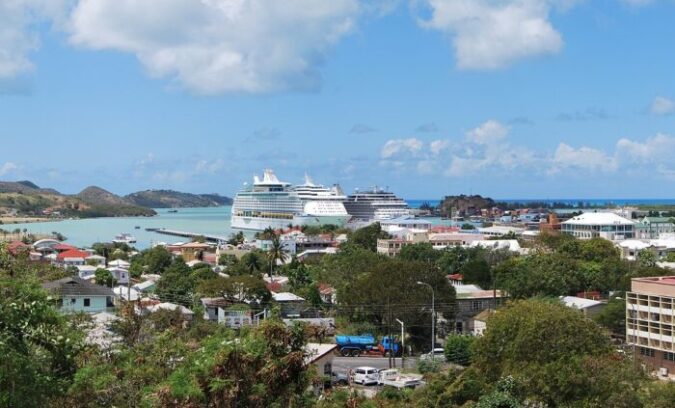
The city is home to Antigua State College, an open campus of the University of the West Indies, and most of the country’s government institutions. Its harbor, once a colonial trading post and naval station, now welcomes cruise ships weekly. The rum distillery still operates. The market still sells fresh fish and produce daily. The streets that were once unpaved and ungoverned have become the corridors of a sovereign, democratic nation.
St. John’s also sits within a broader Caribbean community that has increasingly asserted its own historical memory — including the growing movement to seek reparations for the Atlantic slave trade, a conversation in which Antigua and Barbuda has been an active voice on the international stage.
Blindspots and limits
The historical record of early Antigua is almost entirely filtered through European colonial documentation, which means Indigenous voices and the full texture of African life under enslavement are largely absent from the written archive. The positive story of a city’s founding cannot be told honestly without acknowledging that the labor, land, and lives of enslaved people made it possible. St. John’s grew wealthy on sugar — and sugar meant suffering on a vast scale. That context doesn’t diminish what the city has become, but it belongs in the same sentence.
It is also worth being precise: no source definitively ties the year 1632 C.E. to the founding of St. John’s as a city. That year marks the English colonization of Antigua. The town of St. John’s was formally laid out after 1666 C.E. The two are related but not the same event. The historical record on Antigua continues to be developed by local historians and institutions working to recover a fuller picture.
Read more
For more on this story, see: Wikipedia — St. John’s, Antigua and Barbuda
For more from Good News for Humankind, see:
- Ghana establishes a marine protected area at Cape Three Points
- Indigenous land rights recognition reaches 160 million hectares ahead of COP30
- The Good News for Humankind archive on Antigua and Barbuda
About this article
- 🤖 This article is AI-generated, based on a framework created by Peter Schulte.
- 🌍 It aims to be inspirational but clear-eyed, accurate, and evidence-based, and grounded in care for the Earth, peace and belonging for all, and human evolution.
- 💬 Leave your notes and suggestions in the comments below — I will do my best to review and implement where appropriate.
- ✉️ One verified piece of good news, one insight from Antihero Project, every weekday morning. Subscribe free.