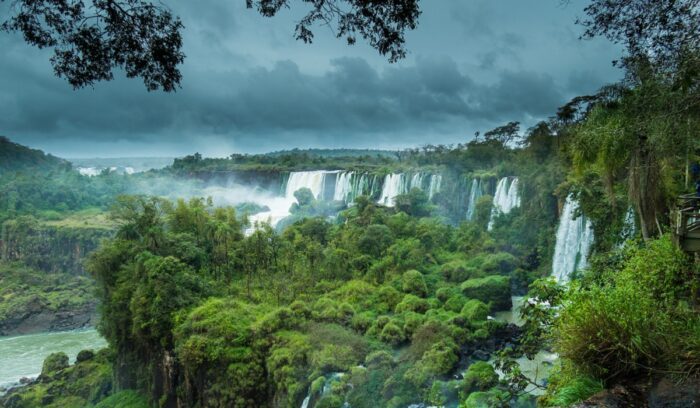
Around 8,000 B.C.E., a distinct human culture was taking shape in one of the most dramatic landscapes on Earth. The Eldoradense people settled in the river valleys and subtropical forests straddling what is now Paraguay, Brazil, and Argentina — a region anchored by the roaring cascades of the Iguazu River, the largest waterfall system in the world.
Key findings
- Eldoradense culture: Archaeological evidence places this Early Holocene culture in the tri-border region where Paraguay, Brazil, and Argentina meet, near the confluence of the Iguazu and Paraná Rivers.
- Early Holocene settlement: Dating to roughly 8,000 B.C.E., this period follows the end of the last Ice Age, when warming climates opened new habitats across South America and supported growing human populations.
- Iguazu River basin: The region’s extraordinary biodiversity — dense subtropical forest, abundant freshwater, and rich fauna — created ideal conditions for hunter-gatherer communities to establish lasting cultural traditions.
A world made possible by water
The Iguazu River rises near what is now Curitiba, Brazil, and flows westward until it plunges over a two-kilometer-wide escarpment in a spectacle that has awed every human being who has ever stood before it. The name itself comes from the Guaraní and Tupi languages — y meaning “water” and ûasú meaning “big.” Big water. The people who lived here first named it, understood it, and built their lives around it.
For the Eldoradense, this landscape was not a backdrop. It was the foundation. The falls divide the Iguazu River into upper and lower sections, creating distinct ecosystems across their length. The surrounding forests supported diverse plant and animal life. The rivers provided protein year-round. The basalt rock formations — part of the ancient Serra Geral formation laid down in the Mesozoic era — shaped the terrain that people navigated daily.
The tri-border zone where Argentina, Brazil, and Paraguay converge today was already, ten thousand years ago, a crossroads. River systems connected inland communities to coastal ones. Shared resources brought groups into contact. Cultural traditions spread, blended, and evolved across vast distances — long before the political borders that now carve up the region were imagined.
Who the Eldoradense people were
The Eldoradense culture is classified as part of the broader tradition of Early Holocene foragers who populated southern South America after the last glacial maximum. These were not isolated wanderers. Archaeological cultures across this period show evidence of territoriality, repeated site occupation, tool traditions passed across generations, and social networks that stretched far beyond any single campsite.
Their material culture — the stone tools, the use of local rock types, the patterns of site location — reflects sophisticated environmental knowledge. They knew this river system in ways that took thousands of years of accumulated learning to develop. The thundering falls at the heart of their territory were almost certainly places of cultural and spiritual significance, as they would be for every Indigenous group that came after them.
The Guaraní people, whose language gave the falls their name, are among the descendants of the long human tradition in this region. Their oral histories carry the memory of this landscape into the present — including the legend of Naipí and Tarobá, whose ill-fated escape down the river was said to have caused the deity to split the river itself, creating the falls as an act of divine fury. Stories like this one encode geography, danger, and meaning in forms that survive for millennia.
Lasting impact
The Eldoradense culture is one link in an unbroken chain of human presence in the Iguazu basin stretching from roughly 8,000 B.C.E. to the present. That continuity matters. The ecological knowledge built up over thousands of years of living in this environment — which plants to harvest, which animals to hunt and when, how to read the river’s moods — fed into the cultural traditions of every group that followed.
The region today remains one of the most biologically diverse on Earth. The Iguazú National Park on the Argentine side and Iguaçu National Park on the Brazilian side were both designated UNESCO World Heritage Sites — in 1984 and 1986, respectively — partly because the landscape has been shaped by human stewardship as much as by natural forces.
The falls themselves remain the sixth-greatest waterfall system by average annual flow in the world, with up to 300 individual cascades dropping between 60 and 82 meters over the basalt ledge. The Devil’s Throat — Garganta del Diablo in Spanish — plunges 70 to 80 meters into a narrow canyon 80 to 90 meters wide. Standing before it, the human impulse to assign it meaning, to build stories around it, feels not just understandable but inevitable.
André Rebouças, a Brazilian engineer, launched the first campaign to protect the falls in 1876 C.E., just four years after Yellowstone became the world’s first national park. He described the falls as endowed with “all possible preservation, from the beautiful to the sublime.” That instinct to protect — to pass something forward — echoes the same relationship with place that the Eldoradense people established ten thousand years earlier.
Blindspots and limits
The archaeological record for the Eldoradense culture remains incomplete. Much of what we know comes from surface finds and limited excavation in a region where tropical conditions accelerate the decay of organic materials, making it difficult to reconstruct the full picture of daily life, belief systems, or social organization. The connections between the Eldoradense and the later Guaraní-speaking peoples of the same region are suggestive but not fully established by current evidence.
The colonial period also brought catastrophic disruption to Indigenous communities across this region — displacement, disease, and forced labor under the Spanish and Portuguese — and that rupture makes it harder to trace living cultural continuities back to the earliest inhabitants. The story of the Eldoradense is, in part, a story of what has been lost as well as what has survived.
Read more
For more on this story, see: Iguazu Falls — Wikipedia
For more from Good News for Humankind, see:
- Indigenous land rights win at COP30 protects 160 million hectares
- Ghana establishes marine protected area at Cape Three Points
- The Good News for Humankind archive on prehistory
About this article
- 🤖 This article is AI-generated, based on a framework created by Peter Schulte.
- 🌍 It aims to be inspirational but clear-eyed, accurate, and evidence-based, and grounded in care for the Earth, peace and belonging for all, and human evolution.
- 💬 Leave your notes and suggestions in the comments below — I will do my best to review and implement where appropriate.
- ✉️ One verified piece of good news, one insight from Antihero Project, every weekday morning. Subscribe free.