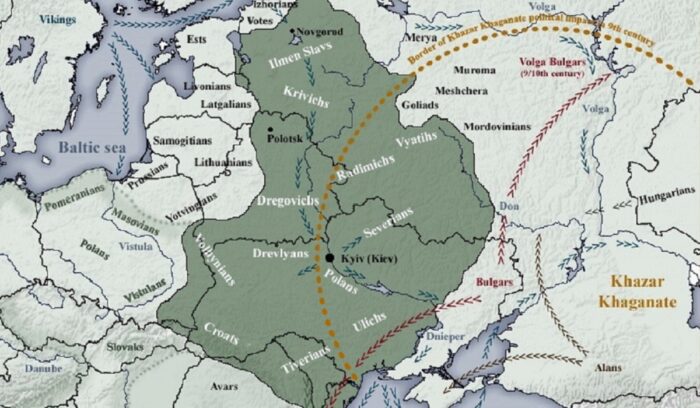
Sometime around the middle of the first millennium C.E., a people began moving across one of the largest continuous landmasses on Earth. The East Slavs — ancestors of modern Russians, Ukrainians, and Belarusians — spread steadily across the East European plain, putting down roots in river valleys, forests, and open steppe. Their expansion was not a single dramatic event but a centuries-long process of migration, settlement, and cultural formation that would eventually shape the lives of hundreds of millions of people.
What the evidence shows
- East Slavic expansion: By roughly 550 C.E., East Slavic-speaking peoples were establishing permanent settlements across a vast region stretching from the Carpathians in the west to the upper Volga and Oka river systems in the east.
- Archaeological record: Material culture from this period — pottery styles, burial practices, and fortified settlements called grady — confirms a broadly shared East Slavic cultural identity emerging across the plain during the 5th through 7th centuries C.E.
- Linguistic heritage: The spread of Proto-Slavic dialects across Eastern Europe during this era is documented by comparative linguistics, with East Slavic branching into the ancestral forms of Russian, Ukrainian, and Belarusian that remain spoken today.
A world already inhabited
The East European plain was not empty when the Slavs arrived. The vast steppes of southern Russia had been home to nomadic pastoralists for thousands of years. Scythian confederacies, Iranian-speaking peoples, and various Turkic and Finno-Ugric groups had long occupied different ecological zones across the region.
The East Slavic expansion was not a conquest in any simple sense. It was a gradual filling-in of forested river valleys and upland areas, often alongside or between existing populations. Finno-Ugric peoples in particular occupied much of what is now central and northern Russia, and archaeological evidence points to long periods of contact, coexistence, and cultural exchange between these groups and incoming Slavic settlers.
The rivers were everything. The Dnieper, the Don, the Volga, the Oka — these waterways were highways for trade, communication, and migration. Settlements clustered along their banks, and the river networks would later become the arteries of the Rus’ state that emerged in the 9th century C.E.
How they lived
Early East Slavic communities were organized around extended family clans and tribal groupings. They practiced a mix of slash-and-burn agriculture, hunting, fishing, and gathering, adapted to the heavily forested landscape of the northern plain. Millet, rye, and wheat were grown in forest clearings. Beekeeping and fur trapping were important supplementary activities, and both would later become foundations of long-distance trade.
Their religious world was animist and polytheistic, centered on natural forces — storms, rivers, the sun, the earth — and on ancestral spirits. Figures like Perun, the thunder god, and Veles, associated with the underworld and livestock, appear across East Slavic traditions. These beliefs persisted for centuries alongside and underneath the Christianity that would arrive in 988 C.E.
Social life was relatively egalitarian by the standards of more stratified societies. Tribal councils and communal assemblies — ancestors of the veche (popular assembly) that would later become an institution in cities like Novgorod — gave communities a degree of collective decision-making that left real traces in later Slavic political culture.
The knowledge exchange no one planned
East Slavic expansion happened at a moment of enormous movement across Eurasia. The Migration Period, roughly 375–568 C.E., saw Hunnic, Gothic, Avar, and other peoples sweeping across the continent, displacing and displacing others in chain reactions that reshaped the ethnic and cultural map of Europe. The East Slavs both contributed to and were shaped by these movements.
They absorbed agricultural techniques from earlier inhabitants, metallurgical knowledge from steppe peoples, and trading practices from contacts with Byzantine merchants to the south. The trade routes linking the Baltic and Black Seas that would later define Kievan Rus’ were already being sketched out by the movement of goods — furs, amber, slaves, silver — across the networks that East Slavic expansion helped connect.
Byzantine influence in particular was a long-term presence. Greek merchants and missionaries had been active around the Black Sea and up the Dnieper corridor for centuries. The cultural and commercial pull of Constantinople would eventually draw Kievan Rus’ into the Byzantine orbit, culminating in the adoption of Orthodox Christianity in 988 C.E. — but those roots stretch back to the settlement patterns of the 6th century C.E. and earlier.
Lasting impact
The East Slavic expansion across the plain was the demographic and cultural foundation on which everything else was built. Without it, there is no Kievan Rus’, no Novgorod republic, no Muscovite state, and no Russian Empire. The three modern nations of Russia, Ukraine, and Belarus all trace their origin populations, languages, and foundational cultural identity to this period.
The settlement patterns established during the 5th through 7th centuries C.E. shaped where cities would later grow, which river routes would become trade arteries, and which regions would retain distinct ethnic and linguistic identities for a millennium. The communal institutions of early East Slavic villages — the assembly, the clan council, the shared management of common land — left imprints on later legal and political culture that historians can still trace.
The Orthodox Christian civilization that emerged from Kievan Rus’ after 988 C.E. drew on Byzantine theology and Greek literary culture, but it was carried and adapted by people whose ancestors had settled the East European plain during precisely this period. That synthesis of Slavic, Byzantine, and later Scandinavian (Varangian) cultural elements produced a distinct civilization that defined Eastern Europe for the next thousand years.
Modern linguistic science traces the divergence of Russian, Ukrainian, and Belarusian from their common Proto-Slavic ancestor to this era. The three languages remain closely related — mutually intelligible to a significant degree — a living marker of a shared origin in the settlements of the early medieval plain.
Blindspots and limits
The written record for this period is sparse. Most of what we know about early East Slavic society comes from archaeology, comparative linguistics, and later chronicles written centuries after the fact — including the Primary Chronicle compiled around 1113 C.E., which projects later political structures backward onto an earlier and more fluid past. The peoples who already lived on the plain when the Slavs arrived — Finno-Ugric, Iranian, and Turkic groups — left fewer written traces and appear in the record mainly as background to the Slavic story, a distortion that modern archaeology is gradually correcting. The expansion also displaced and absorbed communities whose descendants, languages, and traditions were partly or fully erased in the process.
Read more
For more on this story, see: Wikipedia — History of Russia
For more from Good News for Humankind, see:
- Ghana establishes a new marine protected area at Cape Three Points
- Uganda reintroduces rhinos to Kidepo Valley
- The Good News for Humankind archive on the early Middle Ages
About this article
- 🤖 This article is AI-generated, based on a framework created by Peter Schulte.
- 🌍 It aims to be inspirational but clear-eyed, accurate, and evidence-based, and grounded in care for the Earth, peace and belonging for all, and human evolution.
- 💬 Leave your notes and suggestions in the comments below — I will do my best to review and implement where appropriate.
- ✉️ One verified piece of good news, one insight from Antihero Project, every weekday morning. Subscribe free.