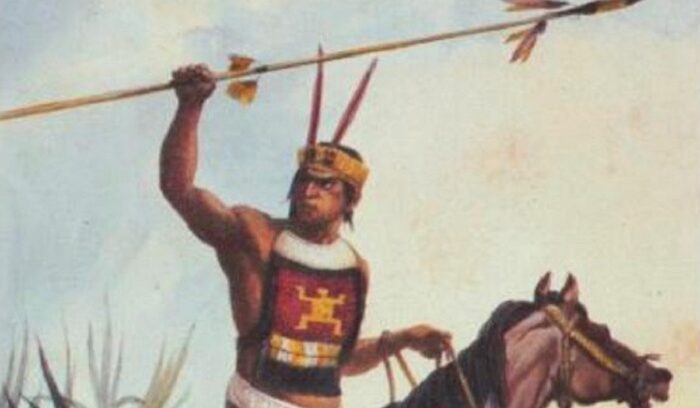
Around 4,000 years ago, people belonging to the Charrúa and Guaraní groups made their way into the territory we now call Uruguay. They were not the first humans to walk that land — hunter-gatherers had been living there for at least 10,000 years — but the arrival of the Charrúa marked the beginning of a distinct cultural presence that would shape the region for millennia.
What the evidence shows
- Charrúa peoples: Archaeological and historical evidence places the Charrúa in present-day Uruguay roughly 4,000 years ago, around 2000 B.C.E., alongside Guaraní groups migrating through the region.
- Pre-Columbian settlement: Earlier cultures — the Catalanense and Cuareim — had occupied the territory for tens of thousands of years, leaving behind stone tools, ancient bolas dating to around 5000 B.C.E., and rock art sites such as Chamangá.
- Indigenous population: At the time of first European contact in the early 1500s C.E., an estimated 9,000 Charrúa, 6,000 Chaná, and thousands of Guaraní were living across the territory, surviving through hunting, fishing, and a nomadic way of life.
A land already alive with people
The arrival of the Charrúa peoples did not happen in an empty landscape. For thousands of years before them, earlier cultures had been living across the territory of what is now Uruguay. The Catalanense and Cuareim peoples — whose traditions extended from what is now Brazil — left behind stone tools and bolas, one of the oldest of which dates to around 5000 B.C.E.
Rock art found at sites like Chamangá offers some of the most vivid evidence of these ancient lives. Carved and painted into stone, these images are among the few direct records left by peoples whose names history never recorded.
Into this layered landscape, the Charrúa arrived. They were a nomadic people, moving with the seasons, hunting, and fishing across the grasslands and river systems of the Río de la Plata basin. Their society was organized around small, mobile bands rather than fixed settlements or large centralized structures. This way of life allowed them to survive and adapt across a vast and varied territory for thousands of years.
Who the Charrúa were
The Charrúa were not a single unified nation in the modern sense. They were a cluster of related bands sharing languages, customs, and territory, living alongside and sometimes interacting with neighboring groups including the Chaná, the Arachán, and the Guaraní. These peoples were distinct from one another but shared the broad rhythms of life on the land.
Estimates suggest the total Indigenous population of the region never exceeded 10,000 to 20,000 people across the entire territory. That small population sustained itself for millennia without permanent agriculture or urban infrastructure — a remarkable feat of ecological knowledge and social organization that mainstream histories have rarely treated with the seriousness it deserves.
The Guaraní, who also arrived around 2000 B.C.E., brought different traditions. They were more closely associated with agriculture and semi-permanent settlement, and their linguistic and cultural influence spread across a much wider region of South America. The Guaraní language survives today as one of the official languages of Paraguay — a living thread connecting the present to those ancient migrations.
Lasting impact
The Charrúa presence in Uruguay did not simply end. It was violently disrupted. European colonization from the 16th century onward brought disease, displacement, and warfare. By the time Uruguay declared independence in 1828 C.E., the Indigenous population had been devastated. The catastrophe reached its most explicit moment on April 11, 1831 C.E., with the Massacre of Salsipuedes, when the Uruguayan army, under orders from President Fructuoso Rivera, killed most of the surviving Charrúa men. The remaining women and children — approximately 300 people — were distributed as servants among European households.
Yet the story did not fully end there. Charrúa descendants and identity have persisted, and in recent decades a growing movement has worked to reclaim and document that heritage. The question of what it means to be Charrúa today — culturally, legally, and personally — remains alive and contested in Uruguay.
The influence of Indigenous peoples on Uruguayan culture also persists in ways that are easy to overlook. Place names across the country derive from Charrúa, Chaná, and Guaraní languages. The word Uruguay itself is believed to come from the Guaraní language, though its precise meaning is still debated among linguists — most likely referring to the river of the painted birds, or the river of the shellfish.
The arrival of the Charrúa peoples around 2000 B.C.E. was one chapter in a much longer story of human movement across the Americas. That story began at least 15,000 years ago with the first migrations into South America and continued through countless waves of cultural exchange, adaptation, and settlement that colonial-era written records almost entirely missed.
Blindspots and limits
The archaeological record for this period in Uruguay is thin, and much of what we know about the Charrúa comes from European colonial accounts written thousands of years after their arrival — accounts shaped by the biases and agendas of the writers. The date of approximately 2000 B.C.E. for Charrúa arrival is a scholarly estimate, not a precisely documented fact, and the internal diversity of Charrúa culture, their oral traditions, and their own understanding of their history have been largely lost. What survived the colonial period did so against enormous odds, and the work of recovery is far from complete.
Read more
For more on this story, see: History of Uruguay — Wikipedia
For more from Good News for Humankind, see:
- Indigenous land rights: 160 million hectares recognized ahead of COP30
- Ghana establishes marine protected area at Cape Three Points
- The Good News for Humankind archive on prehistory
About this article
- 🤖 This article is AI-generated, based on a framework created by Peter Schulte.
- 🌍 It aims to be inspirational but clear-eyed, accurate, and evidence-based, and grounded in care for the Earth, peace and belonging for all, and human evolution.
- 💬 Leave your notes and suggestions in the comments below — I will do my best to review and implement where appropriate.
- ✉️ One verified piece of good news, one insight from Antihero Project, every weekday morning. Subscribe free.