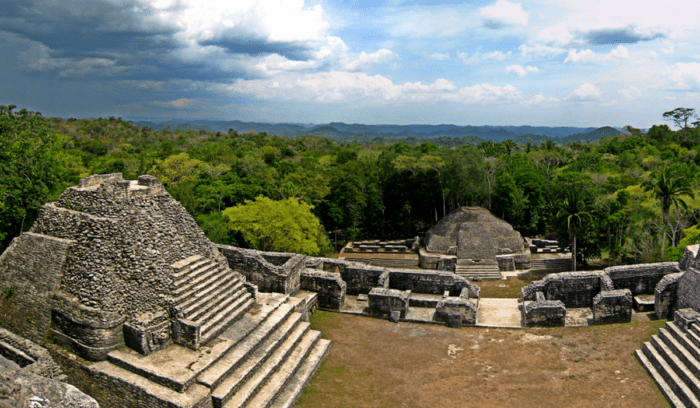
Long before the pyramids of Caracol rose above the jungle canopy of what is now Belize, people were already living on the Vaca Plateau. Around 1200 B.C.E., communities began putting down roots in the broader Caracol area — a moment that set in motion one of the most remarkable stories in ancient Maya history.
What the evidence shows
- Early Caracol settlement: Archaeological evidence places human occupation in the wider Caracol region as early as 1200 B.C.E., though the epicentral area was not settled until around 650 B.C.E.
- Maya Lowlands city: Caracol grew into one of the largest cities in the ancient Maya Lowlands, eventually covering approximately 200 square kilometers — larger than modern Belize City — with an estimated peak population between 120,000 and 180,000 people.
- Caracol archaeology: The site preserves 53 carved stone monuments, more than 250 burials, and 200 ritual caches, offering an exceptionally detailed record of Maya political and spiritual life across many centuries.
A place worth choosing
The Vaca Plateau sits at roughly 500 meters above sea level in the foothills of the Maya Mountains, offering reliable water access, fertile ground for agriculture, and natural defensive advantages. These were not accidental advantages. The people who first settled the Caracol area understood the land and chose it deliberately.
The ancient Maya name for the site was Uxwitza’ — “Three Water Hill” or “Three Hills.” That name encoded the landscape itself into identity, a reminder that early inhabitants read their environment with care and gave it meaning that lasted for generations.
The modern name, Caracol, came much later. Spanish-speaking visitors named it after the winding access road to the site — caracol meaning snail or spiral in Spanish. The site was unknown to the outside world until 1937 C.E., when a logger named Rosa Mai stumbled upon its remains while searching for mahogany trees.
From settlement to metropolis
What began as early occupation on the plateau would, over many centuries, grow into something extraordinary. By the Early Classic period, between 250 C.E. and 550 C.E., Caracol had woven itself into extensive trade networks and pan-lowland ideological systems that created a unified regional economy.
The city was officially founded — in the political and dynastic sense — in 331 C.E. by a ruler named Te’ K’ab Chaak. That moment marked a formal beginning, but it rested on more than a thousand years of human presence and accumulated knowledge in the region.
The city’s most dramatic chapter came in the sixth and seventh centuries C.E. Under the ruler Yajaw Te’ K’inich II, known as Lord Water, Caracol defeated the powerful city of Tikal in 562 C.E. — a conflict recorded in Maya inscriptions as a “star war,” named for a glyph depicting a star pouring liquid onto the earth. Tikal entered a 120-year decline. Caracol flourished, expanding its population, extending its causeway system, and producing monuments at a rate that outpaced its defeated rival.
At its height, Caracol contained approximately 267 structures per square kilometer — 85% more than Tikal. Its largest building, Caana or “sky-palace,” still stands at 43 meters tall, making it the tallest human-made structure in Belize today.
How LiDAR changed what we know
For much of the 20th century, archaeologists underestimated Caracol. The jungle hid most of it. Early surveys captured only the central core, and the site was long classified as a secondary Maya center.
That changed in 2009 C.E., when the Caracol Archaeological Project — led by Arlen and Diane Chase, who have directed excavations at the site every year since 1985 C.E. — used airborne LiDAR to scan the full 200 square kilometers of the site and its surroundings. The technology penetrated the forest canopy and revealed the true scale of the city: a vast, integrated landscape of terraced farmland, residential structures, and radiating causeways connecting neighborhoods to the urban core.
The LiDAR survey was a turning point in Maya archaeology more broadly. It demonstrated that ancient Maya cities were far larger and more densely populated than the clearings around visible temples had suggested. Caracol helped make the case that the Maya Lowlands had supported urban populations comparable in scale to major cities of the ancient world.
Lasting impact
The early settlement of Caracol contributed to a regional tradition of Maya urbanism that would shape Central American civilization for more than a millennium. The city’s political innovations — including what some researchers interpret as a relatively distributed economic system, suggested by the even spacing of structures across the landscape — offer ongoing insight into how ancient societies organized resources and power.
Caracol’s stone monuments and altars, many of which record specific dates and political events in the Maya Long Count calendar, have helped scholars reconstruct a detailed timeline of Classic Maya history. Epigraphy at Caracol has clarified the relationships between major lowland cities, including the pivotal rivalry between Caracol and Tikal.
Today, Caracol is Belize’s largest archaeological site and a significant driver of heritage tourism in the country. The ongoing excavation project continues to train local archaeologists and contribute to Belizean national identity. The National Institute of Culture and History of Belize manages the site, emphasizing its role in the story of the Maya people whose descendants remain part of Belizean society.
Blindspots and limits
The archaeological record at Caracol reflects what survived, what was excavated, and what was deemed worth recording — categories that have historically centered monumental architecture and elite burials over the everyday lives of the majority of inhabitants. Early excavations removed approximately a dozen monuments to the University of Pennsylvania, raising ongoing questions about the stewardship of cultural heritage and who controls access to the material past.
The Caracol area’s occupation before 650 B.C.E. remains sparsely documented, and the full picture of how those earliest communities lived, what they believed, and how they organized themselves is still largely unknown. The jungle continues to hold more than it has yet given up.
Read more
For more on this story, see: Wikipedia — Caracol
For more from Good News for Humankind, see:
- Indigenous land rights recognized across 160 million hectares ahead of COP30
- Ghana establishes a marine protected area at Cape Three Points
- The Good News for Humankind archive on ancient civilizations
About this article
- 🤖 This article is AI-generated, based on a framework created by Peter Schulte.
- 🌍 It aims to be inspirational but clear-eyed, accurate, and evidence-based, and grounded in care for the Earth, peace and belonging for all, and human evolution.
- 💬 Leave your notes and suggestions in the comments below — I will do my best to review and implement where appropriate.
- ✉️ One verified piece of good news, one insight from Antihero Project, every weekday morning. Subscribe free.