
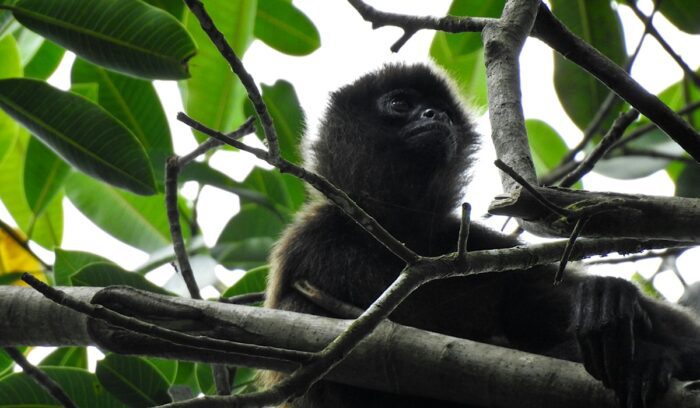
A troop of brown howler monkeys is slowly reclaiming the treetops of Tijuca National Park in Rio de Janeiro — and behind that recovery is a vaccine, a landmark national program, and more than three decades of stubborn fieldwork. Brazil has launched the first population management program of its kind in the country for Alouatta guariba, the brown howler monkey, connecting captive facilities across eight states with wildlife experts trained to return the animals safely to forests where they have vanished.
At a glance
- Yellow fever vaccine: Researchers adapted the human yellow fever vaccine for howler monkeys, and 77 captive animals in Santa Catarina developed antibodies in a 2022 trial — now every howler must be vaccinated before translocation.
- Population management program: Launched in 2023 and coordinated by a multi-agency committee, Brazil’s Alouatta guariba program divides the species’ range into five genetic management zones, including a cross-border effort to shore up a population of just 20–50 animals in Argentina.
- Howler reintroduction: Tijuca National Park, an urban forest inside Rio de Janeiro, now holds two separate groups of brown howlers — the second released in January 2024 C.E. after being acclimated in an on-site enclosure.
How yellow fever nearly silenced the forests
When Zelinda Hirano began studying howlers in Santa Catarina in 1991 C.E., they were abundant. “People here used to say we had a bucketload of monkeys,” she recalls. She worked for 32 years with a group of 59 animals in a forest near Indaial. Then yellow fever arrived.
The disease is caused by a mosquito-borne virus that is dangerous for humans but catastrophic for nonhuman primates, especially howlers. A first epizootic in 2008–09 C.E. killed thousands of animals across Rio Grande do Sul, cutting some populations by 75% and wiping the species from half its forest fragments. A second outbreak in 2016 C.E. swept the entire species range. At the private reserve Feliciano Miguel Abdala in Minas Gerais, researchers estimated an 86.6% population decline. “The forest became silent,” Hirano says.
The brown howler, once listed as least concern by the IUCN Red List, is now ranked among the 25 most threatened primates on the planet. Brazil’s Chico Mendes Institute for Biodiversity Conservation (ICMBio) is expected to classify it as endangered in its next assessment.
Building the vaccine from scratch
No vaccine existed for howler monkeys when the 2016 C.E. outbreak hit. So a team of researchers set out to create one.
Starting in 2018 C.E., Dr. Silvia Bahadian of the Rio de Janeiro Primatology Center (CPRJ), Dr. Alcides Pissinatti from the same institution, and Dr. Marcos Freire from the Fundação Oswaldo Cruz began adapting the existing human yellow fever vaccine for use in the species. In July 2022 C.E., Hirano coordinated a trial on 77 captive howlers in Santa Catarina. Every single animal developed antibodies. The protocol is now standard: no howler moves to a new forest without first being vaccinated.
That breakthrough unlocked the population management program itself. Without protection against yellow fever, releasing animals into the wild would risk repeating the devastation of 2016 C.E.
A decade of work in Tijuca — and what it taught everyone
The NGO Refauna had already been working in Tijuca National Park since September 2015 C.E., when it released the first brown howlers the urban forest had seen in over a century. Early lessons were hard-won. Some animals from captive or semi-domesticated backgrounds sought out human contact and had to be removed. Tracking equipment malfunctioned. One piece of gear wounded an animal’s leg.
The program ultimately came down to one breeding pair: Kala and Juvenal. In 2016 C.E., Kala gave birth to the first baby. Despite the yellow fever outbreak that year, Tijuca’s position inside Rio de Janeiro’s urban matrix shielded the small group, and by 2023 C.E. the pair had grown to six animals.
That year, a second group — including Max and Hope, freshly vaccinated at CPRJ — was placed in an acclimation enclosure inside the park to adjust to new smells, sounds, and fellow howlers before release. The team abandoned radio tracking in favor of patience and binoculars. The January 2024 C.E. release was followed by territorial clashes, one broken arm, and the removal of a female and her infant. Four animals now compose the second group.
“It is very rewarding to see an animal reintroduced,” Bahadian says. Even the best captive conditions, she notes, “can’t come close to offering howlers what should be their normal life, with tall branches and big trees.”
Tijuca’s experience is now informing new releases. In Florianópolis, Dr. Vanessa Kanaan of the Wild Space Institute has released three howler groups in Rio Vermelho State Park, with more planned. A small population in Serra da Cantareira in São Paulo state is also receiving new animals.
What restored howlers mean for the Atlantic Forest
Brown howlers are not just charismatic mammals — they are seed dispersers whose presence shapes the Atlantic Forest ecosystem, one of the most biodiverse and threatened biomes on Earth. Fewer than 12% of the original Atlantic Forest remains, and the loss of large frugivores like howlers changes how forests regenerate.
The population management program addresses that ecological role directly. By linking captive facilities with field expertise — and with a functioning vaccine — conservationists can now move animals strategically to restore wild populations across five genetic zones. The far south zone even extends across the border to support Argentina’s last 20–50 brown howlers, with animals from Rio Grande do Sul and Santa Catarina planned as reinforcements.
Dr. Marcelo Rheingantz, Refauna’s executive director and a biologist at the Federal University of Rio de Janeiro, frames the effort as a convergence of two needs: “an opportunity to unite the captivity management experience — and the possibility of giving a destination to rescued animals — with the necessity of restoring wild populations which have been reduced or extinct.”
The program, coordinated by Hirano and supervised by a committee representing CPB, veterinarians, geneticists, and all eight states where the species occurs, is the first of its kind in Brazil. Its ICMBio-backed framework may also serve as a model for other imperiled Atlantic Forest species facing cascading threats.
Still, the work is far from over. Population sizes remain fragile, territorial conflicts in release sites can set groups back, and the yellow fever virus still circulates in southern Brazilian forests. Maintaining genetic diversity across five management zones while coordinating eight states and one international border is a logistical challenge that will test the program for years to come.
For now, though, the forests of Tijuca are a little louder than they were — and that sound carries weight. Hope reached out and touched Juvenal, and he accepted. That small act, watched by researchers with binoculars from below, captures something larger: the slow, imperfect, stubborn work of bringing a species back from the edge of silence.
Read more
For more on this story, see: Mongabay
For more from Good News for Humankind, see:
- Jaguars in the Brazil-Argentina border forest have more than doubled since 2010
- Critically endangered Siberian crane populations have increased by nearly 50% over last decade
- The Good News for Humankind archive on Brazil
- Species recovery & rewilding: 50+ wildlife good news stories reshaping the planet
About this article
- 🤖 This article is AI-generated, based on a framework created by Peter Schulte.
- 🌍 It aims to be inspirational but clear-eyed, accurate, and evidence-based, and grounded in care for the Earth, peace and belonging for all, and human evolution.
- 💬 Leave your notes and suggestions in the comments below — I will do my best to review and implement where appropriate.
- ✉️ One verified piece of good news, one insight from Antihero Project, every weekday morning. Subscribe free.


