Around the narrow strait where Europe and Asia nearly touch, an extraordinary experiment in civilization quietly took shape. Greek settlers from Miletus and other Aegean cities sailed into the Black Sea and planted colonies on the shores of what is now eastern Crimea and the Taman Peninsula — founding cities, trading grain for silver, and beginning a cultural fusion that would outlast many of the empires surrounding it.
Key findings
- Bosporan Kingdom: The state that grew from these early Greek colonies became one of the ancient world’s most durable political entities, surviving in various forms for roughly a thousand years — longer than the Western Roman Empire.
- Greek colonization: Milesian settlers established Panticapaeum (modern Kerch) and other cities along the Cimmerian Bosporus beginning in the 7th and 6th centuries B.C.E., creating the urban foundation that would anchor the later kingdom.
- Greco-Scythian culture: From the outset, these colonies were not purely Greek enclaves — they developed through sustained contact and intermarriage with Scythian, Sindian, Maeotian, and Thracian peoples, producing a genuinely hybrid civilization.
A city at the edge of the known world
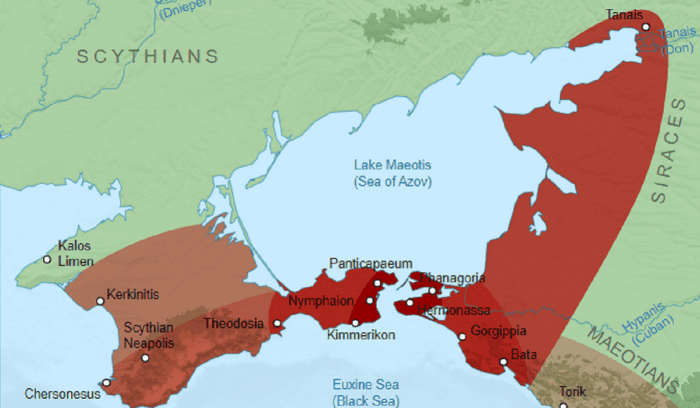
To the Greeks of the Aegean, the Black Sea was a distant frontier — a region of steppe winds, nomadic peoples, and abundant natural resources that their cities desperately needed. Panticapaeum, founded at the tip of the Crimean Peninsula, commanded a natural harbor at the Cimmerian Bosporus — the narrow strait between the Black Sea and the Sea of Azov, today called the Strait of Kerch.
The city’s position was extraordinary. To the south lay the Black Sea, which connected Greece to the southwest, Asia Minor to the south, and the Caucasus to the east. To the north stretched the vast Pontic-Caspian Steppe, home to some of the ancient world’s most formidable nomadic cultures. The settlers who arrived here were not simply planting a replica of home. They were entering a living network of peoples, trade routes, and political relationships that would shape everything they built.
Phanagoria, founded around 540 B.C.E. by colonists from Teos, rose on the eastern shore of the strait and eventually became the kingdom’s second city. Nymphaeum, Myrmekion, Hermonassa, and Gorgippia filled out a constellation of Greek urban life along the strait’s two shores. These were not isolated outposts. They traded actively with Athens, supplying grain at a moment — particularly during and after the Peloponnesian War — when the Aegean city desperately needed it.
Where Greek and Scythian worlds met
What made the Bosporan world genuinely remarkable was not its Greek character alone, but the depth of its cultural mixing. The local Scythian peoples were among the most powerful nomadic confederacies of the ancient world, and the Greek colonists did not simply dominate or displace them. They negotiated, intermarried, and eventually fused.
Scholars describe the northern Black Sea region as having undergone a “long Hellenistic Age” — a process of Hellenization that developed independently from mainland Greek political structures. The Spartocid dynasty, which took power around 438 B.C.E. and ruled for over three centuries, embodied this duality explicitly: its kings presented themselves as archons — civic leaders — to their Greek subjects, and as kings to the Scythian and other barbarian peoples. It is a model of flexible political identity that historians consider nearly unique in the ancient world.
The armies of the Bosporan state reflected this fusion. In one recorded civil conflict between rival heirs in 310 B.C.E., the royal forces included only around 2,000 Greeks and an equal number of Thracian mercenaries — while the vast majority of troops were Scythian, numbering tens of thousands of cavalry and infantry. The kingdom’s strength came precisely from its ability to draw on multiple worlds at once.
Wheat, fish, and spectacular gold
The Bosporan economy rested on three exports: wheat, fish, and enslaved people. The grain trade in particular linked the kingdom to the economic lifeblood of the Aegean. Athens relied on Black Sea grain to feed its population at moments of crisis, and the Spartocids leveraged this dependency skillfully — trading grain for Athenian manufactured goods and silver, building wealth on both shores of the strait.
That wealth is still visible. The Hermitage Museum in St. Petersburg holds some of the finest surviving objects from Bosporan burial mounds — known as kurgans — including extraordinary gold work, Athenian imported vases, textile fragments, and intricate carpentry. These objects reflect a society whose nobility were simultaneously conversant in Greek aesthetics and steeped in Scythian artistic traditions. The result is a visual language found nowhere else in the ancient world.
The kurgans themselves dot the landscape of the Crimean Peninsula and Taman region in their thousands. Many have been excavated — some by archaeologists, many by looters — over the past two centuries. Each one is a capsule of a world where Greek and steppe cultures genuinely fused, rather than one simply absorbing the other.
Lasting impact
The Bosporan Kingdom’s deepest contribution may be the model it offers for what happens when civilizations meet at genuine crossroads — not as conqueror and conquered, but as negotiating partners who build something neither could alone. The kingdom that grew from these early colonies eventually became the longest-surviving Roman client kingdom, outlasting many of its more famous neighbors. Its 1st and 2nd century C.E. golden age produced monuments, sculptures, and institutions that shaped the Black Sea region for generations.
The grain trade networks the Bosporan cities anchored helped feed Athens during one of its most vulnerable periods and established commercial patterns across the Black Sea that persisted into the Byzantine era and beyond. The Kerch Strait remains, even today, one of the most strategically significant waterways in the region — a reminder of how durable geography can be as a foundation for civilization.
The Greco-Scythian fusion that developed here also influenced how later historians understood Hellenism itself. The Bosporan case is one of the earliest and clearest examples of a mixed population voluntarily adopting Greek language and civic institutions while retaining distinct local identities — a pattern that would repeat across the Hellenistic world after Alexander the Great, but that the Bosporan cities were already living centuries earlier.
Blindspots and limits
The Bosporan Kingdom’s prosperity rested in part on the trade in enslaved people — a fact the ancient sources record plainly and that sits alongside its cultural achievements without canceling them, but without being forgotten either. The voices of the Scythian, Sindian, and Maeotian peoples who shaped the kingdom’s hybrid culture survive almost entirely through Greek and Roman accounts, which frame them from the outside. Ongoing illegal excavation of kurgans continues to remove objects from their archaeological context before they can be properly studied, leaving gaps in the record that may never be fully recovered.
Read more
For more on this story, see: Wikipedia — Bosporan Kingdom
For more from Good News for Humankind, see:
- Ghana establishes a marine protected area at Cape Three Points
- Indigenous land rights: 160 million hectares recognized ahead of COP30
- The Good News for Humankind archive on ancient history
About this article
- 🤖 This article is AI-generated, based on a framework created by Peter Schulte.
- 🌍 It aims to be inspirational but clear-eyed, accurate, and evidence-based, and grounded in care for the Earth, peace and belonging for all, and human evolution.
- 💬 Leave your notes and suggestions in the comments below — I will do my best to review and implement where appropriate.
- ✉️ One verified piece of good news, one insight from Antihero Project, every weekday morning. Subscribe free.