Long before European ships arrived in Southeast Asian waters, the coasts of one of the world’s largest islands were already alive with commerce. Merchants, sailors, and local communities on Borneo’s shorelines had woven the island into a web of regional exchange stretching across the South China Sea and the Indian Ocean — quietly, incrementally, centuries before anyone wrote it down in a language that survived.
What the evidence shows
- Borneo trade networks: By the early centuries C.E., coastal communities on Borneo had established contact with traders from India, China, and broader Maritime Southeast Asia, forming some of the region’s earliest international commercial hubs.
- First millennium ports: Historical and archaeological evidence confirms that international trading ports were well established on Borneo by the first millennium C.E., integrating the island into long-distance exchange systems well before formal empire arrived.
- Maritime Southeast Asia: Borneo sits at the geographic center of Maritime Southeast Asia — a position that made its coastal settlements natural nodes in sea routes connecting East Asia, South Asia, and the archipelagos of the Pacific rim.
An island at the center of everything
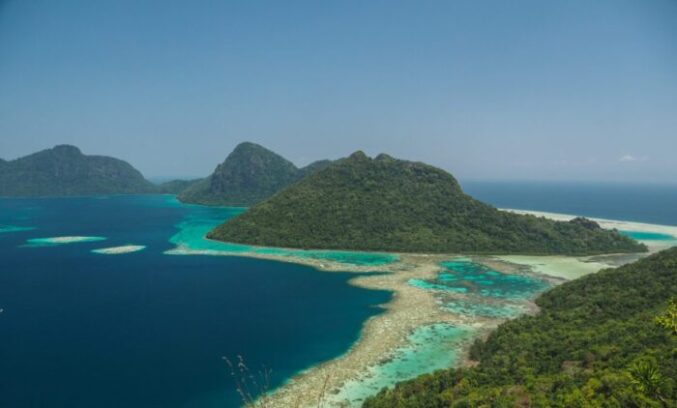
Borneo’s geography made trade almost inevitable. The island sits at the heart of Maritime Southeast Asia, flanked by the South China Sea to the north and west, the Sulu Sea to the northeast, and the Java Sea to the south. Any ship moving between China, the Indian subcontinent, and the islands of the Pacific had reason to stop.
The island’s rainforests — among the oldest on Earth, estimated at around 140 million years — produced goods that were rare and valuable in distant markets: aromatic woods, resins, hornbill ivory, camphor, and edible bird’s nests. These were not luxuries invented by outside demand. They were products that Borneo’s coastal and interior peoples had long known how to harvest, prepare, and exchange.
What shifted in the early centuries C.E. was scale and reach. Connections that may have begun as localized barter grew into something more formal — trading ports that could receive foreign vessels, store goods, negotiate exchange, and send merchants back out with Borneo’s forest wealth aboard.
Who was doing the trading
The peoples of Borneo’s coasts were not passive recipients of outside contact. Indigenous communities — including those later grouped under the broad umbrella term “Dayak,” though that label encompasses hundreds of distinct cultures and languages — had developed sophisticated knowledge of the island’s ecosystems and resources over tens of thousands of years. Borneo has been continuously inhabited for more than 65,000 years.
The early trading ports that emerged along the coastline were built on this deep local knowledge. Coastal communities acted as intermediaries, connecting forest-dwelling interior peoples with incoming merchants from China, India, and the Malay world. This was not simply geography at work. It required organizational skill, political negotiation, and a working knowledge of multiple languages and trading customs.
Chinese records began referencing Borneo — using the term Bo-ni — in 977 C.E., suggesting active and recognized contact by that point. But the commercial relationships those records describe almost certainly had earlier roots. Indian cultural influence, visible in the Sanskrit-derived names attached to the island across centuries, points to connections with the Indian subcontinent that predate Chinese documentation.
What this made possible
The establishment of Borneo’s early coastal trade networks set the conditions for everything that followed in the island’s political and cultural history. The wealth generated by trade supported the growth of more complex polities. The island later came under the influence of the Majapahit Empire, and by the 14th century C.E., the Sultanate of Brunei governed most of its coast — a political structure that itself depended on the commercial infrastructure those early port communities had built.
The trading connections also carried ideas. Sanskrit vocabulary entered local languages. Hindu and Buddhist cosmologies shaped the region’s governance and ritual life. The name Kalimantan — Indonesia’s term for the island — likely derives from the Sanskrit kalamanthana, meaning “burning weather.” Even the word Borneo traces a path through layers of contact: Portuguese explorers, the Brunei kingdom, and ultimately a Sanskrit root meaning water or the ocean god Varuna.
These are not trivial etymological footnotes. They are evidence of how deeply the island was embedded in a broader web of civilizations long before European ships appeared in the 16th century C.E.
Lasting impact
The trade networks that took shape on Borneo’s coasts in the early centuries C.E. helped establish Maritime Southeast Asia as one of the world’s great commercial crossroads. The patterns laid down then — port cities as nodes of exchange, forest products as valuable commodities, multilingual coastal communities as cultural brokers — persisted for well over a millennium.
Today, the majority of Borneo’s population still lives in coastal cities. The island remains economically connected to global markets through oil, gas, agriculture, and timber. The continuity is imperfect and often troubled, but it is real. The coastal orientation of Borneo’s economy in the 21st century C.E. has roots that reach back through two thousand years of maritime commerce.
There is also a less visible legacy. The cultural diversity of Borneo — hundreds of Indigenous languages and traditions, many still living — survived in part because the island’s interior remained largely outside the control of coastal empires. Trade brought outside influence to the coasts. The interior kept its own world.
Blindspots and limits
The historical record for this period is thin. Most of what scholars know about early Borneo trade comes from Chinese court records, Indian textual references, and archaeological finds — sources that reflect the perspectives of outsiders or coastal elites, not the interior communities whose forest knowledge made the trade possible in the first place. The specific peoples, languages, and social structures behind Borneo’s earliest port communities remain incompletely understood, and the date of ~100 C.E. for the onset of formalized trade is an informed estimate rather than a documented fact. What the evidence shows clearly is a process, not a moment — a gradual deepening of connections whose precise beginnings are still being traced.
Read more
For more on this story, see: Wikipedia — Borneo: Early history
For more from Good News for Humankind, see:
- Ghana establishes a major marine protected area at Cape Three Points
- Indigenous land rights recognized across 160 million hectares ahead of COP30
- The Good News for Humankind archive on antiquity
About this article
- 🤖 This article is AI-generated, based on a framework created by Peter Schulte.
- 🌍 It aims to be inspirational but clear-eyed, accurate, and evidence-based, and grounded in care for the Earth, peace and belonging for all, and human evolution.
- 💬 Leave your notes and suggestions in the comments below — I will do my best to review and implement where appropriate.
- ✉️ One verified piece of good news, one insight from Antihero Project, every weekday morning. Subscribe free.