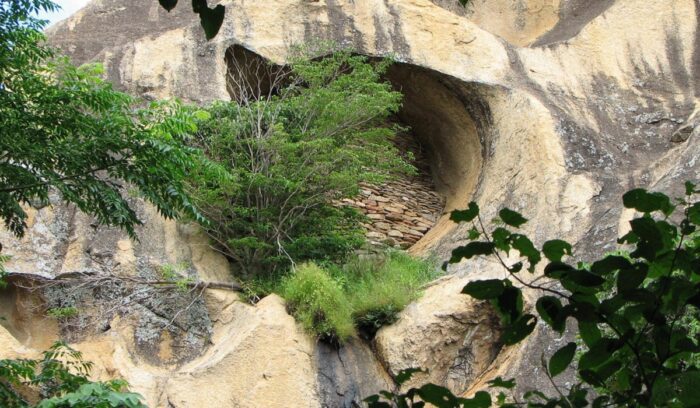
High in the red-clay plateau of what is now southern Madagascar, a cluster of independent kingdoms was taking shape. They shared a language, a reverence for ancestors, and a genius for carving terraced rice fields into steep hillsides — but for generations they governed themselves separately, each with its own oral traditions, noble lineages, and community elders. These were the Betsileo kingdoms, among the most enduring political formations in Malagasy history.
What the evidence shows
- Betsileo kingdoms: Multiple independent polities — including Fandriana, Fisakana, Manandriana, and Isandra — formed across the southern highlands, with oral traditions placing their origins in the 17th century C.E.
- Highland rice terracing: The Betsileo developed elaborate hillside terrace agriculture that fed dense highland populations and became one of the most distinctive agricultural systems in the Indian Ocean world.
- Malagasy oral tradition: The kingdoms’ histories were preserved through generations of spoken record, linking ruling lineages to ancestral spirits and the ceremonial life of the community rather than written chronicles.
A people of the plateau
The Betsileo occupy the southern stretch of the Madagascar plateau, a region defined by the Mania River to the north and the Andringitra Massif to the south. Their territory is divided into three broad zones — northern, central, and southern — each with its own rivers, sub-groups, and political memory.
Ethnically, the Betsileo reflect Madagascar’s larger story: a population of mixed Bantu African and Austronesian descent, shaped by migrations across the Indian Ocean that began more than a thousand years earlier. They speak a dialect of Malagasy, itself a branch of the Malayo-Polynesian family derived from Barito languages of southern Borneo — a linguistic fingerprint of ancient seafaring.
That layered heritage shows up in everything from their language to their ceremonies. The famadihana — the “turning of the bones,” in which the remains of ancestors are removed from tombs, wrapped in fresh linen, and celebrated — echoes mortuary traditions found among Toraja communities in South Sulawesi and Dayak peoples in Kalimantan. Madagascar’s highland cultures did not emerge in isolation. They were always part of a wider Indian Ocean conversation.
How the kingdoms were organized
Each Betsileo kingdom governed itself independently. Political authority rested on a complex kinship system in which family ties determined not just social standing but occupation and administrative role. Community elders — not always formal officeholders — often held more real authority than titled rulers.
Society was stratified into three broad categories: andriana (nobles), hova (free commoners), and andevo (slaves). Slavery was a significant institution in Betsileo society long before European contact, and it would later intersect catastrophically with external demand. The wealth and status of a family were often measured by the size and productivity of its rice fields — a democratic-enough metric in a civilization built on cultivation.
The Betsileo are also renowned as woodcarvers, producing large sculptural works that adorned homes and tombs. Nobles lived in wooden structures; commoners in homes of vegetable fiber — both often decorated with carved motifs or the horns of zebu cattle, the signature animal of the Malagasy highlands. Today, mud and brick construction has replaced most traditional building, but the aesthetic legacy persists.
Rice, ancestors, and spiritual life
Rice is not just food in Betsileo culture — it is the measure of a life well-lived. The terraced rice paddies carved into the hillsides of the Fianarantsoa region remain one of the most striking agricultural landscapes in the Indian Ocean world, comparable in engineering ingenuity to the famous terraces of Southeast Asia. The Betsileo diet — rice accompanied by beef, chicken, duck, cassava, and beans — has remained remarkably stable across centuries.
Spiritual life was anchored in a belief system recognizing ancestral spirits, nature spirits, and a creator deity called Zanahary. Diviners set dates for ceremonies; witch doctors mediated between the living and the dead. When European Protestant and Catholic missionaries arrived in the 19th century C.E., they did not displace these traditions so much as fold into them. Today, roughly 94% of Betsileo identify as Christian — yet the famadihana continues, Zanahary is still invoked in ceremony, and diviners remain active in community life.
Lasting impact
The Betsileo kingdoms did not survive as independent polities. In the early 19th century C.E., King Radama I of the Merina kingdom conquered and reorganized the Betsileo territories, making Fianarantsoa the administrative capital of the central and southern regions. A large portion of the Betsileo population was enslaved — traded domestically or sold to European slave traders. The “Betsileo” identity as a unified group, paradoxically, was partly a creation of that conquest: an administrative label imposed from outside.
Yet the cultural continuity is undeniable. The terraced rice fields still feed the plateau. The kinship networks still shape how communities organize. The famadihana still gathers families across generations. And the Betsileo remain the third-largest ethnic group in Madagascar, with a population counted in the millions.
The name itself carries something worth remembering. Betsileo means “The Many Invincible Ones” — a title earned, according to tradition, when King Besilau repelled an invasion by the Sakalava-Menabe kingdom in the 1670s C.E. Whether or not the story is literally precise, it captures something true: these highland communities built something resilient enough to outlast conquest, colonization, and forced assimilation.
Blindspots and limits
The historical record for the Betsileo kingdoms before the 19th century C.E. is thin by academic standards — oral traditions are rich but difficult to date with precision, and the specific year of 1595 C.E. as a point of emergence is not clearly established in the scholarly literature. The history of slavery within and beyond Betsileo society — both Indigenous and externally imposed — deserves more sustained attention than mainstream accounts typically give it. What survives in the record reflects what was memorable to those who held power, not necessarily to those who built the terraces.
Read more
For more on this story, see: Wikipedia — Betsileo people
For more from Good News for Humankind, see:
- Ghana establishes a new marine protected area at Cape Three Points
- Indigenous land rights secure 160 million hectares ahead of COP30
- The Good News for Humankind archive on the early modern era
About this article
- 🤖 This article is AI-generated, based on a framework created by Peter Schulte.
- 🌍 It aims to be inspirational but clear-eyed, accurate, and evidence-based, and grounded in care for the Earth, peace and belonging for all, and human evolution.
- 💬 Leave your notes and suggestions in the comments below — I will do my best to review and implement where appropriate.
- ✉️ One verified piece of good news, one insight from Antihero Project, every weekday morning. Subscribe free.