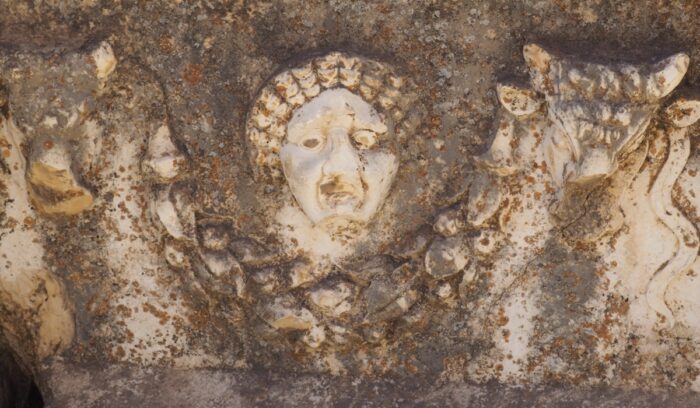
Sometime around 2900 C.E. B.C.E. — in the fertile stretch of land between two mountain ranges in what is now Lebanon — people were already building something remarkable. The site they chose, later known as Baalbek, sat in the heart of the Beqaa Valley, and the structures they raised there would outlast empires, religions, and civilizations that hadn’t yet been imagined.
Key findings
- Baalbek Phoenician city: By around 2900 B.C.E., Baalbek had developed into an organized Phoenician religious and civic center dedicated to the sky-god Baal and his consort Astarte — though human habitation at the site stretches back as far as 9000 B.C.E.
- Megalithic construction: The retaining wall monoliths at Baalbek weigh up to 300 tons each, and a single stone found nearby tips the scale at over 900 tons — the engineering methods behind their placement remain unexplained by modern scholars.
- UNESCO World Heritage Site: Baalbek’s surviving temples, including the Temple of Bacchus — larger than the Parthenon in Athens — are preserved today as a UNESCO World Heritage Site, drawing researchers and visitors from around the world.
A city shaped by sacred purpose
The name Baalbek translates roughly as “Lord Baal of the Beqaa Valley.” That name tells you everything about what this place meant to the people who built it. This was not primarily a trading post or a military stronghold. It was a pilgrimage site — a place where people came to stand before something larger than themselves.
At the center of the early city stood a grand temple dedicated to Baal and Astarte, the Queen of Heaven in Phoenician religion. The ruins of that original structure still lie beneath the later Roman Temple of Jupiter Baal, buried but not gone. Successive builders did not erase what came before — they built on top of it, sometimes literally using the ancient foundations as their own.
That layering tells a story about how the ancient world worked. Sacred sites accumulated meaning over time. A place where people had worshipped for generations carried weight that newcomers recognized and chose to inherit rather than discard.
Stones that still puzzle engineers
The most startling feature of early Baalbek is its scale. The cornerstones of the early temple weigh over 100 tons. The retaining wall monoliths weigh up to 300 tons each. And roughly one mile from the main site, a single quarried block weighs over 900 tons — among the largest stones ever worked by human hands anywhere on Earth.
How these stones were moved, positioned, and fitted remains an open question. Modern engineering can offer hypotheses — large teams, sledges, wooden rollers, earthen ramps — but no definitive reconstruction has been demonstrated at this scale. The honest answer is that we do not fully know.
What we do know is that this was human work. The “ancient alien” theories that have circulated about Baalbek have found no support in the archaeological or scientific literature. The more interesting and truthful story is that people in the ancient Levant had engineering knowledge and organizational capacity that we are still working to understand — and that that knowledge deserves our serious attention, not dismissal or mythologizing.
A crossroads for every empire
Baalbek’s location in the Beqaa Valley made it a natural waypoint for anyone moving through the Levant. Alexander the Great conquered it in 332 B.C.E. and renamed it Heliopolis — “City of the Sun.” Pompey the Great passed through in 64 B.C.E. when he annexed Phoenicia for Rome. By 15 B.C.E., it had become a Roman colonial city.
The Romans transformed the site dramatically. Under Emperor Septimius Severus, who reigned from 193 to 211 C.E., the Temple of Jupiter Baal was completed — the largest and most ornate religious building in the entire history of the Roman Empire. Its six remaining columns, still standing against the Beqaa sky, are among the most striking surviving fragments of the ancient world.
The Temple of Bacchus, also built during the Roman period, survives in even better condition. It is larger than the Parthenon and arguably better preserved. When Christianity was legalized under Constantine the Great in 313 C.E., the temples at Baalbek were not destroyed — they were converted into churches, which likely saved them.
Muslim Arab forces took control in 637 C.E., renaming the complex Al-Qalaa, meaning “the fortress.” The temples were fortified. A mosque was built among the Roman ruins. Christian additions were removed. Later, Byzantine forces sacked the city twice — in 748 C.E. and again in 975 C.E. — without managing to hold it. The Mongols came. The Ottomans came. Earthquakes came. Through all of it, the stones largely stood.
Lasting impact
Baalbek is not simply a ruin. It is a record — of Phoenician religious life, of Roman imperial ambition, of the way sacred places absorb and survive the passage of power. The site demonstrates that the ancient Levant was not a peripheral backwater but a center of civilization, trade, and spiritual life that drew the attention of every major power in the ancient Mediterranean world.
The architectural techniques at Baalbek influenced later Roman building throughout the empire. The religious traditions centered there — the worship of Baal and Astarte — are among the best-documented examples of Phoenician spiritual life, a culture whose contributions to the ancient world, including the development of the alphabet that underlies most modern writing systems, are still being fully appreciated.
Serious archaeological work at the site began only in 1898 C.E., when German Emperor Wilhelm II visited and dispatched a team of archaeologists. Later international teams continued excavation and preservation. That work is ongoing, and new finds continue to reshape our understanding of what Baalbek was — and when.
Blindspots and limits
The written record for Baalbek before the Greek and Roman periods is thin. Much of what we know about the Phoenician phase comes from archaeology rather than texts, which means significant aspects of daily life, social organization, and even the precise dating of early construction remain uncertain. The 2900 B.C.E. date associated with Baalbek’s development as a Phoenician center is a scholarly estimate, not a precisely documented founding — and the site was clearly inhabited for thousands of years before that phase began.
It is also worth acknowledging that the layers of conquest recorded at Baalbek came with real costs for the people living there. Each transition of power — Greek, Roman, Arab, Byzantine, Mongol — reshaped the site, and not always peacefully. The stones endured. The human experiences of those transitions were far more complicated.
Read more
For more on this story, see: World History Encyclopedia — Baalbek
For more from Good News for Humankind, see:
- Indigenous land rights: 160 million hectares recognized at COP30
- Ghana establishes a marine protected area at Cape Three Points
- The Good News for Humankind archive on Lebanon
About this article
- 🤖 This article is AI-generated, based on a framework created by Peter Schulte.
- 🌍 It aims to be inspirational but clear-eyed, accurate, and evidence-based, and grounded in care for the Earth, peace and belonging for all, and human evolution.
- 💬 Leave your notes and suggestions in the comments below — I will do my best to review and implement where appropriate.
- ✉️ One verified piece of good news, one insight from Antihero Project, every weekday morning. Subscribe free.
More Good News
-

Ghana declares its first marine protected area to rescue depleted fish stocks
Ghana’s marine protected area — the country’s first ever — marks a historic turning point for a nation gripped by a quiet fisheries crisis. Established near Cape Three Points in the Western Region, the protected zone restricts or bans fishing activity to allow severely depleted fish populations to recover. Ghana’s coastal stocks have fallen by an estimated 80 percent from historic levels, threatening food security and the livelihoods of millions of small-scale fishers. The declaration also carries regional significance, potentially inspiring neighboring Gulf of Guinea nations to establish coordinated protections of their own.
-

U.S. researchers cut Alzheimer’s risk by half in first-ever prevention trial
Alzheimer’s prevention may have reached a turning point after a landmark trial showed that removing amyloid plaques before symptoms appear can cut the risk of developing the disease by roughly 50%. Researchers at Washington University School of Medicine studied people with rare genetic mutations that make Alzheimer’s nearly inevitable, finding that early, aggressive treatment can genuinely alter the disease’s course. The results, published in The Lancet Neurology, mark the first time any intervention has shown potential to prevent Alzheimer’s from appearing at all, not merely slow its progression. That distinction matters enormously, since amyloid begins accumulating in the brain two…
-

Marie-Louise Eta becomes first female head coach in men’s top-five European leagues
Female head coach Marie-Louise Eta made history on April 11, 2026, when Union Berlin appointed her as interim head coach — becoming the first woman ever to hold a head coaching position in any of men’s top-five European leagues. The Bundesliga club made the move after dismissing Steffen Baumgart, with five matches remaining and real relegation stakes on the line. Eta, 34, had served as assistant coach since 2023 and was already a familiar, trusted presence within the squad. This was no ceremonial gesture — she was handed a survival fight, which is precisely what makes the milestone significant.