
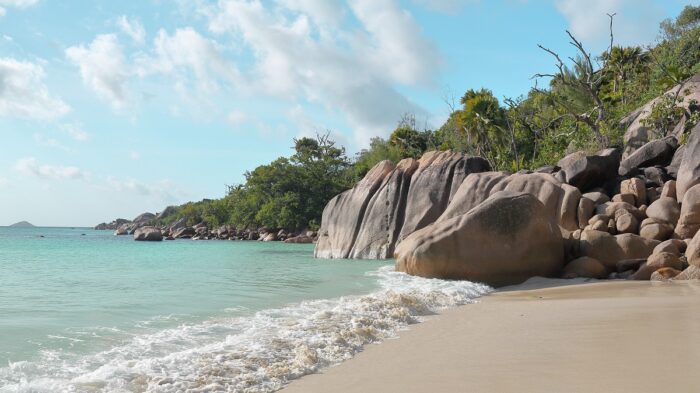
Sometime around 250 C.E., a group of Austronesian seafarers — almost certainly originating from Borneo — may have paused among a remote scatter of granite islands rising from the western Indian Ocean. No one built a fire that lasted. No one stayed. But if the hypothesis holds, they were the first human beings ever to see what we now call the Seychelles.
What the evidence suggests
- Austronesian seafarers: Linguistic, genetic, and archaeological evidence places Austronesian peoples — originating from Taiwan and later Borneo — as the dominant maritime culture crossing the Indian Ocean in the first millennium C.E., eventually settling Madagascar around this same period.
- Seychelles discovery: The Wikipedia-sourced historical record describes the pre-European history of Seychelles as “unknown,” but notes that Austronesians from Borneo “perhaps lingered here circa 200–300 C.E.” on their westward voyage — making this the earliest plausible human contact with the islands.
- Indian Ocean navigation: Arab traders were likely aware of the Seychelles for centuries before European contact, drawn partly by the coco de mer — a massive palm nut found only on these islands — whose hollow shells washed ashore as far away as the Maldives and Indonesia.
A voyage across the world’s third-largest ocean
To appreciate what this moment represents, consider the geography. The Seychelles sit roughly 1,500 kilometers east of the African coast and nearly 3,000 kilometers west of Borneo. There were no maps. There were no compasses in the modern sense. There was the sky, the swell, the color of the water, and the behavior of birds.
Austronesian seafarers were among the most accomplished navigators in human history. Beginning from Taiwan around 3,000 B.C.E. and spreading through the Philippines, Indonesia, and Borneo over millennia, they developed outrigger canoe technology and deep observational knowledge of ocean patterns that allowed them to colonize islands no other culture had reached. Their linguistic family — the Austronesian languages — became one of the most geographically widespread in the world, stretching from Madagascar to Easter Island.
The crossing to Madagascar, which these seafarers ultimately completed, is one of the most extraordinary migrations in the human story. Genetic studies have confirmed that the Malagasy people carry clear Austronesian ancestry, traceable to populations in Borneo. The Seychelles, positioned along the logical oceanic route, may have been a waypoint — or simply a place glimpsed and passed.
Reading the silence in the historical record
What makes this story compelling is also what makes it uncertain: there is almost no direct evidence. No Austronesian artifacts have been conclusively identified in the Seychelles from this period. The islands show no signs of permanent pre-European settlement. The historical record, as the source material frankly states, describes early Seychelles history as “unknown.”
This is not unusual for open-ocean islands. Archaeology in remote archipelagos is expensive, logistically difficult, and often hampered by the fact that temporary stops leave little behind. A group of sailors who anchored for water, rested, and moved on would leave almost nothing an excavator could find a thousand years later.
What we have instead is the logic of the route. Scholars of Austronesian expansion have long noted that island-hopping patterns in the Indian Ocean make the Seychelles a natural waypoint between Indonesia and Madagascar. The hypothesis is not a leap — it is a reasonable inference drawn from what we know about the seafarers’ capabilities, their destinations, and the geography of the ocean they crossed.
The coco de mer and the shape of knowledge
The Seychelles were not entirely invisible to the ancient world. Arab traders knew something was out there. They had to — the coco de mer, the extraordinary double-lobed palm nut that grows only on Praslin and Curieuse islands in the Seychelles, kept turning up far from home. Rotted husks floated across the Indian Ocean and washed ashore in the Maldives and on Indonesian beaches. The Royal Botanic Gardens at Kew notes that the coco de mer produces the largest seed of any plant on Earth — impossible to ignore, impossible to explain without knowing where it came from.
Arab navigators traded these nuts long before Europeans ever recorded the islands. This means knowledge of the Seychelles, however partial, circulated through Indian Ocean trading networks for centuries — a reminder that the history of “discovery” is almost always more layered than a single moment or a single people.
Lasting impact
The Austronesian crossing of the Indian Ocean stands as one of the great feats of human navigation. If these seafarers did pause at what we now call the Seychelles, that moment connects us to a chain of oceanic knowledge that shaped the cultures of Madagascar, the Comoros, and the East African coast. The Malagasy language, cuisine, and agricultural traditions all carry traces of this ancient Bornean origin.
More broadly, the Austronesian expansion — spanning more ocean than any other prehistoric migration — is part of what defines humanity as a species capable of reaching beyond the visible horizon. Every remote island that humans found and reached is evidence of that restless, collaborative intelligence.
The Seychelles themselves became a crossroads of cultures: French, British, African, Indian, and Malagasy peoples all left their marks on the islands and on the Seychellois Creole language and culture that emerged from that mixing. The possible Austronesian pause, if it happened, was the first thread in that long weaving.
Blindspots and limits
The honest answer is that we do not know. The “perhaps” in every description of this event is doing real historical work — this is a plausible hypothesis, not a confirmed discovery. No Austronesian material culture has been definitively dated to this period in the Seychelles, and the source material itself describes the pre-European history of the islands as unknown. Future underwater archaeology or improved aDNA techniques may one day settle the question; for now, it remains an educated and intriguing guess. It is also worth noting that Arab navigators were likely circling this knowledge independently, and their contribution to early Indian Ocean geography deserves its own scholarly attention.
Read more
For more on this story, see: History of Seychelles — Wikipedia
For more from Good News for Humankind, see:
- Ghana creates a new marine protected area at Cape Three Points
- Indigenous land rights: 160 million hectares recognized ahead of COP30
- The Good News for Humankind archive on the ancient world
About this article
- 🤖 This article is AI-generated, based on a framework created by Peter Schulte.
- 🌍 It aims to be inspirational but clear-eyed, accurate, and evidence-based, and grounded in care for the Earth, peace and belonging for all, and human evolution.
- 💬 Leave your notes and suggestions in the comments below — I will do my best to review and implement where appropriate.
- ✉️ One verified piece of good news, one insight from Antihero Project, every weekday morning. Subscribe free.
More Good News
-
Ghana declares its first marine protected area to rescue depleted fish stocks
Ghana’s marine protected area — the country’s first ever — marks a historic turning point for a nation gripped by a quiet fisheries crisis. Established near Cape Three Points in the Western Region, the protected zone restricts or bans fishing activity to allow severely depleted fish populations to recover. Ghana’s coastal stocks have fallen by an estimated 80 percent from historic levels, threatening food security and the livelihoods of millions of small-scale fishers. The declaration also carries regional significance, potentially inspiring neighboring Gulf of Guinea nations to establish coordinated protections of their own.
-

U.S. researchers cut Alzheimer’s risk by half in first-ever prevention trial
Alzheimer’s prevention may have reached a turning point after a landmark trial showed that removing amyloid plaques before symptoms appear can cut the risk of developing the disease by roughly 50%. Researchers at Washington University School of Medicine studied people with rare genetic mutations that make Alzheimer’s nearly inevitable, finding that early, aggressive treatment can genuinely alter the disease’s course. The results, published in The Lancet Neurology, mark the first time any intervention has shown potential to prevent Alzheimer’s from appearing at all, not merely slow its progression. That distinction matters enormously, since amyloid begins accumulating in the brain two…
-

Marie-Louise Eta becomes first female head coach in men’s top-five European leagues
Female head coach Marie-Louise Eta made history on April 11, 2026, when Union Berlin appointed her as interim head coach — becoming the first woman ever to hold a head coaching position in any of men’s top-five European leagues. The Bundesliga club made the move after dismissing Steffen Baumgart, with five matches remaining and real relegation stakes on the line. Eta, 34, had served as assistant coach since 2023 and was already a familiar, trusted presence within the squad. This was no ceremonial gesture — she was handed a survival fight, which is precisely what makes the milestone significant.
