
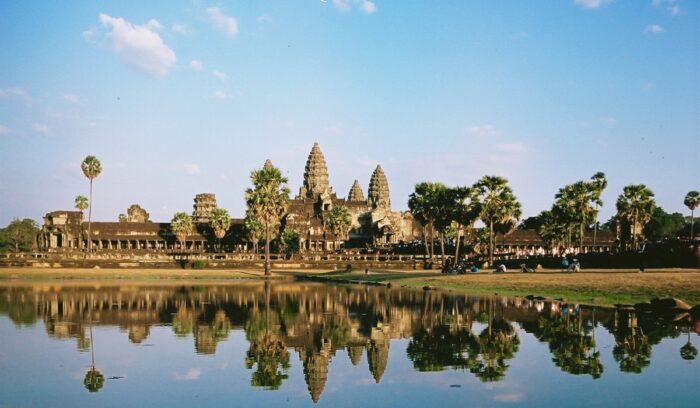
In the early 12th century C.E., workers by the tens of thousands broke ground on what would become the largest religious monument ever built. Rising from the plains of the Khmer Empire in what is now Cambodia, Angkor Wat construction would consume roughly three decades of labor, ingenuity, and devotion — producing a structure so precisely engineered that its axes align with the sun at the equinoxes, and so vast that it remains, nine centuries later, the world’s largest religious complex by land area.
Key facts
- Angkor Wat construction: Commissioned by Khmer King Suryavarman II around 1113 C.E., the temple complex covers roughly 400 acres, including its moat — and took an estimated 30 years to complete, requiring a workforce historians estimate in the tens of thousands.
- Sandstone sourcing: Builders quarried an estimated five to ten million blocks of sandstone from Phnom Kulen, a mountain range some 25 miles away, and floated them downriver on rafts — a logistical achievement that rivals any construction project of the ancient world.
- Hindu cosmology: The temple was designed as a physical model of Mount Meru, the sacred home of the gods in Hindu tradition, with its five towers representing the mountain’s five peaks and its surrounding moat symbolizing the cosmic ocean.
A kingdom at its height
The Khmer Empire in the early 12th century C.E. was one of the most powerful states in Southeast Asia, controlling territory across modern Cambodia, Thailand, Laos, and Vietnam. Suryavarman II came to power after defeating rival claimants, and Angkor Wat construction served both spiritual and political purposes — a dedication to the Hindu god Vishnu and a monument to royal legitimacy built on an almost incomprehensible scale.
The city of Angkor itself was already a thriving metropolis. Scholars now estimate that greater Angkor, at its peak, was home to somewhere between 700,000 and one million people — making it one of the largest pre-industrial urban centers on Earth. The temple did not appear in isolation; it emerged from a dense network of reservoirs, canals, roads, and satellite temples engineered over centuries.
The workforce that built Angkor Wat was drawn from across the empire. Inscriptions on the temple walls record the names of laborers, artisans, and overseers — an unusual act of documentation for the era, and a reminder that this structure was not raised by an abstraction called “the Khmer” but by specific, named human beings.
Engineering in stone and water
What makes Angkor Wat construction remarkable is not only its scale but its integration of landscape and hydrology. The complex includes a moat 570 feet wide and nearly three miles in circumference — fed by a sophisticated water management system that channeled runoff from the Kulen Hills. National Geographic’s coverage of Angkor has highlighted how this hydraulic infrastructure underpinned the empire’s agricultural productivity and, ultimately, its longevity.
The sandstone galleries stretch for nearly half a mile and are covered with some of the most elaborate bas-relief carving in the world — depicting scenes from the Hindu epics Ramayana and Mahabharata, as well as military campaigns and celestial dancers known as apsaras. Researchers have counted more than 1,700 apsara figures carved into the walls, each one slightly different.
Astronomical alignment was built into the design from the start. Smithsonian Magazine has documented how on the spring equinox, the sun rises directly over the central tower when viewed from the main entrance — a feat of planning that required precise knowledge of solar movement across multiple years of observation.
Knowledge systems behind the stones
The architects of Angkor Wat worked within a rich intellectual tradition. Khmer builders drew on Indian mathematical and astronomical texts transmitted through centuries of cultural exchange across the Bay of Bengal — knowledge systems that had been refined in Sanskrit universities, traded along maritime routes, and adapted by local scholars into distinctly Khmer forms.
This was not passive borrowing. Khmer engineers developed their own innovations in hydraulic engineering and stone-joinery techniques that had no direct Indian precedent. The dry-fit interlocking of massive sandstone blocks — assembled without mortar — reflects a mastery of structural mechanics that was, in its time, cutting-edge.
Oral traditions and inscriptions preserved in Sanskrit and Old Khmer provide fragmented but real windows into who these builders were. Many artisans came from hereditary craft guilds and were attached to temple estates, receiving land grants and food rations in exchange for their specialized labor.
Lasting impact
Angkor Wat outlasted the empire that built it. When Suryavarman II’s successors converted to Theravada Buddhism in the 13th century C.E., the temple transitioned from a Hindu royal shrine to a Buddhist monastery — a conversion that likely saved it from abandonment. Monks maintained it continuously for centuries, and when Portuguese explorers encountered it in the 16th century C.E., it was still an active religious site.
Today, Angkor Wat is the symbol on Cambodia’s national flag — the only building in the world to hold that distinction — and the anchor of a UNESCO World Heritage Site that draws more than two million visitors a year. UNESCO’s listing for Angkor describes it as “one of humanity’s most astonishing and enduring architectural achievements.”
The complex has also become a critical site for modern archaeology. Lidar surveys conducted since 2012 C.E. have revealed a vast, previously unmapped urban grid surrounding the temple — rewriting our understanding of how large and complex Angkor truly was. The city beneath the jungle continues to yield new information about urban planning, water management, and social organization in premodern Southeast Asia.
Blindspots and limits
The historical record of Angkor Wat construction is rich in stone inscriptions but nearly silent on the lives of ordinary workers — their conditions, their beliefs about the project, and whether participation was voluntary or coerced. The hydraulic system that made Angkor possible also contributed to its eventual decline: evidence suggests that overstretched water infrastructure and extended droughts in the 14th and 15th centuries C.E. destabilized the city, a cautionary note about the fragility of engineered environments. The temple’s post-colonial rediscovery was also shaped heavily by French archaeologists who made significant early contributions but also worked within assumptions that sometimes minimized the sophistication of Khmer intellectual traditions.
Read more
For more on this story, see: LiveScience — Angkor Wat
For more from Good News for Humankind, see:
- Inca builders complete Machu Picchu, a citadel of stone above the clouds
- Water buffalo domestication begins in the Indian subcontinent and Southeast Asia
- The Good News for Humankind archive on the medieval era
About this article
- 🤖 This article is AI-generated, based on a framework created by Peter Schulte.
- 🌍 It aims to be inspirational but clear-eyed, accurate, and evidence-based, and grounded in care for the Earth, peace and belonging for all, and human evolution.
- 💬 Leave your notes and suggestions in the comments below — I will do my best to review and implement where appropriate.
- ✉️ One verified piece of good news, one insight from Antihero Project, every weekday morning. Subscribe free.


