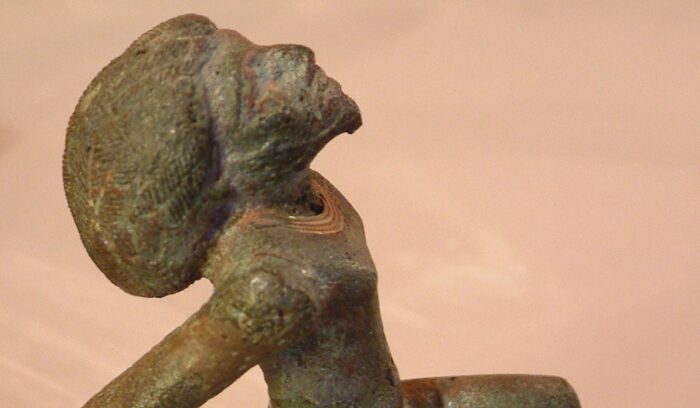
Long before Rome named them, long before the Arab conquests reshaped North Africa, the people who called themselves Amazigh — “free people” — were already there. Their cave paintings still mark the Saharan rock walls. Their language, their cosmology, their relationship with stone and sky: all of it took shape across millennia in the vast region stretching from the Atlantic coast to the Nile delta. Around 5000 B.C.E., as the Sahara began its long drying and hunter-gatherer societies adapted to a changing landscape, the cultural foundations of the Amazigh — known to outsiders as Berbers — were already ancient.
Key findings
- Amazigh origins: Proto-Berber peoples occupied the Maghreb from prehistoric times, with Saharan cave art providing some of the earliest evidence of their presence and cultural life.
- Afroasiatic language family: The ancient Berber languages belong to the same broad linguistic family as ancient Egyptian, Arabic, and Somali — pointing to a shared cultural and demographic ancestry stretching back thousands of years.
- Berber cosmology: The two foundational deities of Berber tradition — solar and lunar figures — closely parallel Egyptian religious forms, suggesting deep cross-cultural exchange along the North African corridor long before written records begin.
A world before the Sahara was a desert
The cave paintings scattered across Saharan rock faces tell a story that the desertification of North Africa nearly buried. Megafauna roam the walls — elephants, hippos, cattle — animals that require a wetter, greener world than exists there today. The people who made those images were not marginal figures scraping by on the edge of an inhospitable landscape. They were hunters, pastoralists, and observers of the sky living in one of Africa’s most resource-rich environments.
Around 5000 B.C.E., the Sahara’s long drying was accelerating. Societies that had spread across the green Sahara began shifting — some south toward the Sahel and the Niger River, some north toward the Mediterranean coast, some east toward the Nile. The Amazigh were among those who stayed, adapted, and built something durable in the Maghreb.
Their cosmology preserved this deep past. The veneration of the sun and moon — noted by the Greek historian Herodotus in the 5th century B.C.E. as universal among the Libyans — mirrors the basal religious forms of ancient Egypt. Scholars of proto-Afroasiatic cultures have traced these parallel traditions to a shared cultural center from which the ancestors of the Berbers, Egyptians, Kushites, and others gradually dispersed across northeastern Africa and the Near East.
Language, stone, and shared roots
The Amazigh spoke languages within the Afroasiatic family — a vast grouping that includes ancient Egyptian, Semitic languages such as Arabic and Aramaic, and the Cushitic languages of the Horn of Africa. This linguistic connection is more than academic. It maps the movement of peoples, the exchange of ideas, and the spread of agricultural and pastoral technologies across a region that, in earlier millennia, was far more ecologically hospitable than it is today.
Stone held particular importance in Amazigh spiritual life. The Berbers buried their dead beneath rock outcroppings and erected stone monuments, a tradition with striking parallels to Nabataean and Arabian practices. The Royal Mausoleum of Mauritania — built in the Roman era by Berber kings in traditional style — still stands today, a monument to how persistently the old forms endured even as political powers around them shifted.
By the 3rd century B.C.E., the Amazigh had developed their own script, the Tifinagh alphabet, drawing on Phoenician influences. A modified version of Tifinagh is still used by Tuareg communities across the Sahara — one of the longest continuously used writing systems in Africa.
From pastoralism to kingdoms
For millennia, Amazigh societies were semi-nomadic and tribal, organized around pastoralism and, over time, trade. Contact with Egypt brought agricultural techniques northward and westward. By the 9th century B.C.E., when Phoenician traders established Carthage on the Tunisian peninsula, larger Berber groups had already made the shift from mobile pastoralism to sedentary agricultural communities.
The Phoenicians found in the Amazigh exactly what they needed: skilled trading partners who knew the land and its routes. Out of this contact grew the two most prominent Libyan kingdoms — Numidia and Mauretania. The Numidians were renowned for their cavalry and became a decisive military force in the ancient Mediterranean world. The Mauri, whose name would eventually give rise to the term Moors, controlled trade routes to the west.
Numidia’s most celebrated king, Massinissa, ruled from 238 to 148 B.C.E. and transformed the kingdom into a sedentary, agriculturally sophisticated state with deep ties to the Roman Republic. Under his rule and those who followed, Berber society urbanized, traded across the Mediterranean, and produced literature, philosophy, and architecture. The Christian theologian Augustine of Hippo, one of the most influential thinkers in Western history, was of Berber descent.
Lasting impact
The Amazigh cultural tradition is among the longest continuous cultural presences in North Africa — and arguably in the world. The linguistic, cosmological, and material culture they developed across thousands of years fed into the broader currents of Mediterranean and African history in ways that are still being traced by archaeologists and linguists.
Their agricultural and pastoral knowledge helped sustain Carthage and, later, Rome’s North African grain supply. Their horsemanship shaped the outcome of the Punic Wars. Their stone-building traditions, their veneration practices, and their sky-oriented cosmology left fingerprints on the religious and architectural forms of communities stretching from the Atlas Mountains to the Arabian Peninsula.
Today, an estimated 30 to 40 million people across North Africa and the diaspora identify as Amazigh. Morocco and Algeria have both granted official recognition to Tamazight, the modern Berber language. The Tifinagh script is taught in Moroccan schools. What was suppressed for centuries is, in measured but meaningful ways, returning to public life.
Blindspots and limits
The historical record of early Amazigh culture is fragmentary and filtered almost entirely through outsider sources — Egyptian hieroglyphs, Greek histories, Roman ethnographies — written by people who often regarded the Berbers as subordinate or hostile. The word “Berber” itself derives from the Latin barbarus, a term Roman writers used to mark people they considered outside civilized norms. The Amazigh called themselves something very different. How they understood their own history, cosmology, and social organization in their own words remains only partially recoverable. The desertification of the Sahara also destroyed or buried much of the archaeological record that might clarify early dates and migration routes.
Read more
For more on this story, see: World History Encyclopedia — The Berbers
For more from Good News for Humankind, see:
- Indigenous land rights secure 160 million hectares at COP30
- Ghana establishes marine protected area at Cape Three Points
- The Good News for Humankind archive on prehistory
About this article
- 🤖 This article is AI-generated, based on a framework created by Peter Schulte.
- 🌍 It aims to be inspirational but clear-eyed, accurate, and evidence-based, and grounded in care for the Earth, peace and belonging for all, and human evolution.
- 💬 Leave your notes and suggestions in the comments below — I will do my best to review and implement where appropriate.
- ✉️ One verified piece of good news, one insight from Antihero Project, every weekday morning. Subscribe free.