Around 900 B.C.E., people began to build and settle on a low-lying coastal plain in what is now northern Belize. They could not have known their home would one day grow into one of the most important cities in the ancient Maya world — a place whose iconic pyramid would eventually become the face of a nation’s most popular beer, and whose royal tombs would reveal connections stretching thousands of miles across the Americas.
What the evidence shows
- Altun Ha settlement: The oldest known structures at the site, two round platforms in Zone C designated C13 and C17, date to approximately 900–800 B.C.E., marking the beginning of continuous occupation that lasted nearly 2,000 years.
- Maya ceremonial architecture: Structure C13, one of the earliest buildings, contained postholes and elite burials, indicating that religious activity and social hierarchy were present from the very beginning of the settlement.
- Belize archaeological record: The site was not formally identified by archaeologists until 1963 C.E., when quarrying activity by local villagers uncovered an elaborately carved jade pendant, prompting a reconnaissance trip that led to extensive excavations from 1964 C.E. through 1970 C.E.
A city grows from the swamp
The land at Altun Ha was not obviously hospitable. The ancient site sat on a dry tropical coastal plain that was heavily swampy during its pre-Columbian occupation, with few reliable water sources. The people who built there solved this problem deliberately — constructing reservoirs, aguadas, and at least two raised causeways to cross impassable wetland terrain.
The site’s name offers a clue to how central water was to daily life. In Yucatec Mayan, haltun refers to a stone water cistern, and ha means water. The Belize Institute of Archaeology translates “Altun Ha” as “Rockstone Water” — a name derived from the nearby modern village of Rockstone Pond, itself named for the ancient stone ruins locals had long lived alongside.
The city eventually covered roughly 8 square kilometers (about 3.1 square miles), organized around a central precinct of two major plazas — Group A and Group B — surrounded by suburban zones extending outward. No stone stelae have been found at the site, which sets Altun Ha apart from many other Maya cities and suggests its ceremonial traditions followed a distinct local pattern.
Trade networks and a connected ancient world
What makes Altun Ha remarkable is not just its age, but the reach of its connections. During the Early Classic period, a tomb in Structure F8 contained nearly 250 pieces of green obsidian from Pachuca, in central Mexico — a material strongly associated with the great city of Teotihuacan, more than 1,000 kilometers away. Alongside the obsidian were ceramic vessels, jade, Spondylus shell, and puma and dog teeth. The combination points to a deliberate symbolic relationship with Teotihuacan, whether through direct diplomacy, trade, or shared ideology.
The connections did not stop at central Mexico. A ceremonial deposit dated to around 500 C.E. contained a small gold-copper alloy bead representing a jaguar claw — a material and style nearly identical to objects produced by the Coclé culture of central Panama. For decades, scholars believed gold did not enter the Maya world until the Postclassic period. This deposit pushed that timeline back by centuries and demonstrated that long-distance trade networks in the ancient Americas were far more sophisticated and far-reaching than previously understood.
Over 800 pieces of jade have been recovered at Altun Ha, more than 60 of them carved. Jade held deep cosmological significance throughout Mesoamerica, associated with life, fertility, and royal power. Its abundance at Altun Ha signals the city’s status as both a political center and a node in a broader network of exchange.
The Sun God’s Tomb and what it tells us
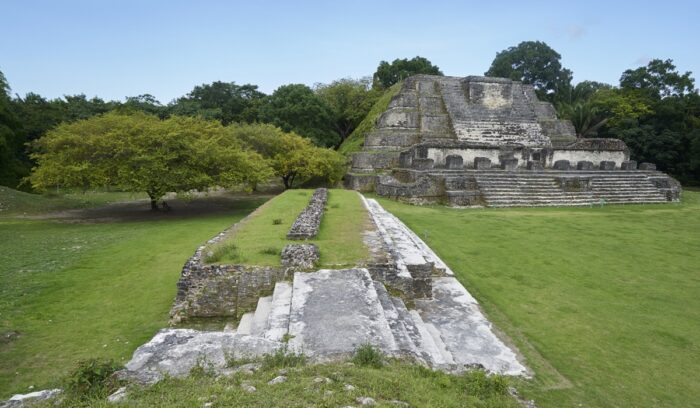
The most celebrated find at Altun Ha came in 1968 C.E., during excavations of Structure B-4 — the Temple of the Masonry Altars, a 16-meter pyramid that still anchors the site today. Excavators working through the seventh phase of the structure’s construction uncovered what they called “The Sun God’s Tomb,” dated to approximately 600–650 C.E.
Inside was a large carved jade head representing Kinich Ahau, the Maya sun god — the largest carved jade object ever found in the Maya world. At roughly 4.4 kilograms, it remains one of the most significant single artifacts ever recovered from a Maya archaeological site. Its craftsmanship and scale suggest a level of artistic and political power that had been quietly accumulating at Altun Ha for well over a millennium by the time it was made.
Lasting impact
The early settlement of Altun Ha set in motion nearly 2,000 years of continuous urban development — from a small ceremonial clearing in a swamp to a city that traded with Panama, exchanged symbols with Teotihuacan, and produced some of the finest jade carving in the ancient world. When the city declined after 900 C.E., the stones of its buildings were quietly repurposed by later villagers, who built homes from the rubble of temples without necessarily knowing — or needing to know — what they were dismantling.
Altun Ha’s legacy endures in unexpected ways. The Temple of the Masonry Altars appears on every bottle of Belikin beer, Belize’s most popular brand — a quiet reminder that this ancient city is still very much part of the country’s living identity. The site is now a protected archaeological zone and one of Belize’s most-visited heritage destinations, connecting a young nation to one of the most complex civilizations the Western Hemisphere has produced.
The archaeological record at Altun Ha has also reshaped scholarly understanding of ancient Maya trade — demonstrating that coastal lowland cities were not isolated backwaters but active participants in hemispheric exchange networks that spanned thousands of kilometers.
Blindspots and limits
The written record of Altun Ha is limited by what archaeology can recover. The site contains no stelae, so there are no royal name sequences, no recorded dynastic histories, and no dates inscribed in the Maya Long Count — leaving much of the city’s political history invisible. The communities who lived at and around the site after its Classic period peak, and those who quarried its stones for centuries before archaeologists arrived, have left little documentation of their own relationship to this place. What survives is necessarily a partial picture, shaped as much by what was preserved and excavated as by what actually happened.
Read more
For more on this story, see: Wikipedia — Altun Ha
For more from Good News for Humankind, see:
- Indigenous land rights recognition reaches a new milestone at COP30
- Ghana establishes a major new marine protected area at Cape Three Points
- The Good News for Humankind archive on prehistory
About this article
- 🤖 This article is AI-generated, based on a framework created by Peter Schulte.
- 🌍 It aims to be inspirational but clear-eyed, accurate, and evidence-based, and grounded in care for the Earth, peace and belonging for all, and human evolution.
- 💬 Leave your notes and suggestions in the comments below — I will do my best to review and implement where appropriate.
- ✉️ One verified piece of good news, one insight from Antihero Project, every weekday morning. Subscribe free.
More Good News
-

Ghana declares its first marine protected area to rescue depleted fish stocks
Ghana’s marine protected area — the country’s first ever — marks a historic turning point for a nation gripped by a quiet fisheries crisis. Established near Cape Three Points in the Western Region, the protected zone restricts or bans fishing activity to allow severely depleted fish populations to recover. Ghana’s coastal stocks have fallen by an estimated 80 percent from historic levels, threatening food security and the livelihoods of millions of small-scale fishers. The declaration also carries regional significance, potentially inspiring neighboring Gulf of Guinea nations to establish coordinated protections of their own.
-

U.S. researchers cut Alzheimer’s risk by half in first-ever prevention trial
Alzheimer’s prevention may have reached a turning point after a landmark trial showed that removing amyloid plaques before symptoms appear can cut the risk of developing the disease by roughly 50%. Researchers at Washington University School of Medicine studied people with rare genetic mutations that make Alzheimer’s nearly inevitable, finding that early, aggressive treatment can genuinely alter the disease’s course. The results, published in The Lancet Neurology, mark the first time any intervention has shown potential to prevent Alzheimer’s from appearing at all, not merely slow its progression. That distinction matters enormously, since amyloid begins accumulating in the brain two…
-

Marie-Louise Eta becomes first female head coach in men’s top-five European leagues
Female head coach Marie-Louise Eta made history on April 11, 2026, when Union Berlin appointed her as interim head coach — becoming the first woman ever to hold a head coaching position in any of men’s top-five European leagues. The Bundesliga club made the move after dismissing Steffen Baumgart, with five matches remaining and real relegation stakes on the line. Eta, 34, had served as assistant coach since 2023 and was already a familiar, trusted presence within the squad. This was no ceremonial gesture — she was handed a survival fight, which is precisely what makes the milestone significant.