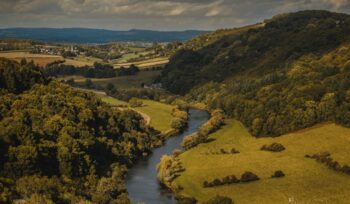
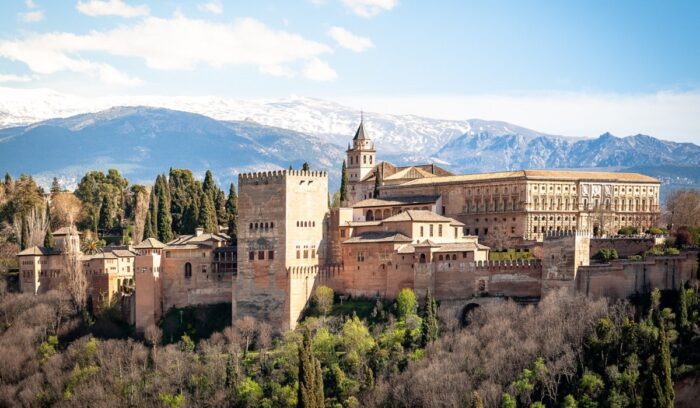
High on the Sabika hill above Granada, a small reddish castle watched over a fractured landscape. The year was 889 C.E., and the Iberian Peninsula was alive with conflict between Arab rulers and the Muladi population — Iberians who had converted to Islam. Amid that turmoil, a poet shot an arrow over the ramparts of a reddish-walled fortress, and the lines tied to that arrow gave the world its first written record of a place that would one day become one of the most celebrated buildings on Earth.
What the evidence shows
- Qal’at al-Ḥamrā: The Arabic name, meaning “the red fortress,” appears in poetry recorded by the historian Ibn Hayyan (d. 1076 C.E.), attached to an arrow fired over its walls during conflicts of the late 9th century C.E.
- Sabika hill fortress: The structure referenced in 889 C.E. was modest — described in surviving documents as small, with walls not capable of stopping a determined army. It likely had earlier Visigothic origins on the same outcrop.
- Nasrid Alhambra: The palace complex recognized today was not begun until 1238 C.E., when Muhammad I Ibn al-Ahmar, founder of the Emirate of Granada, broke ground on what would become the last great monument of Islamic rule in Iberia.
A fortress born from conflict
The 9th century C.E. in al-Andalus was not a time of settled dynasties. The collapse of central authority under the Umayyad emirs created space for local strongholds, tribal competition, and shifting alliances. It was in that environment that Qal’at al-Ḥamrā first appears in the written record — not as a monument to power, but as a modest hilltop position during the reign of ‘Abdallah ibn Muhammad (r. 888–912 C.E.).
The reddish color that gave the fortress its name came from the iron oxide in local clay used in its rammed-earth walls. This was practical construction, not decorative ambition. The hill had likely been fortified before, possibly during the Visigothic period, and archaeologists have found ancient foundations beneath what would later become one of the most studied architectural sites in the world.
What makes this first mention remarkable is how little the original builders could have imagined what their hilltop would become. A poet’s taunt fired over the walls of a small castle would eventually point toward a place that drew Washington Irving in the 19th century C.E. and millions of visitors every year today.
The long road to the Alhambra we know
Between that arrow in 889 C.E. and the palace complex that now draws over two million visitors annually, centuries of history unfolded on the Sabika hill. In the early 11th century C.E., the Zirid dynasty — a Sanhaja Berber group from North Africa — built their own citadel nearby, and the Jewish administrator Samuel ha-Nagid reportedly built a palace on the hill itself, complete with gardens and water features. Nothing of that palace survives.
The Almohads and Almoravids each swept through al-Andalus in the intervening centuries. It was only after the collapse of Almohad rule after 1228 C.E. that Muhammad I Ibn al-Ahmar founded the Nasrid dynasty and began the construction that would define the site. The Nasrid rulers built the Alhambra as a self-contained royal city — complete with a Friday mosque, hammams, workshops, a tannery, and a sophisticated water supply system drawing from the Darro River.
The defining royal palaces — the Comares Palace and the Palace of the Lions, now a UNESCO World Heritage Site — took their final form during the 14th century C.E. under Yusuf I and Muhammad V. The geometric tilework, carved stucco, muqarnas vaulted ceilings, and courtyard fountains that travelers recognize today came from that era, not from the modest red fortress of 889 C.E.
Why this first mention matters
The significance of 889 C.E. is not architectural. It is a reminder that great human achievements rarely spring fully formed into existence. They accumulate — layer by layer, ruler by ruler, century by century — on foundations that were often unremarkable at the time.
The Alhambra is now understood as the only well-preserved palace from the medieval Islamic world. Its architecture reflects a tradition of Moorish design that synthesized knowledge, craft, and aesthetic philosophy across North Africa, the Middle East, and Iberia over centuries. Scholars continue to study its geometric patterns, which encode mathematical principles that were at the frontier of human knowledge in the 14th century C.E.
The cross-cultural story of the Alhambra is often underappreciated. Before the Nasrids, Jewish, Berber, Arab, and Iberian communities all left traces on the Sabika hill. After 1492 C.E., the Catholic monarchs Ferdinand and Isabella used the site as their royal court, and Christopher Columbus received endorsement for his westward expedition there. Charles V later added a Renaissance palace directly beside the Nasrid structures. The hill absorbed all of it.
Lasting impact
The Alhambra’s influence on architecture, art, and design extended far beyond Iberia. Its geometric patterns became a reference point for 19th- and 20th-century designers working across Europe and the Americas. M.C. Escher visited in 1936 C.E. and credited his study of its tessellating patterns with transforming his entire artistic approach. Islamic architectural principles of courtyard design, water as reflective element, and interior-focused decoration have continued to influence building traditions globally.
Washington Irving’s Tales of the Alhambra (1832 C.E.), written while he lived in the palace itself, introduced the site to an English-speaking world and helped spark serious scholarly and preservation interest. That attention led to the first modern scientific study of an Islamic monument and to ongoing restoration work that has protected the site into the present day.
Blindspots and limits
The written record of the Alhambra’s earliest centuries is thin, and most of what we know about the 9th and 10th century C.E. structures comes from fragments, later chronicles, and archaeology still in progress. The original Arabic names of most Nasrid-era buildings have been lost; many names used today were invented by 19th-century European romantics. The post-1492 C.E. history of the site also involved the displacement and eventual expulsion of Granada’s Muslim and Jewish communities — a cost that the palace’s beauty does not erase.
Read more
For more on this story, see: Alhambra — Wikipedia
For more from Good News for Humankind, see:
- Ghana establishes a marine protected area at Cape Three Points
- Indigenous land rights: 160 million hectares recognized ahead of COP30
- The Good News for Humankind archive on the medieval era
About this article
- 🤖 This article is AI-generated, based on a framework created by Peter Schulte.
- 🌍 It aims to be inspirational but clear-eyed, accurate, and evidence-based, and grounded in care for the Earth, peace and belonging for all, and human evolution.
- 💬 Leave your notes and suggestions in the comments below — I will do my best to review and implement where appropriate.
- ✉️ One verified piece of good news, one insight from Antihero Project, every weekday morning. Subscribe free.