Science & academia

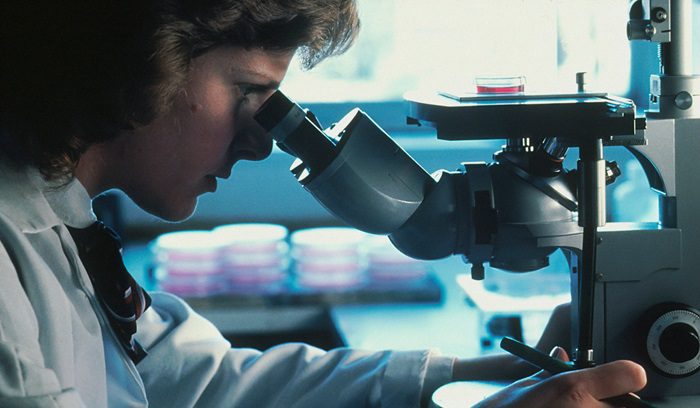
Medical researcher in a lab examining vials related to asthma and COPD treatment and mRNA vaccine development

Injection beats steroids for asthma and COPD attacks in first major advance in 50 years

Asthma and COPD treatment may be on the verge of its biggest advance in 50 years, after a clinical trial found that a single injection of benralizumab outperformed standard steroid tablets for treating acute attacks. The study, published in Lancet Respiratory Medicine, showed four times fewer treatment failures at three months and 30% fewer follow-up interventions among patients receiving the injection. The trial targeted eosinophilic flare-ups, the biological subtype behind roughly half of all asthma attacks and nearly a third of COPD episodes. Together, the two conditions kill an estimated 3.8 million people annually, yet the standard of care has remained largely unchanged since the 1970s.

Ovarian and Cervical Cancer Awareness. a Teal Ribbon

Cervical cancer deaths are plummeting among young U.S. women

Every year, thousands of American women die of cervical cancer. However, from 1992 to 2015, the number of deaths due to cervical cancer among U.S. women under the age of 25 fell steadily from each three-year period to the next, dropping roughly 75% altogether over that span. The sharp decline in cervical cancer deaths is likely due, at least in part, to the widespread introduction of the HPV vaccine in 2006.

MIT building

MIT will make tuition free for families earning less than $200,000 a year

Families making under $100,000 will not have to pay housing, dining or other fees, and they’ll have an allowance for books and other personal expenses. Families who make Families of students at the Massachusetts Institute of Technology (MIT) making under $100,000 will not have to pay housing, dining, or other fees, and they’ll have an allowance for books and other personal expenses. Families who make more than $200,000 a year can still receive need-based financial aid. Tuition for the 2024-2025 academic year at MIT is nearly $62,000. Housing, dining, and other fees can add up to another $24,000 annually, making it an enormous burden for families or forcing students to go into decades of debt.

Breakthrough genomic test identifies virtually any infection in one go

Researchers at University of California San Francisco (UCSF) have developed a single genomic test that can quickly detect virtually any kind of pathogen in a patient. This allows for much quicker diagnoses, enables targeted treatment to begin sooner, and could lower healthcare costs. Over the course of 7 years, researchers led by UCSF professor Charles Chiu tested 4,828 patients’ samples with its clinical mNGS method. The mNGS test accurately identified 86% of neurological infections.

Close-up of a human eye with clear cornea, for an article about stem-cell cornea transplant research in Japan

Japanese researchers restore sight with stem-cell cornea transplants in a world first

Stem-cell cornea transplants have been successfully performed on human patients for the first time, with Japanese surgeons using reprogrammed induced pluripotent stem cells to restore vision in three of four participants — results that held for more than a year. Published in The Lancet in 2024, the trial offers a potential path around the global shortage of donor corneal tissue, which currently leaves millions without treatment options. Corneal disease is among the leading causes of blindness worldwide, making a scalable alternative to donor transplants significant. While the trial was small, a 75% sustained success rate in a first-in-human study is a meaningful early result.

Landmine

Groundbreaking laser tech enables faster, safer landmine detection

Researchers at the University of Mississippi have come up with a faster, more efficient method for detecting landmines – millions of which pose a lethal threat to people in war-ravaged countries all over the world. That could spell a safer future for people who live in 70 current and former war-torn countries around the world that are riddled with an estimated 110 million active landmines. These explosives caused 2,793 deaths globally in 2017, and that number tragically rose to 4,710 in 2022.

Wooden satellite

World’s first wooden satellite, developed in Japan, heads to space

LignoSat, developed by Kyoto University and homebuilder Sumitomo Forestry, opens new tab, will be flown to the International Space Station on a SpaceX mission, and later released into orbit about 250 miles above the Earth. Named after the Latin word for “wood”, the palm-sized LignoSat is tasked to demonstrate the cosmic potential of the renewable material as humans explore living in space. Decommissioned satellites must re-enter the atmosphere to avoid becoming space debris. Conventional metal satellites create aluminum oxide particles during re-entry, but wooden ones would just burn up with less pollution.

Salmon run

Salmon return to Klamath River for first time in 112 years

On October 16, biologists with the Oregon Department of Fish and Wildlife spotted the fish above the former site of the J.C. Boyle Dam in the Upper Klamath River. The dam was one of four that had blocked the salmon’s migration between the Klamath Basin and the Pacific Ocean. Each of those dams was recently deconstructed in the largest dam removal project in United States history, which has restored the river to its natural, free-flowing state.

Holding turmeric-like substance in front of Berkeley's Campanile

U.C. Berkeley researchers use turmeric-like powder to ‘clean the air entirely’ of carbon dioxide

New research from U.C. Berkeley, published in Nature, points to a new material – a bright yellow powder that resembles turmeric – that could help rid the air all around us of CO2. The scientists say that just 200 grams of the material can absorb up to 20 kilograms of carbon in a year – which is approximately the same absorption potential as a tree. The substance could be easily integrated into carbon capture systems already deployed to remove CO2 from refinery emissions or to capture atmospheric carbon and store it underground.

Blood cells under microscope

Danish scientists design new form of insulin that automatically switches itself on and off

For decades, researchers have been working to develop a system that can automatically adjust insulin activity based on the amount of glucose in a person’s blood. Now, Rita Slaaby, a principal scientist at pharmaceutical company Novo Nordisk in Bagsværd, Denmark, and her colleagues engineered an insulin molecule with a switch that turns its activity on and off in response to glucose levels in the blood. In animals, this ‘smart’ insulin reduces high blood-sugar concentrations effectively while preventing levels from dropping too low.