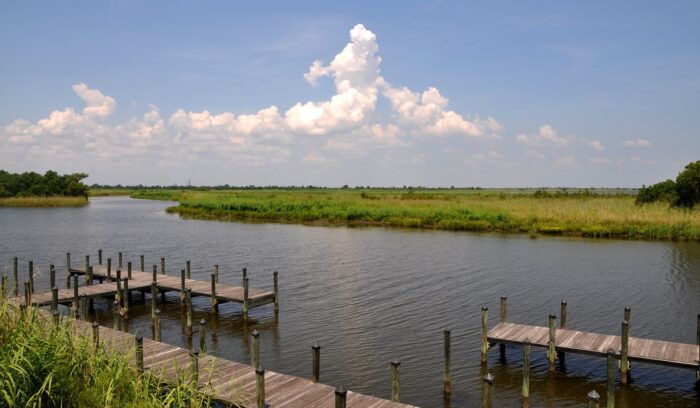
A $15 million conservation purchase has permanently protected nearly 8,000 acres at the heart of the Mobile-Tensaw Delta in Clarke County, Alabama — one of the most biodiverse freshwater ecosystems on the planet. The Nature Conservancy in Alabama closed the deal in January 2024 C.E., securing a stretch of swamps, streams, and oxbow lakes that scientists say rivals the biodiversity of any ecosystem on Earth.
At a glance
- Mobile-Tensaw Delta: The protected tract sits at the head of the delta, where the Alabama and Tombigbee Rivers flow side by side before merging — a region so species-rich it is often called America’s Amazon.
- Holdfast Collective: Patagonia’s nonprofit shareholder contributed $5.2 million — its largest single gift to date — alongside a $3 million commitment from The Nature Conservancy and a $10 million anonymous revolving loan fund.
- Wildlife corridor: The acquisition anchors a long-term strategy to link the Gulf of Mexico to the Appalachian Mountains through a continuous protected corridor running the length of Alabama.
Why this place is extraordinary
The Mobile-Tensaw Delta is not a household name, but among biologists it has long been spoken of in the same breath as the world’s great wild places. The late Harvard professor and two-time Pulitzer Prize winner E.O. Wilson, who grew up in and around Mobile, spent decades championing the delta as one of North America’s richest biological treasures.
Mitch Reid, state director for The Nature Conservancy in Alabama, put it bluntly: “There’s always been this sort of moniker that the Mobile Delta is North America’s Amazon. Well, if you look at the biodiversity of the Mobile Delta, it really should be the Amazon is South America’s Mobile.”
The numbers support that claim. The delta hosts an exceptional number of fish, reptile, amphibian, bird, plant, and mammal species — many of them found nowhere else. The specific tract now protected, known as the Land Between the Rivers, encompasses the area where the Alabama and Tombigbee Rivers run parallel before joining the broader delta system. Its ox-bow lakes, swamp forests, and interconnected streams create the habitat complexity that drives extreme biodiversity.
How the deal came together
The purchase required creative financing. The Holdfast Collective — a nonprofit that owns 98% of Patagonia’s stock and directs the company’s profits toward environmental causes — provided $5.2 million. The Nature Conservancy committed $3 million directly. An anonymous donor contributed $10 million into a revolving loan fund structured so that, as the loans are repaid, the proceeds flow into future conservation purchases across the Southeast.
The previous landowners chose to sell to a conservation buyer rather than allow the tract to be clear-cut for timber or broken into smaller parcels. Reid said that decision mattered as much as the money. “If a piece of land like this were sold off and clear-cut, which we understand was an option, that would have been a travesty,” he said. Clear-cutting would have released enormous stores of carbon, triggered sedimentation, and likely eliminated habitat for turtles, migratory birds, and dozens of fish species.
Greg Curtis, executive director of the Holdfast Collective, called Alabama a priority for the organization’s global conservation work. “The Holdfast Collective sees Alabama, and the Land Between the Rivers, as a landscape that is as critical to protect as our other priority areas around the globe,” he said.
A corridor taking shape
This purchase does not stand alone. In the two years before it closed, The Conservation Fund secured 23,000 acres in Alabama’s Red Hills region, protecting habitat for the endangered Red Hills salamander and dozens of other species. Together, the two acquisitions form cornerstones of a much larger vision: a wildlife corridor running from the Gulf of Mexico north through Clarke County, up through the Red Hills, along the Alabama River, and into the Talladega Mountains.
Reid described E.O. Wilson’s legacy as the intellectual foundation for that vision. Wilson’s research on species connectivity — the idea that wildlife populations need linked habitat to survive and adapt — gave conservationists the scientific framework to argue for landscape-scale protection rather than isolated reserves. His advocacy also helped attract major donors to a state that rarely dominates conservation headlines.
“It’s not going to be 10 years, it may not be 50 years, but eventually I think this strategy is going to play out,” Reid said.
The protected land will remain accessible to the public, and a hunting club already operating on the property will continue. The Nature Conservancy has not yet finalized the long-term management structure, which means questions about full public access and stewardship still need to be worked out — a reminder that securing land is only the first step in conservation.
What is already certain: nearly 8,000 acres of one of Earth’s most biodiverse places will not be logged, drained, or subdivided. The rivers will keep running through intact forest, the oxbow lakes will keep filling with turtles and herons, and the delta will keep doing what it has done for thousands of years — quietly sustaining an extraordinary community of life.
Read more
For more on this story, see: AL.com
For more from Good News for Humankind, see:
- Ghana creates a new marine protected area at Cape Three Points
- Indigenous land rights recognized for 160 million hectares ahead of COP30
- The Good News for Humankind archive on conservation
About this article
- 🤖 This article is AI-generated, based on a framework created by Peter Schulte.
- 🌍 It aims to be inspirational but clear-eyed, accurate, and evidence-based, and grounded in care for the Earth, peace and belonging for all, and human evolution.
- 💬 Leave your notes and suggestions in the comments below — I will do my best to review and implement where appropriate.
- ✉️ One verified piece of good news, one insight from Antihero Project, every weekday morning. Subscribe free.