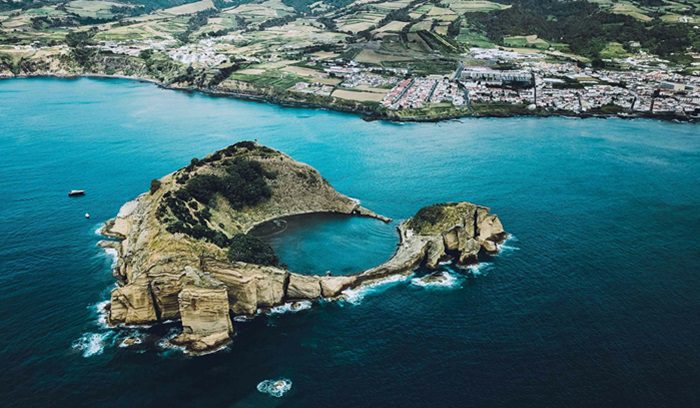
Nine volcanic islands rising from the middle of the North Atlantic, roughly 1,400 kilometers west of Lisbon — the Azores were long assumed to have been empty until Portuguese sailors arrived in the 15th century C.E. Then sediment cores told a different story. Buried in lake mud on the islands, scientists found biological and botanical traces of human activity dating to at least 700 C.E. — more than seven centuries before Portugal’s official claim.
What the evidence shows
- Pre-Portuguese Azores settlement: Researchers detected 5-beta-stigmasterol — a compound found in livestock feces — in sediment layers dated to between 700 and 850 C.E., indicating that domesticated animals such as sheep or cattle were present on the islands long before Portuguese colonization.
- Land clearance: Alongside the fecal biomarker, the same sediment layers contain evidence of fire-based land clearing and deposits of non-native ryegrass, suggesting deliberate agricultural or pastoral activity rather than accidental contact.
- Viking hypothesis: Mice on the Azores carry mitochondrial DNA consistent with Northern European origin, pointing toward Norwegian Vikings as one possible group of early arrivals — though researchers caution that Scandinavian mice could also have reached the islands aboard Iberian trading vessels.
An archipelago at the crossroads of Atlantic legend
Long before any confirmed landing, the Azores occupied a vivid place in the European and Mediterranean imagination. Greek poets wrote of the Fortunate Isles somewhere in the western sea. Irish monks recorded missionary voyages deep into the Atlantic in their immrama — sailing tales that mixed geography with myth. Norse sagas described island-hopping journeys across cold northern waters. Medieval Andalusian Arab geographers contributed their own accounts, including the 9th-century navigator Khashkhash of Cordoba and the 12th-century story of eight Maghurin, or Wanderers, from Lisbon.
These traditions — Greek, Irish, Norse, Arab, and Iberian — cross-pollinated over centuries, producing a rich shared mythology of Atlantic islands. That mythology, it now appears, may have had more basis in reality than scholars once assumed.
The Azores began appearing on European portolan charts in the 14th century C.E., most notably the Medici Atlas of 1351 C.E. and the Catalan Atlas of 1375 C.E. — both of which name islands in configurations that match the Azorean archipelago with reasonable accuracy. These maps predate Portugal’s official discovery by roughly a century, and their source remains unexplained.
The case for early human presence
The sediment research published around 2010–2011 C.E. built on something archaeologists had already begun to notice. Structures carved into embankments — possible burial sites known as hypogea — were found on the islands of Corvo, Santa Maria, and Terceira. Their age and origin remain under investigation.
The biomarker evidence is harder to dismiss. The presence of 5-beta-stigmasterol in layered sediments is a well-established proxy for the presence of grazing animals — and neither sheep nor cattle are native to the Azores. Someone brought them. The fires and the non-native grass in the same layers reinforce the picture: these were not accidental visitors leaving no trace, but people who cleared land and kept livestock.
The Viking angle is the most speculative piece of the puzzle. Mouse genetics offer a clue — but as geographer Simon Connor notes, trade routes between Scandinavia and the Iberian Peninsula were active enough that a mouse of Northern European origin could have boarded a ship in Portugal rather than Norway. The DNA doesn’t rule out the possibility. It doesn’t confirm it either.
Other candidates include Iberian and Basque fishermen, whose movements in the Atlantic were rarely documented but almost certainly ranged far beyond what the official record shows. Medieval Andalusian Arab navigators, active in Atlantic waters since at least the 9th century C.E., are another possibility the evidence does not exclude.
Lasting impact
The significance here reaches well beyond the Azores. For centuries, the Portuguese “Age of Discovery” was framed as a story of Europeans venturing into an empty, unknown Atlantic. The sediment evidence from the Azores joins a growing body of research — including Norse settlement at L’Anse aux Meadows in Newfoundland and evidence of Polynesian contact with South America — that fundamentally revises this picture.
The Atlantic was not a blank space waiting for 15th-century Europeans to fill it. It was a navigated sea, crossed and perhaps settled by multiple peoples across centuries, many of whom left no written record and received little credit in the histories that followed.
The Azores, once thought to be among the last truly uninhabited places on Earth before European colonization, now appear to be another chapter in a much older story of human movement across open water — a story told not in documents, but in lake mud, mouse DNA, and ancient grass.
When Portuguese sailors did arrive in the 15th century C.E. and begin formal colonization, they built on an archipelago that may have already witnessed centuries of human presence. The islands they settled were not entirely new ground.
Blindspots and limits
The sediment and genetic evidence is suggestive but not conclusive. No confirmed habitation site, no tools, no human remains from the pre-Portuguese period have yet been found on the Azores, and archaeological investigation of the hypogea structures is still in early stages. The identity of whoever reached the islands before 850 C.E. — Norse, Arab, Iberian, or some other group entirely — remains genuinely open. It is also worth noting that the official Portuguese colonization of the Azores, beginning in the 1430s C.E., involved the forced labor of enslaved Africans and Moorish captives, a history that sits alongside the islands’ storied place in the narrative of Atlantic exploration.
Read more
For more on this story, see: History of the Azores — Wikipedia
For more from Good News for Humankind, see:
- Ghana establishes a marine protected area at Cape Three Points
- Indigenous land rights recognized across 160 million hectares
- The Good News for Humankind archive on the medieval era
About this article
- 🤖 This article is AI-generated, based on a framework created by Peter Schulte.
- 🌍 It aims to be inspirational but clear-eyed, accurate, and evidence-based, and grounded in care for the Earth, peace and belonging for all, and human evolution.
- 💬 Leave your notes and suggestions in the comments below — I will do my best to review and implement where appropriate.
- ✉️ One verified piece of good news, one insight from Antihero Project, every weekday morning. Subscribe free.