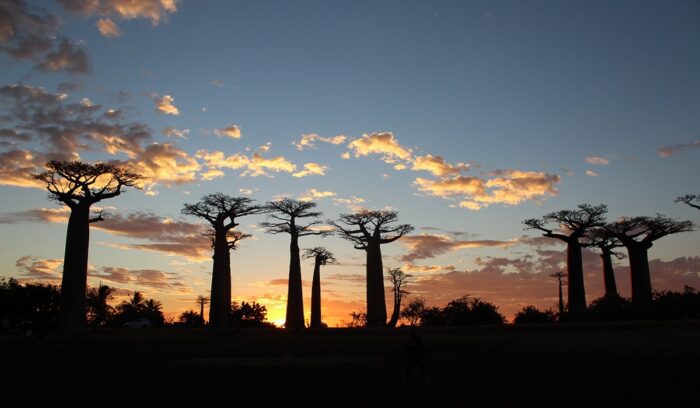
Long before the Merina empire rose to dominate Madagascar, a people known as the Vazimba built the island’s first known highland kingdoms — ruled, by some accounts, largely by queens. Their story, woven from oral history and fragmentary archaeology, is one of the oldest chapters in the human settlement of Madagascar, and one of the least told outside the island itself.
What the evidence shows
- Vazimba kingdoms: Oral histories describe the Vazimba period — the faha vazimba — as the first era of Malagasy highland civilization, marked by the emergence of chieftaincies and kingdoms in the central highlands, often under the rule of queens.
- Highland settlement: Archaeological research and oral tradition both point to Vazimba communities practicing slash-and-burn agriculture, cultivating bananas, tubers, and ginger, gathering forest products, and organizing into villages ruled by chiefs and sovereigns.
- Malagasy origins: Scientific evidence confirms human arrival in Madagascar between 350 B.C.E. and 500 C.E., likely from the region of modern-day Indonesia, with some scholars theorizing successive waves of settlement that may explain how Vazimba societies formed and evolved.
Who the Vazimba were
The name “Vazimba” carries layers of meaning that scholars are still untangling. Some researchers, including Solofo Randrianjanahary, describe the Vazimba less as a single ethnic group and more as a way of life — a cultural identity shaped by centuries of adaptation to Madagascar’s highland forests in near-total isolation from the outside world.
Oral history divides them geographically: the vazimba andrano lived along rivers and lakes; the vazimba antety were the most numerous, clustered in the Betsiriry valley of the central highlands; and the vazimba antsingy occupied limestone cave formations in western Madagascar. Each group developed its own relationship with the land.
What most accounts agree on is that the Vazimba were the tompontany — the masters of the land. Their rulers are said to have reddened their hair with a local mushroom, a royal association with the color red that persists in parts of Madagascar to this day. According to oral tradition, the first sovereign of the central highlands was named Andriandravindravina. Queens Rangita and Rafohy are among the figures whose names have survived in the genealogies of later Merina rulers — a sign of how deeply Vazimba heritage became woven into those who eventually displaced them.
A civilization built from the forest
When the Vazimba first moved into the ancient tropical highland forests, they cleared land through tavy — the slash-and-burn agricultural method still practiced in parts of Madagascar today. They grew staple crops, gathered honey and wild fruit, and hunted small game. As communities grew, villages formed around the authority of chiefs, then kings and queens.
They are said to have herded zebu cattle — likely introduced to the island by Bantu-speaking settlers from East Africa who migrated to Madagascar and brought their pastoral culture with them — but, according to tradition, without slaughtering them for meat. This practice is still remembered in the community of Tsirendresaka, where a fady, or taboo, forbids killing zebu out of respect for Vazimba tradition.
The oral history of the Malagasy is rich with named Vazimba figures. A woman named Ramboamana and a man named Ramboabesofy are described as among the earliest inhabitants of the Ankavandra region. Their sons, Rangoromana and Zafihisoky, are credited in legend with first bringing zebu to the island — blending history, myth, and ecological fact into a single living story.
Lasting impact
The Vazimba did not disappear so much as transform. When Merina sovereigns — beginning with Andriamanelo in the 16th century C.E. and culminating with Andrianjaka in the early 17th century C.E. — pushed the Vazimba westward and eventually claimed their highland territories for rice cultivation, the cultural boundary was never absolute.
Andriamanelo himself was half-Vazimba through his Vazimba-lineage ancestors Queens Rangita and Rafohy. Oral histories in many Merina and Betsileo families speak of intermarriage with Vazimba ancestors. Researcher Jean-Pierre Domenichini has argued that many so-called Vazimba were not destroyed but assimilated — that “Vazimba” described a cultural position as much as an ancestry.
Their legacy persists in living traditions. Certain bogs and river sites where the Vazimba are said to have submerged their dead remain sacred today, visited as pilgrimage sites. Some Malagasy believe the Mikea hunter-gatherer people and the Vezo fishing communities of Madagascar’s western and southern coasts may descend from Vazimba ancestors. The faha vazimba — the Vazimba era — remains the opening chapter of Malagasy oral history, a foundation on which everything else was built.
Similar figures exist in other Austronesian cultures: the Menehune of Hawaii carry a strikingly parallel role in Hawaiian tradition — an earlier, smaller people said to have inhabited the islands before the ancestors of modern Hawaiians arrived. The resonance across thousands of miles of ocean points to something deep in the shared heritage of Austronesian-speaking peoples, whose seafaring cultures connected the Indian Ocean world long before the age of European exploration.
Blindspots and limits
The Vazimba remain one of history’s most elusive peoples. The ~1100 C.E. date associated with the height of their highland kingdoms is a scholarly approximation — the oral record does not offer clean chronologies, and archaeological evidence for this specific period is limited. The pygmy theory, which some researchers have proposed to explain descriptions of Vazimba as physically smaller than average, has not been proven and remains speculative.
Much of what we know comes filtered through the oral traditions of the Merina, who were also the people who displaced the Vazimba — a reminder that the victors of historical transitions often shape how those they displaced are remembered. The full complexity of Vazimba society, their own names for themselves, their governance structures, and their knowledge systems, remains largely beyond our reach.
What is clear is that Madagascar was not an empty island waiting to be filled. It had already been shaped, over centuries, by people who read the forests, named the rivers, and buried their dead in sacred water. The Tsingy de Bemaraha — the dramatic limestone formations in western Madagascar where the vazimba antsingy are said to have lived — is now a UNESCO World Heritage Site, its ancient human echoes recognized alongside its ecological ones.
The broader story of Madagascar’s human settlement, including the interplay between Austronesian and Bantu-speaking arrivals, is an area of active research. Recent genetic studies have begun to trace the precise origins and mixing of Madagascar’s founding populations, adding molecular detail to what oral history has preserved for centuries. The picture that emerges is of a society far more dynamic, multilayered, and interconnected than older narratives allowed.
Read more
For more on this story, see: Wikipedia — Vazimba
For more from Good News for Humankind, see:
- Ghana establishes a new marine protected area at Cape Three Points
- Indigenous land rights reach a new milestone ahead of COP30
- The Good News for Humankind archive on the medieval era
About this article
- 🤖 This article is AI-generated, based on a framework created by Peter Schulte.
- 🌍 It aims to be inspirational but clear-eyed, accurate, and evidence-based, and grounded in care for the Earth, peace and belonging for all, and human evolution.
- 💬 Leave your notes and suggestions in the comments below — I will do my best to review and implement where appropriate.
- ✉️ One verified piece of good news, one insight from Antihero Project, every weekday morning. Subscribe free.