
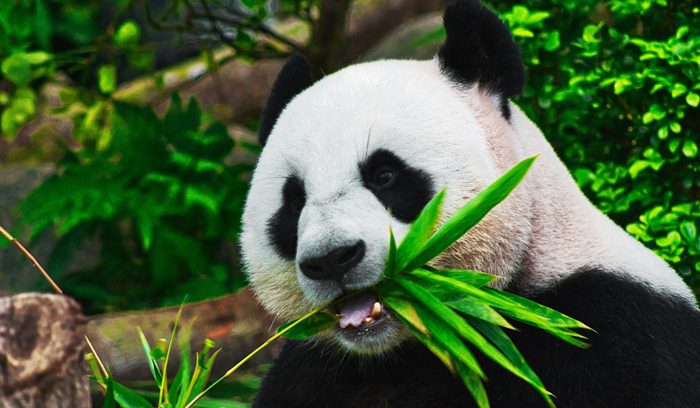
After decades of habitat loss, poaching, and population collapse, the giant panda has stepped back from the edge. China’s State Forestry and Grassland Administration confirmed that wild giant panda populations have recovered sufficiently for the species to be reclassified from “endangered” to “vulnerable” on conservation status assessments — a milestone that reflects one of the most sustained and deliberate wildlife recovery efforts in modern history.
At a glance
- Giant panda conservation: Wild panda populations have grown to roughly 1,900 individuals, up from fewer than 1,100 in the early 1970s — a recovery driven by decades of Chinese government investment and international cooperation.
- Habitat protection: China has established more than 60 panda nature reserves covering over 14,000 square kilometers, protecting not just pandas but hundreds of other species that share the same bamboo forest ecosystems.
- Breeding programs: Captive breeding efforts at facilities including the Chengdu Research Base of Giant Panda Breeding have produced hundreds of cubs, providing a genetic safety net and boosting public awareness worldwide.
How the recovery happened
Giant panda conservation did not happen by accident. China banned panda hunting in 1962 and steadily expanded legal protections throughout the following decades. The landmark Wildlife Protection Law, strengthened multiple times since its 1989 passage, gave enforcers real tools to prosecute poachers and illegal traders.
The reserve network was equally decisive. When the first reserves were established in Sichuan, Shaanxi, and Gansu provinces, fragmented panda populations were isolated from one another — a serious genetic threat. Conservationists, working with local communities and government agencies, began building wildlife corridors to reconnect those populations. The Qinling mountain pandas, long separated from Sichuan populations, became a particular focus of corridor planning.
International partnerships added resources and expertise. The World Wildlife Fund, which adopted the panda as its logo in 1961, has collaborated with Chinese scientists for decades on population surveys, habitat mapping, and community outreach. Those surveys — shifting from visual counts to camera traps and DNA analysis from droppings — gave researchers far more accurate population data than was previously possible.
What the numbers actually mean
A population of roughly 1,900 sounds small by any measure. And it is. “Vulnerable” is still a serious conservation category, not a clean bill of health.
The IUCN Red List — the international standard for species threat assessments — continues to list the giant panda as vulnerable, meaning the species still faces a high risk of extinction in the wild if pressures are not managed. Climate change poses a growing threat: studies project that rising temperatures could eliminate more than a third of the panda’s bamboo habitat by the end of this century. Research published in Nature Climate Change found that higher elevations, where cooler temperatures currently sustain bamboo forests, may not be accessible to pandas if mountain habitats fragment further.
There is also a naming discrepancy worth noting. China’s domestic reclassification to “vulnerable” preceded a formal IUCN update, and conservation organizations have urged caution about reading the change as a signal to reduce protections. The WWF and other groups have been clear: the panda’s recovery is real, but it remains fragile.
A broader win for biodiversity
What makes the panda’s recovery especially significant is what it did for everything else living in those forests. Giant pandas are an umbrella species — protecting their habitat protects thousands of other plants and animals, including snow leopards, red pandas, golden snub-nosed monkeys, and dozens of endemic plant species.
China’s nature reserve expansion for pandas effectively created a network of protected landscapes that would have been nearly impossible to establish for any less charismatic species. Researchers estimate that the reserve system protects habitat for roughly 70% of the endemic vertebrate species found in that region of China — a conservation dividend that extends far beyond a single black-and-white bear.
Local communities have been part of this story too. Many families living adjacent to panda reserves have transitioned from logging and farming in panda habitat to working as rangers, guides, and conservation monitors — creating economic incentives aligned with habitat protection rather than against it. That shift has not been without friction or hardship, and some communities lost livelihoods when logging was banned. Acknowledging that tension honestly is part of understanding how hard-won this recovery actually is.
What comes next
Conservationists are focused now on the next phase: increasing the wild population beyond 2,000, expanding corridor connectivity, and preparing panda habitat for climate-driven shifts in bamboo distribution. The Chengdu Research Base continues refining techniques for reintroducing captive-born pandas to the wild — a process that has proven far more difficult than breeding alone.
The panda’s journey from the edge of extinction to a cautiously hopeful outlook took more than 50 years of sustained effort across governments, scientists, local communities, and international organizations. It is a reminder that species recovery is possible — and that it rarely happens quickly or easily.
Read more
For more on this story, see: Australia to set aside at least 30% of its land mass to protect endangered species
For more from Good News for Humankind, see:
- Giant pandas are removed from the endangered species list
- China’s Yangtze River fishing ban brings endangered species back from the edge
- The Good News for Humankind archive on wildlife conservation
- Amur leopard numbers have grown fivefold in Russia’s Far East
About this article
- 🤖 This article is AI-generated, based on a framework created by Peter Schulte.
- 🌍 It aims to be inspirational but clear-eyed, accurate, and evidence-based, and grounded in care for the Earth, peace and belonging for all, and human evolution.
- 💬 Leave your notes and suggestions in the comments below — I will do my best to review and implement where appropriate.
- ✉️ One verified piece of good news, one insight from Antihero Project, every weekday morning. Subscribe free.


