Transportation

This archive covers 314 stories about how people are rethinking the way we move — from cleaner transit systems and safer roads to breakthroughs in electric vehicles and urban bike infrastructure. Each article focuses on real progress, grounded in evidence, showing what’s working and where.

Floating Dock. Woodcut from Venice (1560), for article on Song Dynasty dry dock

Song Dynasty China pioneers the dry dock, transforming ship repair

Dry docks first appeared in Song Dynasty China, when palace official Huang Huai-Hsin devised a way to repair the emperor’s decaying dragon ships without destroying them. Engineers dug a basin beside Chin-ming Lake, floated the 200-foot vessels in over submerged beams, then pumped the water out. Europe wouldn’t build anything comparable for another four centuries.

Viking longship, for article on Scandinavian longship design

Scandinavians develop the longship, launching a new era of seafaring

Longships emerged in Scandinavia around 300 C.E., when shipbuilders began riveting overlapping planks into hulls that were light, flexible, and fast. The oldest confirmed examples, found in Denmark and Sweden, date to roughly 320 C.E. The design opened the North Atlantic to Norse sailors and carried them, eventually, as far as North America.

a f z, for article on sintashta culture chariot

Sintashta culture pioneers the spoked-wheel chariot on the Eurasian steppe

Chariots first appear in the archaeological record around 2000 BCE, when people of the Sintashta culture buried two-wheeled vehicles alongside horses and bronze weapons on the steppes of what is now Russia and Kazakhstan. Their breakthrough was the spoked wheel, light enough for a horse to pull at speed. Within centuries, the design had spread across the ancient world.

Sailboat, for article on ancient Egyptian sailboat

Ancient Egyptians develop sail-powered boats, reshaping how humans move across water

Ancient Egyptian sailboats, appearing in pottery and tomb art around 4,000 B.C.E., are among the earliest documented vessels to harness wind across water. Simple square cloth panels on narrow hulls moved grain and stone along the Nile, and within two thousand years, sail-powered trade routes stitched the Mediterranean together — one of humanity’s quietest, farthest-reaching leaps.

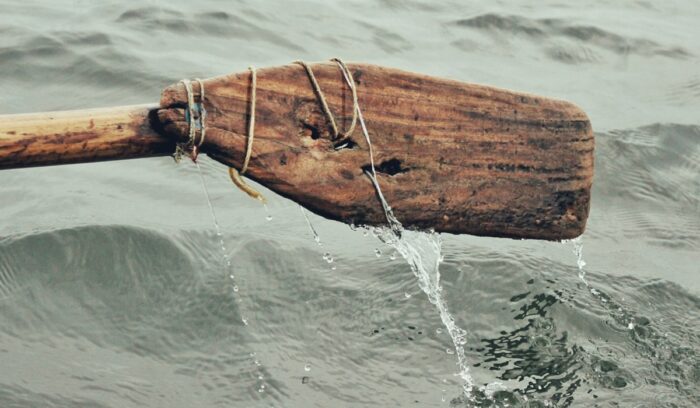
Broken paddle, for article on Hemudu Culture oars

Hemudu Culture peoples produce world’s earliest known rowing oars

Rowing oars from around 5000 B.C.E., unearthed in what is now Zhejiang, China, are the oldest ever confirmed by archaeologists. The Hemudu people who shaped them were rice farmers living in stilt houses above tidal wetlands, where water was a highway rather than a barrier. Their simple design — shaft, blade, pivot — still propels boats today.