Clean & renewable energy

This archive tracks real progress in clean and renewable energy — from solar and wind expansion to grid upgrades and policy wins. Each story focuses on what’s working, where, and why it matters for people and the planet.

Wind turbines silhouetted against a sunset sky at a large U.S. renewable energy farm

Largest-ever U.S. renewable energy project comes online, supplying power to 1 million homes

SunZia is now the largest wind energy project in U.S. history, and its scale changes what Americans can imagine building. Its 916 turbines generate more power than the Hoover Dam, delivered through one of the first major long-distance HVDC transmission lines completed in the country in decades. Over 30 years, the project will send $1.3 billion directly to local governments, schools, and landowners in New Mexico and Arizona — communities that have long watched energy wealth flow elsewhere. It’s proof that transformational clean energy infrastructure can actually get built, and a model other regions will be watching closely.

Floating solar panels

Portugal is opening Europe’s biggest floating solar park this year

Floating solar on reservoirs is quietly rewriting what clean energy infrastructure can look like — and Portugal is leading the way. At Alqueva, Europe’s largest artificial lake, 12,000 solar panels work alongside an existing hydropower dam, producing 7.5 gigawatt-hours of electricity per year without requiring new land or new grid connections. Electricity from the park costs a third of what a gas-fired plant produces at current fuel prices, making the case that green power can be both practical and affordable. Models like this give the broader renewables transition something valuable: a proven, cost-competitive blueprint ready to scale.

Offshore wind farm

Taiwan’s ‘biggest offshore wind farm’ generates its first power

Taiwan’s offshore wind sector just crossed a milestone that shows the island’s clean energy ambitions are becoming real. The Greater Changhua facility — 111 turbines spread across deep water off Taiwan’s west coast — will power around one million households once fully operational. Taiwan ranks second in Asia-Pacific for planned offshore wind installations, and projects like this one help build the track record that makes future investment easier to secure. Every turbine connected to the grid is proof that island nations with strong wind resources can lead the global shift away from fossil fuels.

School bus on the road

New York enacts first-in-nation plan to electrify all state school buses

New York’s commitment to electrifying all 50,000 of its school buses sets a new standard for what statewide climate and children’s health policy can look like together. More than two million students — disproportionately from low-income communities — currently ride to school in diesel buses linked to asthma, reduced lung development, and cognitive harm. At least $500 million in state funding, paired with federal support, gives districts a real financial path forward. For advocates working to make clean air a guarantee rather than a privilege, this is a proof of concept other states can follow.

Beijing traffic lights at dusk

China’s EV revolution prevented more than 250,000 air-pollution deaths by 2023

China’s electric vehicle boom is saving lives right now — not in projections, but in the air people are actually breathing. A peer-reviewed study in Nature Health found that EV adoption cut fine particulate matter by nearly 24% across 150 Chinese cities, with researchers estimating 262,000 premature deaths already prevented by 2023. A parallel study from California found measurable air quality gains there too, suggesting this is a repeatable pattern. The evidence is growing that electrifying transportation may be one of the fastest tools humanity has for reducing preventable death at scale.

Three solar panels on metal poles against a partly cloudy blue sky

Africa nearly tripled new renewable capacity in 2025

African countries added 11.3 gigawatts of renewable energy capacity in 2025, nearly triple the 4.2 GW added in 2024, according to the International Renewable Energy Agency.The shift reaches deeper than capacity numbers. Of 322 energy projects announced across Africa last year, 253 were renewable — 173 of them solar — while only 22 were natural gas. The economics, as one Kenyan climate finance lead put it, have “decisively turned in favor of clean energy.”The biggest remaining obstacle isn’t technology. It’s financing — African countries face borrowing costs up to three times higher than wealthy nations, owing to political and economic risk premiums that no amount of falling solar prices can erase on their own. Closing that gap could determine whether this momentum reaches the communities who need power most.

Beijing skyline at sunset with modern skyscrapers in China's capital city

Clean energy holds China’s emissions flat for two years without an economic slowdown

China’s CO2 emissions have now stayed flat or declining for 21 straight months — a first in modern history, and one that’s happening while the economy keeps growing. New analysis from Carbon Brief estimates emissions dipped 0.3% in 2025, as a 43% surge in solar generation and a 14% rise in wind together absorbed nearly all the year’s added electricity demand. Even more striking, China added 75 gigawatts of battery storage — outpacing peak demand growth and weakening the long-standing case for new coal plants. If this pattern holds, the world’s largest emitter may be quietly showing every country what it looks like when clean energy stops chasing demand and starts outrunning it.

Blue concrete mixer truck parked on a Japanese street beside black cars and storefronts

Electric concrete mixers are booming in China, hitting 70% of new sales

Electric concrete mixers are quietly rewriting what “hard to electrify” really means — and in China, they’re on track to make up roughly 70% of new mixer sales in 2025, up from under 2% just four years earlier. The reason is refreshingly simple: these trucks return to the same batching plant every shift, so charging infrastructure can live right where the work begins and ends. In early 2026, Chinese buyers chose pure electric over hydrogen almost unanimously, signaling that batteries have won this corner of heavy transport. Trials are now spreading to the U.K., Germany, Switzerland, Norway, and Australia. The bigger lesson for climate progress: electrification advances fastest not by tackling the hardest routes first, but by recognizing where the work is already bounded enough to make the switch obvious.

Solar farm with sky above

India hits 150 GW of solar capacity after fastest quarter on record

India’s solar power capacity has crossed 150 GW, with a remarkable 6.65 GW installed in March 2026 alone — one of the strongest single months the sector has ever seen. The growth spans rooftops, sprawling utility-scale farms, and off-grid systems now powering remote communities that the main grid has yet to reach. Behind the numbers are falling panel costs, smart policy choices, and a country choosing to meet rising electricity demand without leaning harder on fossil fuels. With India’s Paris Agreement goal of 500 GW of non-fossil capacity by 2030 now well within sight, this milestone shows that the world’s most ambitious clean energy transitions are no longer aspirational — they are unfolding in real time.

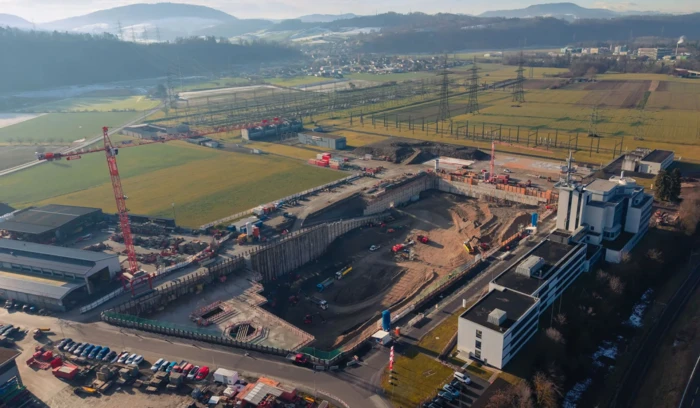
Flexbase redox flow battery in Switzerland

Switzerland begins work on the world’s most powerful redox flow battery

A redox flow battery rising from a 27-meter pit in northern Switzerland will become the world’s most powerful, capable of running 210,000 homes for a full day once it comes online in 2029. Unlike the lithium-ion batteries in our phones, this one stores energy in two liquid electrolytes pumped through a membrane — a design that’s non-flammable, almost fully recyclable, and built to cycle indefinitely without wearing out. It can respond to grid swings in milliseconds, soaking up excess wind power and releasing it when nearby AI data centers need a steady surge. Projects like this hint at what a renewables-first grid actually looks like: not just cleaner generation, but storage patient and powerful enough to make wind and solar genuinely dependable.