Activism & Protests

Activism and protests have driven some of history’s most lasting social changes. This archive covers milestones in organizing, civil resistance, and grassroots movements — from landmark legal victories to policy shifts won through sustained public pressure.

image for article on Iranian Green Movement

Iran’s Green Movement rises in historic post-election protests

Iran’s Green Movement brought millions into the streets in the summer of 2009, after a disputed presidential election handed Mahmoud Ahmadinejad a landslide victory that opposition supporters rejected as fraudulent. On June 15, a crowd estimated in the hundreds of thousands to three million gathered around Tehran’s Azadi Tower — the largest demonstration in the Islamic Republic’s history to that point.

South Korea flag, for article on June Democracy Movement

South Korea’s June Democracy Movement forces direct presidential elections

In June 1987, millions of South Koreans filled the streets for 19 days, demanding an end to military rule and the right to elect their own president. A broad coalition of students, workers, and church groups — galvanized by the deaths of two young activists — forced the regime to concede. The reforms shaped the democracy South Korea still lives under today.

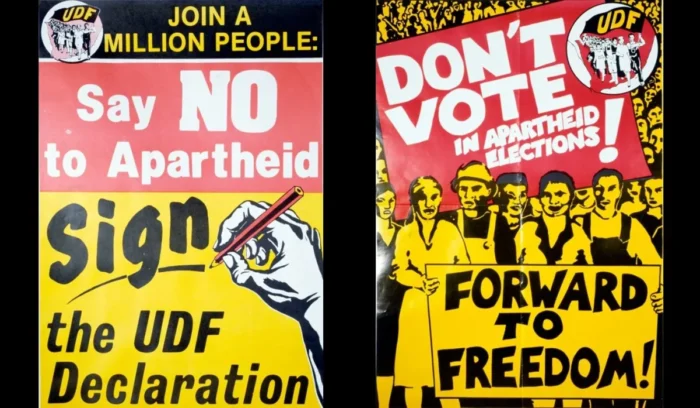
United Democratic Front flyer, for article on united democratic front south africa

United Democratic Front launches in South Africa, uniting 575 organizations against apartheid

The United Democratic Front launched on August 20, 1983, when roughly 10,000 people filled a community hall in Mitchell’s Plain near Cape Town. Delegates from 575 organizations — unions, churches, student groups, civic associations — united behind one slogan: “UDF Unites, Apartheid Divides.” It became one of the broadest nonracial coalitions in South Africa’s long struggle against apartheid.

Mau demonstration in Apia, for article on mau movement samoa

Samoa’s Mau movement rises to demand self-rule from colonial powers

The Mau movement rose in Samoa in the early 1900s, a non-violent independence struggle rooted in traditional chiefly leadership and the motto “Samoa for the Samoans.” Even after Black Saturday in 1929, when New Zealand police killed up to 11 marchers in Apia, the movement held to peaceful resistance — a patience that helped carry Samoa to independence in 1962.