California

California is home to some of the nation’s most ambitious climate, housing, and social policy experiments. This archive tracks the progress stories and milestones emerging from the state — from clean energy breakthroughs to community health wins.

Salmon run, for article on Klamath dam removal, for article on Klamath River dam removal

Salmon return to Klamath River for first time in 112 years

Wild Chinook salmon have returned to the upper Klamath River for the first time since 1912, with biologists confirming the fish about 230 miles inland from the Pacific. The sighting came just months after the last of four dams was removed in summer 2024, completing the largest dam removal project in U.S. history. Klamath tribal members, who fought for decades to free the river, describe the salmon’s return as the homecoming of relatives. Biologists hope steelhead, coho, Pacific lamprey, and bull trout will follow. For rivers everywhere still bound by aging dams, one fish swimming home is a reminder that ecosystems can begin healing the moment we let them.

Birds flying at the beach on a sunny day, for article on Chumash Heritage National Marine Sanctuary

California gets final approval for nation’s third-largest marine sanctuary

Chumash Heritage National Marine Sanctuary now protects 4,543 square miles of California coastline, making it the country’s third-largest marine sanctuary and the first anywhere in the U.S. shaped from the start by Indigenous tribes. The waters off San Luis Obispo and Santa Barbara counties are so biologically rich that one Chumash leader compares them to the Galápagos, and they’re now off-limits to oil and gas exploration. The designation also safeguards ancient village sites resting on seafloor that was dry land thousands of years ago. After a decade of tribal-led advocacy, this sanctuary offers a new model for ocean conservation — one where the people with the longest relationship to a place help decide its future.

Virus up close, for article on lenacapavir HIV prevention

‘Gamechanger’ HIV prevention drug to be made available cheaply in 120 countries

Lenacapavir, a twice-yearly HIV prevention shot with near-perfect results in clinical trials, is about to become far more affordable for millions of people. Gilead Sciences has licensed six generic manufacturers across India, Egypt, Pakistan, and the U.S. to produce the drug for 120 lower-income countries, where researchers estimate it could eventually be made for as little as $40 per patient per year. In trials among cisgender women in South Africa and Uganda, not a single participant who received the injection contracted HIV. Advocates are urging wider access, since much of Latin America was left out of the deal. Still, it’s a hopeful signal that breakthrough prevention tools can reach the people who need them most — fast.

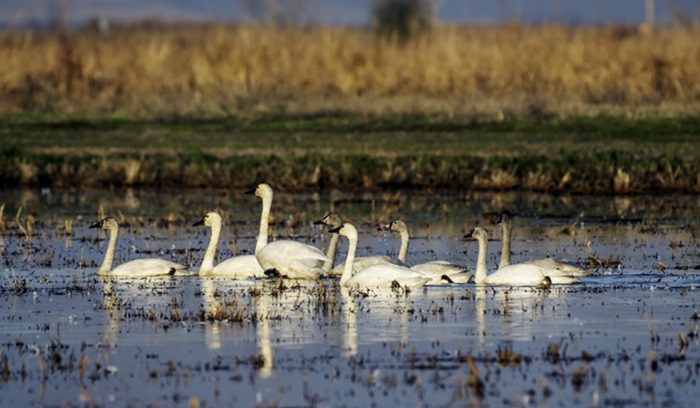
Nervous Swans in the Rice Fields, for article on tidal habitat restoration

California tears down levee in ‘largest tidal habitat restoration in state history’

Tidal waters rushed across 3,400 acres of California’s Sacramento-San Joaquin Delta this month after crews cut a 600-foot gap through a century-old levee at Lookout Slough — the first of nine planned breaches in what’s being called the largest tidal habitat restoration in state history. The reborn marsh will offer shallow, sediment-rich water for the endangered Delta smelt, a tiny fish whose health signals the wellbeing of the entire food web, while also giving salmon better passage and migrating birds new resting ground. It will also hold more than 40,000 acre-feet of floodwater, easing pressure on Sacramento-area communities during heavy storms. Lookout Slough is a quiet reminder that working with natural water systems, rather than against them, can protect wildlife and people at once.

Produce aisle at grocery store, for article on California plastic bag ban

California bans all plastic shopping bags at grocery stores

California’s plastic bag ban gets real on January 1, 2026, when even the thicker “reusable” plastic bags that quietly replaced the originals will disappear from grocery stores, pharmacies, and convenience stores statewide. Senator Catherine Blakespear, who authored the bill, put it plainly: those bags were single-use in everything but name. Shoppers will reach for paper or bring their own, and families using CalFresh and similar food assistance won’t pay the paper bag fee. California’s market is huge enough that what happens at its checkout counters tends to ripple outward, nudging manufacturers and other states to rethink their own rules. It’s a small, tangible reminder that closing loopholes — not just passing laws — is where real progress lives.

Salmon run, for article on Klamath River salmon

Salmon will soon swim freely in the Klamath River for first time in a century once dams are removed

Klamath River salmon are swimming freely past the sites of two demolished dams for the first time in over a century, just in time for fall Chinook spawning season. The breakthrough completes the largest dam removal project in U.S. history, a victory the Karuk and Yurok Tribes spent at least 25 years fighting to secure. Already, salmon have been spotted at the river’s mouth, beginning the upstream journey their ancestors couldn’t make. Ecologists point to Washington’s Elwha River as proof that rivers heal themselves once obstacles fall away. Beyond restoring a vital ecosystem, this moment shows what sustained Indigenous-led advocacy can accomplish — reshaping policy, moving concrete, and reopening a relationship between people and place that was interrupted but never broken.

Good news for LGBTQ rights, for article on Thailand marriage equality, for article on conversion therapy ban, for article on same-sex partnership rights, for article on forced outing of queer students, for article on Greece same-sex marriage

California passes first-in-the-nation law banning forced outings of queer students in state public schools

California just became the first state in the country to ban schools from forcibly outing queer students, after Governor Newsom signed the SAFETY Act into law and it took effect immediately. The bill, which passed the State Assembly 60-15, also shields teachers from retaliation if they refuse to disclose a student’s gender identity to parents without consent. It arrived after years of organizing by educators like Karen Poznanski, a Murrieta teacher and parent of a nonbinary child, whose complaint helped trigger a state investigation. Eight other states currently require this kind of outing, so California’s move offers a real counter-model. For queer kids deciding when and how to come out, this puts one of life’s most tender conversations back in their own hands.

Fervo Energy geothermal plant, for article on enhanced geothermal power purchase agreement

World’s biggest geothermal power purchase agreement completed in western U.S.

A Utah geothermal project just secured what developers are calling the world’s largest geothermal power purchase agreement — a 15-year deal to deliver 320 megawatts of always-on clean electricity to Southern California Edison, enough to power roughly 350,000 homes. Fervo Energy’s Cape Station plant uses horizontal drilling borrowed from the oil and gas industry to circulate water through deep hot rock, unlocking geothermal power in places where it was never viable before. First electrons are expected to flow in 2026, with the rest coming online by 2028. For a clean grid that needs to run when the sun sets and the wind stops, this kind of steady, weather-proof power may be the missing piece — and a signal that geothermal is ready for prime time.

Good news for public health, for article on CAB-LA HIV prevention, for article on lenacapavir HIV prevention, for article on HIV infections in young men

New twice-yearly shot to prevent HIV achieves 100% success rate in late-stage trial

Lenacapavir, a twice-yearly HIV prevention shot, protected every single one of 2,134 women who received it in a late-stage trial across South Africa and Uganda — a 100% efficacy result so striking that monitors ended the blinded phase early. The breakthrough matters because daily prevention pills, while powerful in theory, often falter in real life: stigma, forgotten doses, and disrupted routines all chip away at protection. Two clinic visits a year, by contrast, means a full year of coverage. The remaining hurdle is access, with advocates pressing manufacturer Gilead to license generic versions for the regions hardest hit. If that happens, a tool this effective could reshape the global push to end the HIV epidemic by 2030.

A neuron or nerve cell is an electrically excitable cell, for article on ALS synapse-regenerating pill

Breakthrough synapse-regenerating ALS pill moves to phase 2 human trials

A once-daily ALS pill designed to rebuild neural connections — not just slow their loss — has cleared FDA approval to begin Phase 2 trials, with patients across the U.S. starting doses in April 2024. SPG302 works on synapses, the tiny junctions where neurons talk to each other, which start vanishing before motor neurons themselves die. Every ALS drug currently on the market aims to slow decline; this one is being tested for whether it can actually help recover lost function. For the roughly 30,000 Americans living with ALS, that’s a genuinely different question to be asking. If it works, it could reshape how researchers approach neurodegenerative disease far beyond ALS.