Sub-Saharan Africa

Sub-Saharan Africa spans dozens of countries south of the Sahara, each with distinct challenges and achievements. This archive collects milestones in health, education, conservation, and economic opportunity from across the region — reported with context and care.

element digital T CXBZLUvic unsplash, for article on Seychelles democratic transition

Seychelles ends one-party rule and holds its first multiparty elections

Seychelles returned to multiparty democracy in 1993, sixteen years after a 1977 coup had dissolved the young nation’s first experiment with self-rule. A new constitution reopened the ballot across the 115-island archipelago, and opposition voices long silenced could campaign freely again. For a country barely a generation into independence, it was a quiet but meaningful homecoming.

Zambia flag, for article on zambia multiparty democracy

Zambia restores multiparty democracy after two decades of one-party rule

Zambia’s shift to multiparty democracy arrived in 1991, when a constitutional amendment ended nearly two decades of one-party rule. That October, Frederick Chiluba defeated President Kenneth Kaunda with roughly 76 percent of the vote, and Kaunda stepped aside peacefully. It became one of post-Cold War Africa’s earliest examples of a sitting leader accepting defeat at the ballot box.

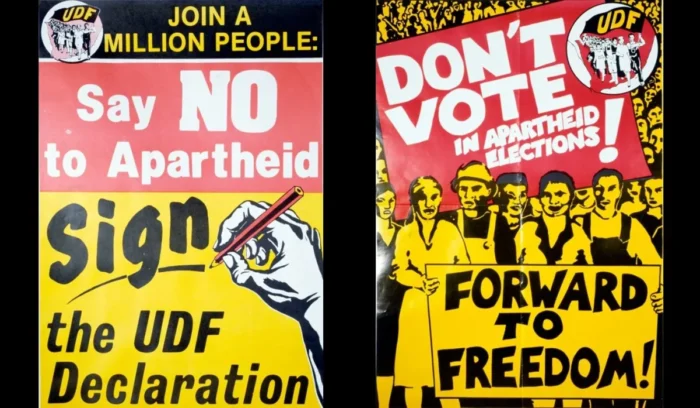
United Democratic Front flyer, for article on united democratic front south africa

United Democratic Front launches in South Africa, uniting 575 organizations against apartheid

The United Democratic Front launched on August 20, 1983, when roughly 10,000 people filled a community hall in Mitchell’s Plain near Cape Town. Delegates from 575 organizations — unions, churches, student groups, civic associations — united behind one slogan: “UDF Unites, Apartheid Divides.” It became one of the broadest nonracial coalitions in South Africa’s long struggle against apartheid.

Flag of Seychelles, for article on Seychelles independence

Seychelles gains independence from the United Kingdom

Seychelles independence arrived on June 29, 1976, when the Indian Ocean archipelago raised its flag as a sovereign republic after 165 years of British rule. The new nation of roughly 60,000 people, scattered across 115 islands, was itself a creation of empire — a Creole society built from African, Asian, and European roots finally claiming its own home.

image for article on angola independence

Angola achieves independence from Portugal after centuries of colonial rule

Angola’s independence came on November 11, 1975, ending more than four centuries of Portuguese presence and a liberation war that began in 1961. The path opened unexpectedly when Portugal’s own dictatorship fell in the 1974 Carnation Revolution. The country’s name itself honors the ngolas — rulers of the pre-colonial Ndongo kingdom, a reminder that Angola’s story stretches far deeper than colonization.

Flag of Zambia, for article on Zambia independence

Zambia gains independence from the United Kingdom

Zambia’s independence came on 24 October 1964, when the Union Jack came down over Lusaka and Kenneth Kaunda was sworn in as the new republic’s first president. Thousands gathered to watch, and the moment rippled far beyond the country’s borders — one more sign that the era of African colonial rule was drawing to a close.