
The Chola dynasty comes to power in modern-day India
The Chola dynasty was one of the longest-ruling dynasties in the history of southern India.

The Chola dynasty was one of the longest-ruling dynasties in the history of southern India.

Greek language introduced Greek literature into the former Persian Empire, thereby influencing the philosophical thought and writing of the region

The Dipavamsa is the oldest historical record of Sri Lanka. Together with the Mahavamsa, it is the source of many accounts of ancient history of Sri Lanka and India.

The Nanda dynasty ruled in northern part of the Indian subcontinent during the 4th century B.C.E., and possibly during the 5th century B.C.E. The Nandas overthrew the Shaishunaga dynasty in the Magadha region of eastern India, and expanded their empire to include a larger part of northern India.

The origin of Buddhism points to one man, Siddhartha Gautama, the historical Buddha, who was born in Lumbini (in present-day Nepal) during the 5th century B.C.E..

An ancient metropolis, the capital of the Republic of the Vaishali state and the capital of the Vajjian Confederacy (Vijji), Vaishali is prominently mentioned in Jain and Buddhist texts which emerged later.

The Sushruta Samhita is one of the most important treatises on medicine and herbalism to survive from the ancient world.

Jainsm has a set of five vows: nonviolence, truth-speaking, non-stealing, no sexual immorality and non-attachment to worldly things.

Vanga was an ancient kingdom and geopolitical division on the Ganges delta in the Indian subcontinent. It was located in southern Bengal, with the core region including present-day southern West Bengal (India) and southwestern Bangladesh.
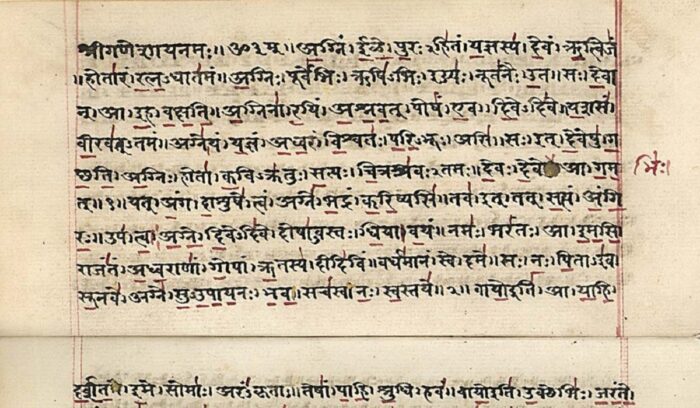
The Rigveda is one of the four canonical sacred texts of Hinduism known as the Vedas. It is one of the oldest extant texts in any Indo-European language.