South America

This archive covers progress stories and milestones from across South America, spanning countries from Brazil and Colombia to Argentina and Peru. Expect reporting on conservation wins, public health advances, economic shifts, and community-led efforts shaping life across the continent.

Aerial view of river and mangroves, for article on Amazon mangrove protection

Brazil boosts protection of Amazon mangroves with new reserves in Pará state

Brazil has protected nearly all of Pará state’s Amazon coastline after President Lula signed a decree creating two new extractive reserves — the Filhos do Mangue and the Viriandeua — adding 74,700 hectares of mangrove ecosystems to federal protection. The move completes what experts call the world’s largest and most conserved mangrove belt, securing the livelihoods of roughly 7,100 families and locking away massive stores of carbon. It took 16 years of community organizing to make it happen. 83 words.

Argentinian flag flying near a building, for article on crimes against trans women

In first, an Argentine court convicts ex-officers of crimes against trans women during dictatorship

Argentina just made legal history: a court in La Plata convicted 11 former officials of the 1976–1983 dictatorship for crimes against humanity specifically committed against transgender women — believed to be the first ruling of its kind anywhere in the world. Eight trans plaintiffs took the stand to testify about rape and torture at the Banfield Pit, one of the country’s largest clandestine detention centers. Ten defendants received life sentences; one was sentenced to 25 years. When the verdict was read, survivors and families packed the courtroom and wept. Argentina has been quietly building the world’s most ambitious reckoning with state terror, and this ruling extends that work to a community long left outside official memory — a model other nations are studying.

Bolivian rainforest, for article on Amazon rainforest protection

Bolivian town Sena protects 1 million acres of Amazon rainforest

Amazon rainforest protection just got a remarkable boost from an unlikely source: a Bolivian town of 2,500 people passed a law safeguarding 1.1 million acres of intact forest. The new Gran Manupare reserve lifts conservation coverage in Bolivia’s Pando Department to 26% of its land, and locks in an estimated 9.2 million tons of irrecoverable carbon. It’s also a haven for giant river otters, jaguars, and big-leaf mahogany — and it works because standing forests pay, thanks to a Brazil nut economy that depends on healthy ecosystems. Piece by piece, Bolivian communities have now stitched together 10 million contiguous hectares of protected Amazon, proving that community-led conservation can match anything achieved by national decree.

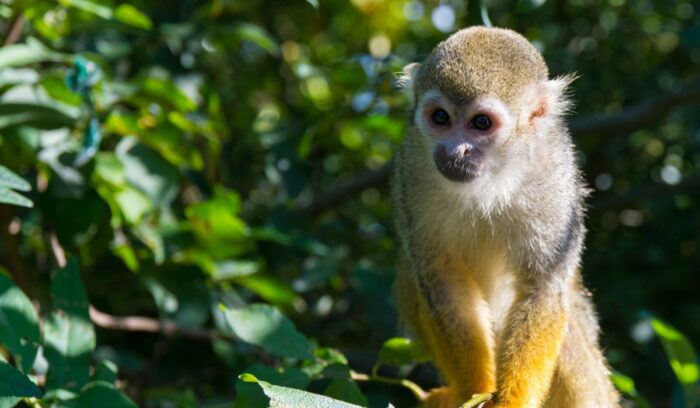
Squirrel monkey, for article on Indigenous-led land management

New fund supports Indigenous-led land management in biodiverse area of Bolivia

Indigenous communities in Bolivia’s Madidi Landscape just launched a dedicated conservation fund, opening with $650,000 from the Bezos Earth Fund to back work they’ve been doing for generations. Four nations — the Tacana, Lecos, T’simane Mosetene, and San José de Uchupiamonas — will direct the money themselves through an Indigenous-led board, finally putting resources behind territorial plans they first drafted twenty years ago. Madidi National Park is the most biodiverse protected area on land anywhere, home to more than 9,000 recorded species, from Andean condors to maned wolves. Globally, only a sliver of conservation funding reaches Indigenous hands directly, even though these communities steward most of the world’s remaining biodiversity. Funds like this one offer a hopeful blueprint for changing that.

River dolphin, for article on river dolphin declaration

11 countries sign global pact to protect endangered river dolphins

River dolphins just got their first global lifeline: 11 countries have signed the Global Declaration for River Dolphins, a pact aiming to double Asian populations and halt declines across South America by 2030. It’s a meaningful turn for a group of species that has lost nearly three-quarters of its numbers since the 1980s. The hope isn’t abstract — China’s Yangtze finless porpoise population grew 23% over five years under strict protections, and the Indus river dolphin has nearly doubled in two decades. Because dolphins signal the health of the rivers nearly a billion people depend on, their recovery points toward something larger: that coordinated, community-rooted conservation can still pull ecosystems back from the brink.

Amazon River Rainforest, for article on Amazon deforestation

Deforestation in Brazil’s Amazon fell by nearly 50% in 2023 compared to 2022

Amazon deforestation in Brazil dropped by nearly half in 2023, with satellite data showing 5,153 square kilometers cleared compared to 10,278 the year before. Environment Minister Marina Silva credited the turnaround to a revitalized enforcement agency, Ibama, whose inspectors have been back in the field issuing fines and dismantling illegal logging networks. President Lula has pledged to end Amazon deforestation entirely by 2030, calling this year’s numbers a first step. The shift matters far beyond Brazil’s borders: roughly 60% of the rainforest sits within the country, and scientists warn the ecosystem is approaching a tipping point. It’s a hopeful reminder that political will, paired with real enforcement, can change a forest’s trajectory in a single year.

Uruguayan flag, for article on Uruguay renewable electricity

Uruguay now generates more than 90% of its electricity from renewables

Uruguay now generates between 90% and 98% of its electricity from renewables, a shift it pulled off in roughly 15 years after starting out almost entirely dependent on imported oil. The turning point came in 2008, when an oil price spike pushed the government to take a chance on a nuclear physicist with an unconventional pitch: skip the nuclear plant, go all in on wind. About 50 wind farms later, paired with existing hydropower, the country had one of the cleanest grids on Earth — and around 50,000 new jobs in a nation of just 3.4 million. Uruguay’s quiet experiment offers something the global energy transition badly needs: proof that a small country, starting from scratch, can actually do this.

Rainforest, for article on Siekopai land rights

Historic ruling in Ecuador returns ownership of ancestral land to the Siekopai people

The Siekopai people of the Ecuadorian Amazon have just won back legal ownership of 42,360 hectares of ancestral rainforest along the Ecuador-Peru border, more than 80 years after a 1941 war forced their families into exile. To prove their deep roots in the land, their lawyers drew on an unlikely source: a 1753 Jesuit manuscript held at the New York Public Library, containing roughly 1,200 words in the Siekopai language Paikoka. The court also ordered Ecuador’s environment ministry to deliver a formal public apology on Siekopai territory. It’s the first time a Latin American country has granted an Indigenous community full ownership inside a national protected area — a precedent that could reshape land justice across the region.

Rainforest scene, for article on Amazon restoration funding

Brazil launches $204 million drive to restore Amazon rainforest

Amazon restoration just got a $204 million boost from Brazil, aimed at bringing degraded rainforest back to life through replanting and natural regrowth. The program flows through the Amazon Fund, with renewed backing from Norway and Germany after years of paused support. Much of the work will lean on Indigenous and traditional communities, whose territories consistently show lower deforestation than surrounding lands. It builds on real momentum: deforestation in the first half of 2023 fell by half compared to the year before. No single check rewrites decades of loss, but a forest that shelters roughly 10% of all known species — and helps regulate rainfall across a continent — is finally being treated as something worth actively healing.

Colombia rainforest landscape

Deforestation in Colombia down 70% year-on-year

Since taking power last year, leftist President Gustavo Petro has enacted a slate of new policies aimed at protecting Colombian forests, including paying locals to conserve woodland. The recent gains in Colombia mirror similar advances in the Brazilian Amazon, where leftist President Luiz Inacio Lula da Silva has cracked down on forest clearing.