Transportation

This archive covers 314 stories about how people are rethinking the way we move — from cleaner transit systems and safer roads to breakthroughs in electric vehicles and urban bike infrastructure. Each article focuses on real progress, grounded in evidence, showing what’s working and where.

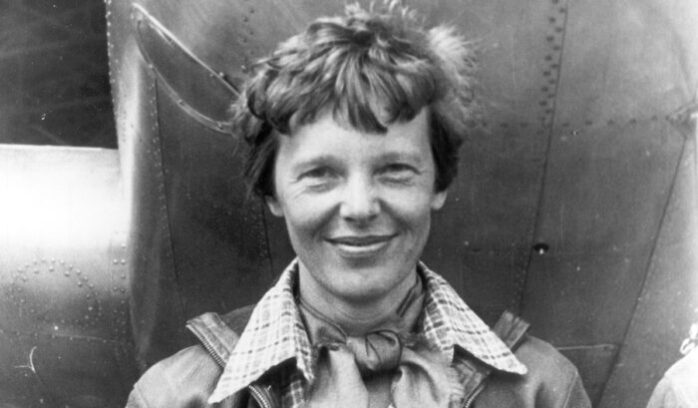
Amelia Earhart, for article on solo transatlantic flight

Amelia Earhart becomes first woman to fly the Atlantic solo

Amelia Earhart lifted off from Harbour Grace, Newfoundland on May 20, 1932, and pointed her red Lockheed Vega east across the Atlantic. Fifteen hours later, battered by ice, flames from a cracked manifold, and a broken altimeter, she landed in an Irish pasture — the first woman to fly the ocean solo, and only the second pilot ever.

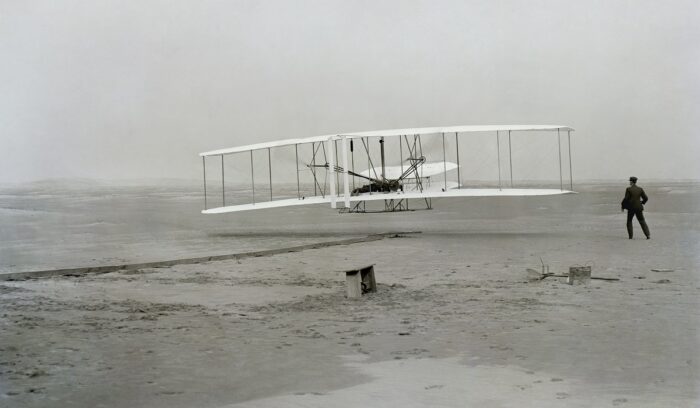
The first controlled, for article on powered airplane flight

Wright Brothers achieve first powered airplane flight at Kitty Hawk

Powered flight began on a cold December morning in 1903, when Orville and Wilbur Wright lifted a homemade machine off the dunes of Kitty Hawk, North Carolina. The first hop lasted 12 seconds; by day’s end, they had flown four times, the longest covering 852 feet. Two bicycle mechanics, working mostly alone, had solved controlled flight.

London Underground signage, for article on london underground history

London’s Metropolitan Railway opens as the world’s first underground passenger railway

The London Underground opened on January 10, 1863, when 38,000 passengers descended into gas-lit wooden carriages running beneath Paddington and Farringdon. Steam locomotives filled the tunnels with such thick fumes that staff were encouraged to grow beards as filters. It was the world’s first underground railway — a template cities everywhere would eventually follow.

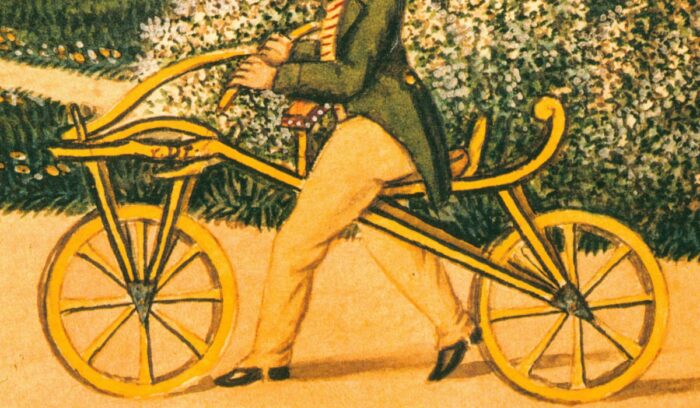
Karl von Drais on his original Laufmaschine, for article on draisine invention

Karl von Drais builds the first human-powered two-wheeled vehicle

The bicycle’s ancestor rolled into existence on June 12, 1817, when German inventor Karl von Drais glided 14 kilometers between Mannheim and Schwetzingen on a two-wheeled wooden contraption he pushed with his feet. He built it during the crop-failing “Year Without a Summer,” when starving horses made a self-powered machine feel suddenly necessary. Every bicycle since traces back to that ride.