Good News

School meal

Free school meals to be extended to half a million more of England’s poorest children

Since 2018, children in England have only been eligible for free school meals if their household income is less than £7,400 per year, meaning hundreds of thousands of children living in poverty have been unable to access them. Now, from the start of the 2026 school year, every child whose household is on universal credit will be entitled to free school meals. The major policy expansion is expected to offer free meals to an additional 500,000 children across, lift 100,000 children out of poverty, and put an extra £500 in parents’ pockets.

Aerial view of river

The Yurok Tribe reclaims 17,000 acres of stolen land in California’s largest-ever landback deal

The Yurok people have lived along the Klamath River in Northern California for millennia. But when the California gold rush began, the tribe lost 90% of its territory. For the last two decades, the tribe has worked with the nonprofit Western Rivers Conservancy to get its land back. The 17,000 acres compose the final parcel of a $56 million, 47,097-acre land transfer that effectively doubles the tribe’s land holdings. The tribe has already designated the land as a salmon sanctuary and community forest and plans to put it into a trust.

Sea turtle underwater

Samoa establishes nine new marine protected areas covering 30% of its ocean

The Samoan government has enacted a law establishing a plan to sustainably manage 100% of its ocean by 2030. The plan creates nine new marine protected areas that cover 30% of Samoa’s ocean, an area roughly the size of Taiwan. The MPAs mean that Samoa meets its 2020 agreement to protect 30% of Earth’s land and ocean by 2030. They ban activities that harm marine life or habitats, including fishing, mining, and drilling.

Art against domestic violence

Colorado passes new law to reform handling of sexual assault cases and reduce rape kit backlog

Currently, it takes 554 days for the Colorado Bureau of Investigation (CBI) to process DNA evidence kits from sexual assaults, leaving 1,369 cases in limbo as victims and investigators wait for results. The new law, now officially signed by Gov. Polis, requires increased oversight of CBI and creates a 60-day turnaround goal per DNA evidence kit, three times faster than the state’s current 180-day guidance. Sexual assault victims will be entitled to updates on their pending evidence kits every 90 days under the new law.

Person repairing a smartphone

Five U.S. states have passed Right to Repair legislation in 2025

Right-to-repair bills allow consumers to fix broken products and replace missing parts, boosting consumer rights, affordability, and waste reduction. In May, Washington Gov. Ferguson signed two bills, covering consumer electronics, appliances, and wheelchairs. Then, the Oregon and Nevada legislatures passed their own wheelchair bills, while Texas and Connecticut passed consumer electronics measures. 2025 is now already the most productive year ever for Right to Repair.

Silhouette of wind turbines at dusk

Wind overtakes fossil fuels as U.K.’s primary source of electricity

For the first time in British history, UK wind energy generated more electricity across a full calendar year than fossil fuels, according to Ember’s 2024 annual energy analysis and government statistics. Wind hit a record 29.5% of UK electricity in 2024, while fossil fuels fell to 31.8% — their lowest share since the 1950s. Combined wind, solar, and hydro reached 37% of UK electricity, overtaking fossil fuels at 35%. The UK also closed its last coal plant in October 2024. Just three years earlier, in 2021, fossil fuels produced 46% of UK electricity while renewables produced 27%.

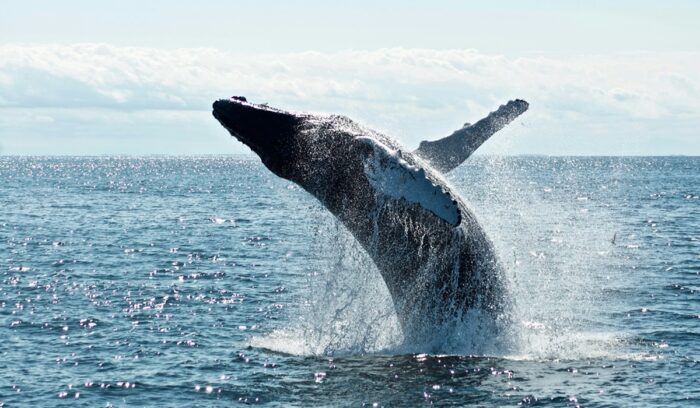
Whale jumping

E.U. pledges €3.5 billion to protect world’s oceans

At the Our Ocean Conference in Greece, the European Union demonstrated its strong engagement for international ocean governance by announcing 40 commitments for action for 2024. These actions will be funded by €3.5 billion from various E.U. funds, including €1.9 billion for sustainable fisheries in Greece, Spain, Cyprus, Poland, and Portugal.

Happy family

Consumption poverty in the U.S. has fallen 27% since 1980

Between 1980 and 2022, consumption poverty fell from 33.8% to 6.0% even though the official poverty rate indicated a drop by only 1.5 percentage points over that same period. According to researchers from the University of Notre Dame, consumption, which measures what families are able to purchase in terms of food, housing, transportation, and other goods and services, offers a better indicator of economic well-being than income, which can fluctuate for reasons unrelated to well-being.