
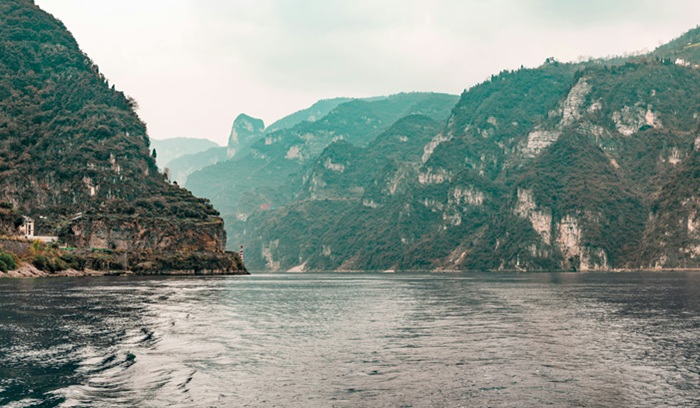
Along the Chishui River, a key tributary of the Yangtze, China has demolished more than 300 dams and shut down 342 small hydropower plants in what ranks among the largest river restoration efforts ever attempted. The move marks a striking reversal: a government that spent decades building water infrastructure is now systematically dismantling it, prioritizing ecological health over energy output — and the results are already visible in the water.
At a glance
- Yangtze River restoration: More than 300 dams and 342 small hydropower stations have been removed from the Chishui River, a major Yangtze tributary, restoring natural flow to a historically biodiverse waterway.
- Yangtze sturgeon: The critically endangered fish, once considered extinct in the wild, has been observed returning to healthier habitats following the removal of barriers that blocked its migratory routes.
- Fishing ban: In 2020 C.E., China imposed a decade-long moratorium on commercial fishing across the Yangtze and its tributaries, compounding the ecological benefits of the dam removals.
Why removing dams works
When a dam comes down, rivers respond quickly. Water moves at its natural pace again. Sediment travels downstream the way it should. Fish that were cut off from spawning grounds can reach them once more.
On the Chishui, scientists have documented exactly this sequence. Fragmented habitats have been reconnected. Migratory routes that had been blocked for decades are open again. The Yangtze sturgeon — a species that has survived on Earth for more than 140 million years — is among those benefiting, with researchers observing signs of recovery in sections of the river that were previously inaccessible.
A landmark study published in Nature found that dam removals consistently improve ecological conditions within years, not decades. The Chishui project fits that pattern, and its scale gives researchers an unusually large dataset to study.
A coordinated plan, not just demolition
The dam removals don’t stand alone. China’s approach to Yangtze River restoration has been deliberately layered.
The 2020 C.E. fishing ban — which runs through 2030 C.E. — removed commercial pressure from a river system that had been severely overfished. New regulations targeting sand mining, a major driver of riverbed degradation, added another layer of protection. Water quality monitoring has been scaled up across the basin. Together, these measures are designed to give the ecosystem enough breathing room to rebuild itself.
The World Wildlife Fund has documented the Yangtze’s biodiversity crisis for years, noting that the river basin holds more than 400 fish species and supports hundreds of millions of people. Restoring it is both an ecological and a human priority.
Communities and economies along the river
River restoration carries real economic weight. Healthier waterways support cleaner drinking water, more productive fisheries over the long term, and new opportunities for sustainable tourism — all of which matter to the communities that depend on the Chishui and the Yangtze.
Research by Headwaters Economics has shown that dam removal projects across multiple countries generate measurable economic returns, particularly in rural areas where local livelihoods are tied to river health. The Chishui corridor, with restored fish populations and cleaner water, is positioned to see similar gains.
China is not alone in this shift. American Rivers reports that thousands of dams have been removed across the U.S. over the past three decades, with consistent improvements in aquatic biodiversity, flood resilience, and community well-being. Europe has removed more than 5,000 dams since 2000 C.E. The Chishui project adds significant momentum to what is now a genuinely global movement.
This kind of coordinated ambition is part of a broader pattern of large-scale environmental action. As countries pursue renewable energy alternatives that now make up nearly half of global power capacity, pressure on rivers for hydropower is beginning to ease — creating conditions where projects like this become politically and economically viable.
What remains unfinished
The Yangtze River restoration is an ambitious undertaking, but it faces real limits. Decades of pollution, habitat loss, and population pressure don’t reverse overnight, and some species — including the Yangtze River dolphin, declared functionally extinct in 2006 C.E. — cannot be brought back regardless of how well the river recovers. The fishing ban also displaces tens of thousands of fishing families, whose economic transition depends on government support programs that vary in effectiveness.
Still, the Chishui project demonstrates something important: political will and coordinated policy can produce measurable ecological recovery at a scale that once seemed impossible. That’s a finding with implications far beyond China’s borders — and a reason to watch what happens next on the Yangtze with genuine interest.
Advances in ecological science are expanding our understanding of what recovery is possible, much as advances in medicine have driven progress elsewhere — including in areas like declining cancer death rates in the U.K., another sign of what sustained, evidence-based effort can achieve.
Read more
For more on this story, see: Good News for Humankind
For more from Good News for Humankind, see:
- Renewables now make up at least 49% of global power capacity
- U.K. cancer death rates down to their lowest level on record
- The Good News for Humankind archive on environment
About this article
- 🤖 This article is AI-generated, based on a framework created by Peter Schulte.
- 🌍 It aims to be inspirational but clear-eyed, accurate, and evidence-based, and grounded in care for the Earth, peace and belonging for all, and human evolution.
- 💬 Leave your notes and suggestions in the comments below — I will do my best to review and implement where appropriate.
- ✉️ One verified piece of good news, one insight from Antihero Project, every weekday morning. Subscribe free.
More Good News
-
Rhinos return to Uganda’s wild after 43 years in landmark conservation milestone
For the first time in 43 years, wild rhinos are roaming Uganda again. After poaching wiped out the population in the early 1980s, conservation authorities have successfully reintroduced rhinos into Kidepo Valley National Park — the result of decades of breeding, community engagement, and anti-poaching work. The milestone is one of Africa’s most significant wildlife recovery achievements in recent memory and offers a model for rewilding efforts across the continent.
-

UK cancer death rates fall to lowest level ever recorded in historic milestone
Cancer death rates in the United Kingdom have fallen to their lowest level ever recorded, Cancer Research UK announced in March 2026. Decades of investment in screening programs, early detection, and new treatments are behind the milestone. Despite the progress, researchers warn that geographic and socioeconomic inequalities in cancer outcomes remain significant, and that sustained funding and equitable access to care will be essential to drive further gains.
-

California condors nest on Yurok land in Pacific Northwest for first time in over a century
California condors are nesting in the Pacific Northwest for the first time in more than a century, confirmed on Yurok Tribe territory in Northern California. The Yurok, who regard condors as sacred relatives, launched their restoration program in 2003 and released the first birds in 2022. The nesting confirmation marks a milestone for both species recovery and Indigenous-led conservation, showing that when Native peoples lead ecological restoration on their own lands, the results can be extraordinary.
