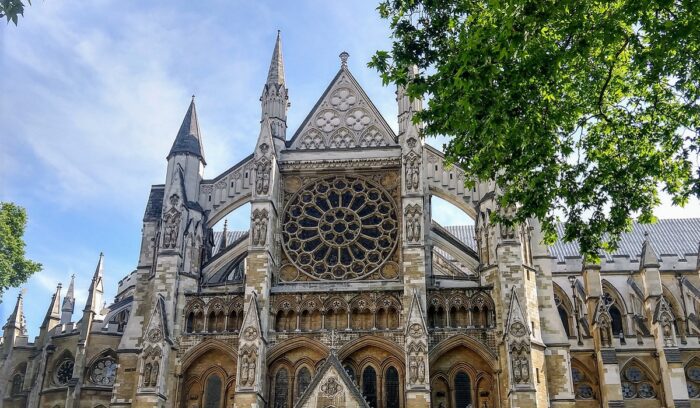
On a summer morning in July 1245 C.E., workers broke ground on one of the most ambitious building projects medieval England had ever attempted. King Henry III of England had ordered the old Romanesque church at Westminster torn down and rebuilt from scratch — taller, more luminous, and more French in spirit than anything England had yet produced. What rose from that foundation over the following decades would become one of the most visited, most storied buildings on Earth.
Key facts
- Westminster Abbey construction: Henry III ordered the rebuild on 6 July 1245 C.E., placing master mason Henry of Reynes in charge of a workforce that swelled to 400 workers during peak summer seasons.
- Gothic architecture: The design drew heavily from French precedents — particularly Reims Cathedral and the Sainte-Chapelle in Paris — making the abbey among the earliest and purest expressions of the Gothic style on English soil.
- Medieval craftsmanship: The building crew included stonecutters, marblers, glaziers, plumbers, painters, smiths, and marble polishers — a coordinated labor force that represented the full range of high medieval building trades.
Why Henry III built it
Henry III was not simply building a church. He was building a statement.
He wanted Westminster to rival the great sanctuaries of France — cathedrals that used height and light and stone filigree to suggest the divine pressing through into the material world. He also wanted a shrine worthy of Edward the Confessor, the Anglo-Saxon king who had commissioned the first major church on the site in the 1040s C.E. and who had been canonized as a saint in 1161 C.E. And he wanted a royal burial church — a place where his own remains, and those of his dynasty, would rest in glory.
Those three purposes — veneration, competition, and legacy — drove every stone laid from 1245 C.E. onward.
The abbey that existed before 1245 C.E. was already old and historically weighted. Edward the Confessor had built in the Romanesque style, with thick walls, rounded arches, and a cruciform floor plan — the first of its kind in England. That building had stood for nearly two centuries. Henry ordered it replaced not because it was failing, but because he dreamed of something greater.
The builders behind the building
Henry of Reynes led the first phase of construction, overseeing the eastern end, the transepts, and the easternmost bay of the nave. His name suggests a connection to Reims, France, and the design choices visible in the abbey’s early sections — the tall arcades, the clerestory windows, the radiating chapels — confirm that French Gothic influence was central to his vision.
Around 1253 C.E., Henry of Reynes was succeeded by John of Gloucester, then by Robert of Beverley around 1260 C.E. Each mason brought his own interpretation to the project, which is partly why the abbey today is a layered conversation between different hands and different moments in time.
The funding was equally layered — and not always voluntary. A major portion of the cost of the shrine to Edward the Confessor came from the estate of David of Oxford and from a forced contribution of £2,500 extracted from Licoricia of Winchester, a Jewish moneylender and one of the wealthiest women in 13th-century England. That contribution was the largest single donation to the abbey at the time. Licoricia’s role in financing the shrine — under legal coercion — is one of the more uncomfortable details embedded in the building’s foundation story, and one that mainstream accounts often omit.
By 1261 C.E., Henry III had spent over £29,000 on the abbey. The final total may have approached £50,000 — an almost incomprehensible sum for the era. A consecration ceremony held on 13 October 1269 C.E. marked a major milestone, when the remains of Edward the Confessor were moved to their new shrine behind the main altar.
Lasting impact
The abbey Henry III began in 1245 C.E. has functioned as the symbolic center of English — and later British — national life for nearly 800 years.
It has hosted the coronations of 40 monarchs since William the Conqueror in 1066 C.E. It became the burial site of 18 monarchs, as well as poets, scientists, military leaders, and an unknown soldier representing all those who died unnamed in war. UNESCO designated the abbey, the Palace of Westminster, and St Margaret’s Church a World Heritage Site in 1987 C.E., citing their historic and symbolic significance.
The building also had political consequences its builders never anticipated. From 1257 C.E., Henry III held assemblies of local representatives in the abbey’s chapter house. Those gatherings were a direct precursor to what would become the House of Commons — meaning that one of the foundational institutions of parliamentary democracy has roots in a room built to serve a medieval shrine.
The abbey’s Gothic architecture influenced English church design for generations. Its nave, completed over more than a century after Henry’s death, became a reference point for later builders working in the Perpendicular Gothic style. The Henry VII Chapel, added at the eastern end in the early 16th century C.E., was called by the antiquarian John Leland “orbis miraculum” — the wonder of the world.
Blindspots and limits
The abbey’s story has generally been told through its monarchs, its architects, and its famous dead. The hundreds of laborers — stonecutters, painters, glaziers, and general workers — who built it over decades are largely nameless in the historical record. The forced financial contribution from Licoricia of Winchester, extracted under conditions that reflected the legal persecution of Jewish communities in medieval England, is a reminder that monumental architecture often rests on power exercised without consent. Construction also stopped and started repeatedly after Henry III’s death in 1272 C.E., leaving Edward the Confessor’s old Romanesque nave attached to the new Gothic building for over a century — a patchwork that the building still quietly contains.
Read more
For more on this story, see: Westminster Abbey — Wikipedia
For more from Good News for Humankind, see:
- U.K. cancer death rates fall to their lowest level on record
- Renewables now make up at least 49% of global power capacity
- The Good News for Humankind archive on the medieval era
About this article
- 🤖 This article is AI-generated, based on a framework created by Peter Schulte.
- 🌍 It aims to be inspirational but clear-eyed, accurate, and evidence-based, and grounded in care for the Earth, peace and belonging for all, and human evolution.
- 💬 Leave your notes and suggestions in the comments below — I will do my best to review and implement where appropriate.
- ✉️ One verified piece of good news, one insight from Antihero Project, every weekday morning. Subscribe free.