
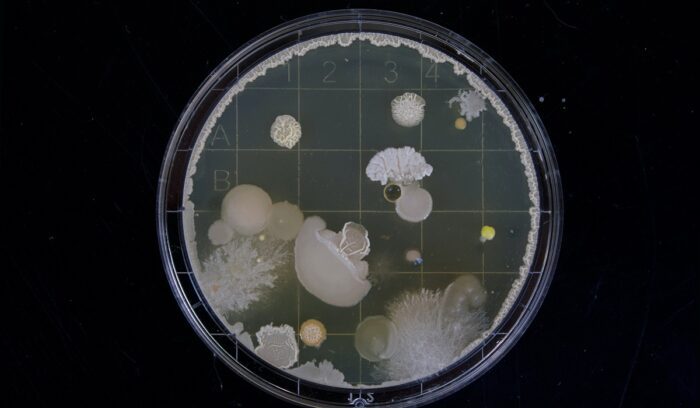
In 1675 C.E., a cloth merchant in the Dutch city of Delft pressed his eye to a tiny bead of glass and saw something no human had ever documented: a droplet of pond water swarming with miniature living creatures. Antonie van Leeuwenhoek called them animalcules. We now call them microorganisms. In that moment — or something very close to it — the boundary of the visible world shifted permanently.
What the evidence shows
- Van Leeuwenhoek microscope: Leeuwenhoek’s handmade single-lens instruments achieved magnifications up to approximately 266×, far exceeding the 30–50× possible with the compound microscopes of his era, while producing sharper, clearer images with fewer optical distortions.
- Free-living microorganisms: In more than 200 letters to the Royal Society of London, Leeuwenhoek documented the first systematic observations of microorganisms living independently in water, soil, and the human mouth — descriptions detailed enough that modern scientists can identify many of the species he saw.
- Single-lens design: By reducing optical interfaces to a minimum — one tiny, nearly perfectly spherical glass bead mounted between brass plates — Leeuwenhoek eliminated the chromatic and spherical aberrations that blurred compound microscopes, a design principle confirmed by modern neutron tomography and interferometric analysis of his surviving instruments.
A craftsman in a city of seeing
Leeuwenhoek was not a trained scientist. He had no university degree, read no Latin, and moved in the world of commerce, not academia. What he had was extraordinary patience, exceptional manual skill, and an almost obsessive curiosity about how things looked up close.
He also had Delft. The city in the mid-seventeenth century was a crossroads of optical craft, artistic ambition, and mercantile precision. The painter Johannes Vermeer — whose The Geographer (1668 C.E.) depicts a figure absorbed in maps and measuring tools — likely walked the same streets as Leeuwenhoek. Archival records show Leeuwenhoek served as executor of Vermeer’s estate after the painter’s death. Both men were, in their different ways, committed to the same project: seeing the world more clearly than anyone had before.
That cultural environment mattered. Dutch visual culture of the era prized material fidelity, clarity, and truth to observation. Leeuwenhoek absorbed all of it. His microscopes were not sophisticated in the way we typically imagine scientific instruments — they were small enough to hold in one hand, with no tubes or eyepieces, requiring the user to hold the lens almost directly against the eye. But in their simplicity lay their power.
What he saw — and what it meant
When the Royal Society of London received Leeuwenhoek’s letters describing living creatures in pond water, the reaction ranged from astonishment to skepticism. The Society sent a delegation to Delft to verify his claims. They confirmed what he had described.
But Leeuwenhoek’s observations went well beyond pond water. He documented red blood cells and the flow of blood through capillaries, resolving a question that had puzzled anatomists for decades. He observed spermatozoa, overturning assumptions about reproduction. He described the bacteria in his own mouth — a community of microorganisms living in a human body, undetected for all of prior history. He examined fungal hyphae, the structure of wood vessels, and the geometry of salt crystals, showing that hidden order pervades living and non-living matter alike.
Each observation arrived not as a theory but as a carefully drawn fact. Leeuwenhoek’s method was empirical before empiricism had a name: look, describe, repeat, submit to scrutiny. The Royal Society published his findings in its journal Philosophical Transactions, circulating them across Europe’s scientific community. He was elected a Fellow of the Society in 1680 C.E.
Lasting impact
It is difficult to overstate how much of modern medicine rests on what Leeuwenhoek started. The germ theory of disease — the foundational insight that microorganisms cause illness — would not be formalized until the work of Louis Pasteur and Robert Koch in the nineteenth century C.E. But it could not have happened without someone first proving that microorganisms existed. That someone was Leeuwenhoek.
The downstream consequences are staggering. Vaccines, antibiotics, surgical sterilization, food safety standards, water treatment systems, understanding of infection and immunity — all trace a direct intellectual line back to a cloth merchant in Delft pressing his eye to a glass bead in 1675 C.E.
His design philosophy has proven equally durable. The single-lens principle — minimize optical interfaces, maximize clarity — lives on in unexpected places. The Foldscope, a paper-based microscope developed at Stanford University that costs under a dollar to produce, applies the same logic: a single micro-lens mounted on a folded sheet, capable of 140× magnification, now used in classrooms and field research across the developing world. Clip-on smartphone microscopes work on the same principle. Leeuwenhoek’s minimalism turned out to be not a limitation but a template.
His work also established something quieter but equally important: that rigorous observation by a single dedicated person, working without institutional support, could redefine the boundaries of human knowledge. Science did not require a cathedral. It required attention.
Blindspots and limits
Leeuwenhoek never fully understood what he was seeing. He documented microorganisms with extraordinary precision but had no framework for what they were, how they reproduced, or why they mattered to human health — those connections would take nearly two centuries to establish. He also guarded his lens-making techniques jealously, taking most of his methods to his grave in 1723 C.E., which slowed the replication of his work and left a significant gap in microscopic capability for decades after his death. And the historical record almost certainly underrepresents others who may have glimpsed the microbial world without the literacy, access, or institutional connections to document it in ways that survived.
Read more
For more on this story, see: Antonie van Leeuwenhoek and the birth of scientific microscopy — Springer
For more from Good News for Humankind, see:
- Antrea Net reveals how early humans fished with precision and skill
- Bear bone from County Clare reveals possible evidence of Ireland’s first humans
- The Good News for Humankind archive on the early modern era
About this article
- 🤖 This article is AI-generated, based on a framework created by Peter Schulte.
- 🌍 It aims to be inspirational but clear-eyed, accurate, and evidence-based, and grounded in care for the Earth, peace and belonging for all, and human evolution.
- 💬 Leave your notes and suggestions in the comments below — I will do my best to review and implement where appropriate.
- ✉️ One verified piece of good news, one insight from Antihero Project, every weekday morning. Subscribe free.


