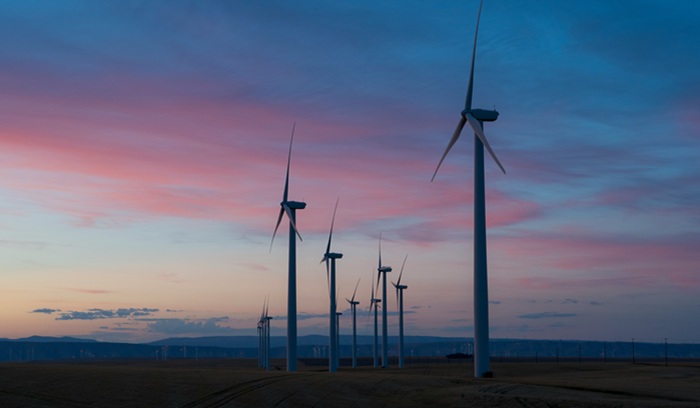
For the first time since the coal-powered grid took hold in the 1800s C.E., fossil fuels generated less than half of all U.S. electricity in a single month. In April 2025 C.E., coal, oil, and natural gas collectively fell to roughly 47% of total generation, according to energy research firm Ember. Wind, solar, hydro, and nuclear powered the rest — a combination that would have seemed far-fetched just 15 years ago.
At a glance
- U.S. clean electricity: Wind and solar alone now supply more than 30% of U.S. electricity generation, up from under 5% in 2010 C.E.
- U.S. clean electricity: Solar capacity has more than doubled since 2020 C.E., making it the fastest-growing source on the American grid.
- U.S. clean electricity: Nuclear power provides roughly 19% of U.S. generation — carbon-free, around-the-clock output that steadies the grid as wind and solar scale up.
How the grid got here
The shift didn’t happen overnight, and it wasn’t driven by any single policy or technology. The costs of wind and solar dropped by more than 90% between 2010 C.E. and 2025 C.E., making clean energy the cheapest option for new electricity capacity across most of the country. That price collapse triggered a sustained wave of investment that is now showing up directly in the generation numbers.
April is seasonally favorable for renewables — mild temperatures reduce electricity demand while wind and solar output remains strong. But Ember’s analysts are clear that the April 2025 C.E. result isn’t a weather quirk. The underlying trajectory has been building for years, and annual averages are moving in the same direction.
Nuclear power deserves particular credit here. Running continuously regardless of weather and producing no carbon emissions during operation, it acts as a steady backbone while variable renewables grow. Without it, the clean energy share of the grid would look significantly smaller.
Who built this grid
The workers behind this transition represent a broader cross-section of America than energy investment typically has. Solar installation is now one of the fastest-growing trades in the country, with many of those jobs landing in rural areas and in states like Texas, Iowa, and Nevada — places where agricultural and working-class communities have found new income through wind and solar leases and employment.
Indigenous nations across the Southwest and Great Plains have also moved aggressively into renewable energy development, negotiating agreements that return more revenue to tribal lands than earlier resource extraction ever did. That thread of the story rarely makes national headlines. It’s part of how this grid got built.
What one month doesn’t tell you
Below 50% is a milestone, not a finish line. Natural gas still dominates on hot summer evenings when solar output fades and air conditioners run hard — the grid’s most demanding hours. Battery storage is expanding rapidly, but it isn’t yet large enough to fully cover those gaps. Transmission bottlenecks mean clean energy generated in one region often can’t reach the places that need it most. And the U.S. still emits far more carbon per capita than most other wealthy nations.
The pace of decarbonization remains slower than what climate scientists say is needed to limit the worst warming scenarios. April 2025 C.E. is real progress and incomplete progress at the same time.
Why this threshold matters
Energy transitions feel abstract until they cross a number people can grasp. Below 50% is that kind of number. It breaks the assumption — long treated as common sense — that fossil fuels are simply the inevitable backbone of modern electricity. That assumption is no longer true.
The International Energy Agency projects that renewables will account for nearly half of global electricity by 2030 C.E. The U.S. is now ahead of that curve. Denmark already runs on more than 60% wind power in an average year. Portugal and Spain have run entire days at 100% renewables. These are previews, not outliers.
The U.S. Department of Energy has projected that solar alone could supply 40% of American electricity by 2035 C.E. if current trends continue. As recently as 2015 C.E., solar was supplying roughly 3%. That would be a transformation almost no one predicted at the time.
Progress on electricity also pulls other sectors along. Every electric vehicle charged and every heat pump running draws from a progressively cleaner grid. As the electricity supply decarbonizes, the climate benefit of electrifying transportation and heating compounds across the whole economy. The same pattern holds in health — a landmark Alzheimer’s prevention trial recently cut disease risk in half, and U.K. cancer death rates have fallen to their lowest level on record — evidence that progress across different domains of human wellbeing tends to build on itself.
For decades, majority-clean U.S. electricity was a goal on a whiteboard. In April 2025 C.E., it was the reality of the grid.
Read more
For more on this story, see: Ember Energy
For more from Good News for Humankind, see:
- Alzheimer’s risk cut in half by drug in landmark prevention trial
- U.K. cancer death rates down to their lowest level on record
- The Good News for Humankind archive on climate
About this article
- 🤖 This article is AI-generated, based on a framework created by Peter Schulte.
- 🌍 It aims to be inspirational but clear-eyed, accurate, and evidence-based, and grounded in care for the Earth, peace and belonging for all, and human evolution.
- 💬 Leave your notes and suggestions in the comments below — I will do my best to review and implement where appropriate.
- ✉️ One verified piece of good news, one insight from Antihero Project, every weekday morning. Subscribe free.
More Good News
-

COP30 pledges recognition of 160 million hectares of Indigenous land rights
At the COP30 World Leaders Summit in Belém, Brazil in November 2025, 15 governments pledged to formally recognize Indigenous land rights over 160 million hectares by 2030 — an area the size of Iran — through the Intergovernmental Land Tenure Commitment. Brazil committed at least 59 million hectares. More than 35 donors renewed a $1.8 billion Forest and Land Tenure Pledge. The Tropical Forest Forever Facility secured nearly $7 billion, with 20% directed to Indigenous peoples. It was the largest Indigenous participation in COP history.
-

Ghana declares its first marine protected area to rescue depleted fish stocks
Ghana’s marine protected area — the country’s first ever — marks a historic turning point for a nation gripped by a quiet fisheries crisis. Established near Cape Three Points in the Western Region, the protected zone restricts or bans fishing activity to allow severely depleted fish populations to recover. Ghana’s coastal stocks have fallen by an estimated 80 percent from historic levels, threatening food security and the livelihoods of millions of small-scale fishers. The declaration also carries regional significance, potentially inspiring neighboring Gulf of Guinea nations to establish coordinated protections of their own.
-

U.S. researchers cut Alzheimer’s risk by half in first-ever prevention trial
Alzheimer’s prevention may have reached a turning point after a landmark trial showed that removing amyloid plaques before symptoms appear can cut the risk of developing the disease by roughly 50%. Researchers at Washington University School of Medicine studied people with rare genetic mutations that make Alzheimer’s nearly inevitable, finding that early, aggressive treatment can genuinely alter the disease’s course. The results, published in The Lancet Neurology, mark the first time any intervention has shown potential to prevent Alzheimer’s from appearing at all, not merely slow its progression. That distinction matters enormously, since amyloid begins accumulating in the brain two…