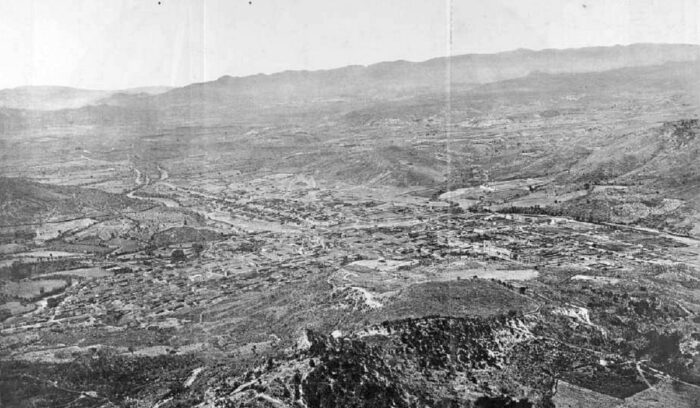
On September 29, 1578 C.E., a group of Spanish colonizers staked a claim on a valley ringed by mountains in what is now south-central Honduras. They named their new settlement Real de Minas de San Miguel de Tegucigalpa — Royal Silver Mines of Saint Michael of Tegucigalpa — and in doing so planted the seed of what would grow, over the following four centuries, into the largest city in Honduras.
Key facts about the Tegucigalpa founding
- Tegucigalpa founding: Spanish colonizers formally claimed the site on September 29, 1578 C.E., establishing it as a mining settlement on land already occupied by Lenca and Tolupan peoples.
- Nahuatl place name: The word “Tegucigalpa” most likely derives from the Nahuatl language, with competing interpretations ranging from “hills of silver” to “place of painted rocks” to “homes of the sharp stones” — none fully settled by scholars.
- Colonial urban growth: Within two centuries, the settlement had gained a cathedral, a mint, multiple churches, and its first masonry bridge — all foundations of a city that would eventually become a national capital.
A valley that was already home
Before any Spanish document recorded the name Tegucigalpa, the valley was inhabited. The Lenca and Tolupan peoples lived on this land, and the Spanish settlement was built directly on an existing native site. This is not a footnote — it is the foundation.
The name itself carries this history. Most linguists trace “Tegucigalpa” to Nahuatl, the language of the Mexica and other Mesoamerican peoples whose reach extended well into Central America. The most popular translation, “hills of silver,” turns out to be historically ironic: local Indigenous peoples at the time reportedly had no knowledge of the mineral deposits that made the Spanish so eager to settle. Other translations — “painted rocks,” “place of the noble’s residence,” “homes of the sharp stones” — each suggest a landscape already named, known, and inhabited long before 1578 C.E.
The Spanish brought ambition and a mining economy. They found a valley that already had a name worth arguing about for centuries.
Silver, governance, and early city life
The settlement’s first mayor, Juan de la Cueva, took office in 1579 C.E. — just one year after the founding. The speed of that administrative step reflects how seriously the Spanish crown treated its mining outposts. Silver was the engine of the colonial economy across the Americas, and Tegucigalpa was positioned to feed it.
Over the next two hundred years, the town accumulated the architecture of permanence. The Dolores Church went up in 1735 C.E. The San Miguel Cathedral followed in 1765 C.E. The Casa de la Moneda — the mint — opened in 1780 C.E., turning locally extracted silver into currency. By 1762 C.E., the settlement had been elevated to the status of Real Villa under Governor Alonso Fernández de Heredia.
None of this growth was smooth. The town’s local government was dissolved entirely in 1788 C.E., absorbed into neighboring Comayagua in 1791 C.E., and only restored to self-governance in 1817 C.E. Colonial bureaucracy pushed and pulled at Tegucigalpa for generations before the city found its footing.
The long road to becoming a capital
When Honduras gained independence, Tegucigalpa still wasn’t the capital. That distinction belonged to Comayagua, which had served as the colonial seat of power. After 1824 C.E., the two cities were required to alternate as capital — an arrangement that continued, awkwardly, for decades.
It wasn’t until October 30, 1880 C.E., that President Marco Aurelio Soto declared Tegucigalpa the permanent capital of Honduras. The reasons were partly practical: Soto had close ties to the Rosario Mining Company, an American silver mining firm operating near the city, and keeping the seat of government nearby served his interests. A popular legend adds a more colorful explanation — that Comayagua society snubbed the president’s wife, and the capital move was revenge. Historians tend to favor the mining explanation.
Either way, the decision made permanent what 1578 C.E. had set in motion.
Lasting impact
The Tegucigalpa founding established the geographic and administrative center around which a modern nation would eventually organize itself. The city today is home to more than a million people, 25 foreign embassies, the National Autonomous University of Honduras, and the country’s main political institutions. The Choluteca River valley — once a Lenca and Tolupan homeland, then a silver mining camp — now anchors the civic life of an entire country.
The 1578 C.E. founding also set patterns that persist. The city’s location in a mountain-ringed valley shaped its geography in ways that still challenge urban planners today. Roads laid out for a mining town struggle to serve a metropolis. The tension between rapid growth and deliberate planning has defined Tegucigalpa across every era of its existence.
And the name endures. Whatever its precise origin — silver hills, painted rocks, sharp stones, or noble homes — “Tegucigalpa” is one of the few colonial-era city names in Latin America that preserves, in sound and syllable, a trace of the Indigenous languages that came before the settlers arrived. Locals call the city “Teguz” or “Tegus.” The full name, more than 400 years old, carries a linguistic history that no official record fully explains.
Blindspots and limits
The historical record of the Tegucigalpa founding is almost entirely Spanish — what the Lenca and Tolupan peoples experienced, called this valley, or understood about its transformation into a mining colony is largely lost. The founding is documented as an act of Spanish administration, not as a story that includes the people already living there. That gap is not accidental; it reflects the nature of colonial record-keeping, and it means the full human story of this valley’s transformation remains only partially told.
Read more
For more on this story, see: Wikipedia — Tegucigalpa
For more from Good News for Humankind, see:
- Indigenous land rights win protects 160 million hectares at COP30
- Renewables now make up at least 49% of global power capacity
- The Good News for Humankind archive on Honduras
About this article
- 🤖 This article is AI-generated, based on a framework created by Peter Schulte.
- 🌍 It aims to be inspirational but clear-eyed, accurate, and evidence-based, and grounded in care for the Earth, peace and belonging for all, and human evolution.
- 💬 Leave your notes and suggestions in the comments below — I will do my best to review and implement where appropriate.
- ✉️ One verified piece of good news, one insight from Antihero Project, every weekday morning. Subscribe free.