
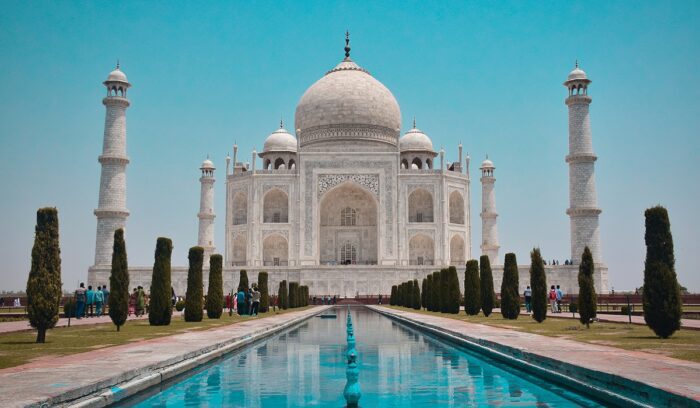
In 1653 C.E., after more than two decades of labor, the Taj Mahal complex in Agra, India, stood complete. Emperor Shah Jahan had set out to build something that had never existed before — a monument so perfectly conceived that it would outlast his grief, his dynasty, and the civilization that made it possible.
What the evidence shows
- Taj Mahal construction: The mausoleum’s central structure was finished in 1648 C.E., but the surrounding mosque, guest house, gardens, and ornamental gateways were not completed until 1653 C.E., making that year the accepted date of the full complex.
- Mughal architecture: The design synthesized Persian, Ottoman, Central Asian, and Indian traditions — executed by a multinational team of architects, calligraphers, and artisans drawn from across the Islamic world and the subcontinent.
- Workforce and cost: More than 20,000 workers and artisans contributed to the project, which cost an estimated ₹32 million at the time — equivalent to roughly US$827 million in 2015 C.E. terms.
A love letter in marble
Shah Jahan commissioned the Taj Mahal in 1631 C.E., the year his wife Mumtaz Mahal died giving birth to their 14th child. Court historians recorded that he was devastated — he withdrew from royal duties for a week and reportedly gave up music and elaborate dress for two years.
The monument he conceived was not simply a tomb. It was a statement about love, permanence, and the afterlife. The name itself — derived from Arabic and Persian roots — means “Crown of the Palace.” The complex includes a mosque, a guest house, formal gardens, and a reflecting pool, all arranged along precise axes of symmetry.
The central mausoleum rises on a platform 8.7 meters high. Its famous onion-shaped marble dome reaches 23 meters, surrounded by four smaller domes and four minarets — each deliberately tilted slightly outward so that, in the event of an earthquake, they would fall away from the tomb rather than onto it. That is not poetry. That is engineering.
A multinational achievement
The Taj Mahal was never a solo act. UNESCO’s World Heritage designation describes it as “the jewel of Islamic art in India,” and the building’s origins reflect exactly that — a convergence of traditions from across the known world.
The project was led by Ustad Ahmad Lahori, Shah Jahan’s court architect, but the full design team included Ottoman dome specialist Ismail Afandi; Persian architects Ustad Isa, Isa Muhammad Effendi, and Puru; chief calligrapher Amanat Khan Shirazi from Shiraz; finial caster Qazim Khan; and multiple masonry supervisors from across the Mughal empire. The Archaeological Survey of India, which now administers the monument, recognizes it as a product of this cross-cultural collaboration.
Design inspirations reached back even further. The Gur-e Amir in Samarkand — the tomb of Timur, progenitor of the Mughal dynasty — influenced the dome. Humayun’s Tomb in Delhi, completed in 1572 C.E., informed the layout of the char bagh gardens and the hasht-behesht (“eight paradises”) plan of the site. The Taj Mahal was the culmination of a long architectural conversation that stretched from Central Asia to the Deccan plateau.
Lasting impact
Few structures in human history have had a longer cultural afterlife. The Taj Mahal now draws more than five million visitors a year. In 1983 C.E., UNESCO designated it a World Heritage Site. In 2007 C.E., it was named one of the New Seven Wonders of the World.
Its influence on architecture has been lasting and global. The use of white marble inlaid with semi-precious stones — a technique called pietra dura — spread throughout Mughal-era building and beyond. Its precise bilateral symmetry, its manipulation of reflection, and its integration of garden, water, and structure into a unified visual statement became reference points for designers and planners for centuries.
The monument also became central to how India is understood internationally. It is one of the most photographed buildings on Earth and one of the most immediately recognizable. Scholars of Mughal architecture treat it as the high-water mark of the tradition — the point at which the synthesis of Persian elegance, Central Asian scale, and Indian craft reached its fullest expression.
Blindspots and limits
The Taj Mahal was built on land acquired from Raja Jai Singh I in exchange for a palace in central Agra — a transaction recorded in court documents, though the terms and the power dynamics involved were never equal. The names of the tens of thousands of laborers who built it — the stonecutters, scaffolders, and carriers who worked for over two decades — were not preserved in the historical record, a silence that runs through most monumental architecture of the era.
There are also ongoing concerns about the monument’s physical condition. Air pollution from nearby industry and the sheer volume of visitors have caused measurable discoloration of the marble, and environmental and conservation experts have raised alarms about the structural integrity of the wooden foundations beneath the Yamuna riverbank. The monument’s preservation remains an active challenge, not a solved one.
Read more
For more on this story, see: Wikipedia — Taj Mahal
For more from Good News for Humankind, see:
- Human Genome Project maps the complete human DNA sequence
- Indus Valley wall art shows earliest known evidence of meditation
- The Good News for Humankind archive on India
About this article
- 🤖 This article is AI-generated, based on a framework created by Peter Schulte.
- 🌍 It aims to be inspirational but clear-eyed, accurate, and evidence-based, and grounded in care for the Earth, peace and belonging for all, and human evolution.
- 💬 Leave your notes and suggestions in the comments below — I will do my best to review and implement where appropriate.
- ✉️ One verified piece of good news, one insight from Antihero Project, every weekday morning. Subscribe free.


