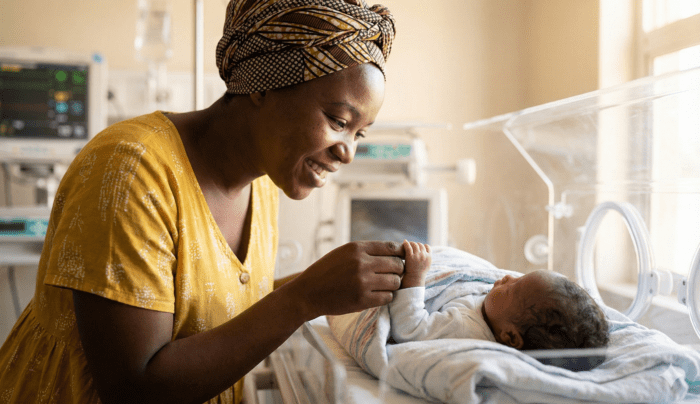
Sierra Leone — one of the countries with the world’s highest newborn mortality rates — has opened its first neonatal intensive care unit, a milestone that health experts say could save thousands of young lives each year. The NICU, established at Ola During Children’s Hospital in Freetown, gives critically ill and premature newborns access to specialized medical care that simply did not exist in the country before.
At a glance
- Neonatal intensive care unit: The new facility at Ola During Children’s Hospital is the first in Sierra Leone’s history, equipped with incubators, oxygen systems, and trained nursing staff to care for premature and critically ill newborns.
- Newborn mortality: Sierra Leone has one of the highest neonatal death rates in the world — approximately 33 deaths per 1,000 live births — meaning roughly one in 30 newborns does not survive their first month of life.
- Global partnership: The unit was developed with support from international health organizations and reflects years of advocacy by Sierra Leonean nurses and pediatric health workers who identified the gap as one of the country’s most urgent medical needs.
Why a NICU changes everything
For most of Sierra Leone’s history, premature babies and newborns in distress had almost no specialized care options. Without incubators, respiratory support, or trained neonatal nurses, families and doctors faced an almost impossible situation.
Neonatal deaths — those occurring in the first 28 days of life — account for nearly half of all child deaths under five globally, according to the World Health Organization. Most of those deaths are preventable with basic clinical interventions: warmth, oxygen, feeding support, and infection control. A functioning NICU delivers exactly those interventions.
Sierra Leone’s maternal and child health system has faced severe strain for decades, worsened by the 1991–2002 civil war and the 2014–2016 Ebola outbreak, both of which devastated health infrastructure and drove health workers out of the country. Rebuilding that system has been a long, uneven process — and the opening of the country’s first NICU represents a meaningful step forward.
The people behind the breakthrough
Credit for this milestone belongs in large part to Sierra Leonean nurses and pediatricians who have pushed for neonatal infrastructure for years. Local health advocates worked alongside international partners to train staff, source equipment, and build the clinical protocols needed to run a unit of this kind sustainably.
That local ownership matters. Research on health system strengthening consistently shows that facilities built with community buy-in and staffed by local professionals are far more likely to remain functional over time than those imposed purely from outside.
Sierra Leone’s government has also made maternal and newborn health a stated priority in recent years, including efforts to eliminate fees for maternal care — a policy that dramatically increased facility-based births when introduced. More births in facilities means more opportunities to identify and treat newborns who need intensive support.
A step forward, with more steps to go
The NICU’s opening is cause for genuine celebration, but Sierra Leone’s neonatal health challenges remain substantial. A single unit in Freetown cannot serve a country of eight million people spread across difficult terrain, and access will remain unequal between urban and rural communities for years to come.
Sustaining the unit also requires continued investment in nursing education, equipment maintenance, and supply chains — all areas where under-resourced health systems frequently struggle. The UNICEF Every Child Alive report has highlighted that equipment without trained staff, or trained staff without functioning equipment, delivers poor outcomes. Sierra Leone will need both, consistently, over the long term.
Still, the hospital now has something it never had before: a place where a baby born too soon has a fighting chance. That is not a small thing.
Globally, advances in neonatal care have driven remarkable reductions in child mortality over recent decades — the global under-five mortality rate has dropped by more than 60 percent since 1990, according to UNICEF data. Sierra Leone now has one more tool to contribute to that progress from within its own borders.
Read more
For more on this story, see: Good News for Humankind
For more from Good News for Humankind, see:
- Ghana establishes a new marine protected area at Cape Three Points
- Alzheimer’s risk cut in half by drug in landmark prevention trial
- The Good News for Humankind archive on Sierra Leone
About this article
- 🤖 This article is AI-generated, based on a framework created by Peter Schulte.
- 🌍 It aims to be inspirational but clear-eyed, accurate, and evidence-based, and grounded in care for the Earth, peace and belonging for all, and human evolution.
- 💬 Leave your notes and suggestions in the comments below — I will do my best to review and implement where appropriate.
- ✉️ One verified piece of good news, one insight from Antihero Project, every weekday morning. Subscribe free.