
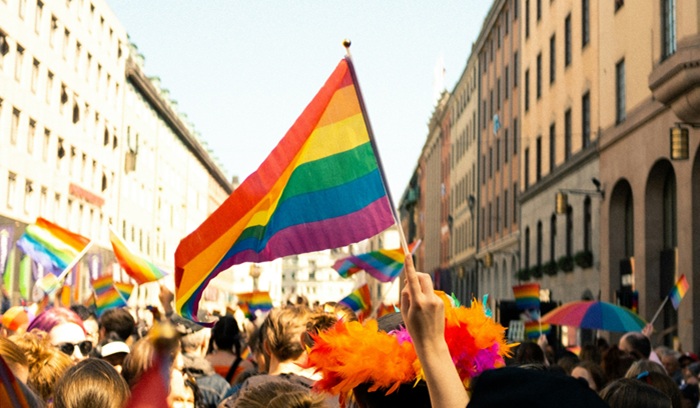
A Ukrainian court has ruled that a same-sex couple constitutes a family under the law — the first time any court in Ukraine has issued such a recognition. The Kyiv District Administrative Court handed down the decision in response to a petition filed by a Ukrainian soldier and his partner of more than 10 years, granting them a legal status that same-sex couples in the country have never before held.
At a glance
- Same-sex family recognition: The Kyiv District Administrative Court ruled that a same-sex couple of over 10 years constitutes a legal family — the first such ruling in Ukrainian history.
- LGBTQ+ military rights: The case was brought by a serving Ukrainian soldier, giving the ruling particular weight for LGBTQ+ service members who had previously lacked legal protections for their partners.
- Civil partnership legislation: President Volodymyr Zelenskyy has expressed support for civil partnerships, and human rights advocates say this ruling adds momentum to ongoing parliamentary discussions.
Why this ruling matters now
The couple at the center of the case sought legal recognition for a practical reason: without it, same-sex partners in Ukraine have no guaranteed right to make medical decisions for an injured or incapacitated partner, no automatic access to social benefits, and no standing in property or inheritance matters.
For a country at war, those gaps carry immediate consequences. LGBTQ+ soldiers and their partners have faced real legal vulnerability — a reality that human rights organizations, including Human Rights Centre ZMINA, have documented and challenged. This ruling creates a legal framework where none existed, and signals that the courts are willing to move ahead of the legislature when human rights are at stake.
A country reexamining its values
Russia’s full-scale invasion in 2022 C.E. accelerated something already underway in Ukrainian civil society: a renewed public conversation about what rights and freedoms Ukraine is fighting to protect. LGBTQ+ Ukrainians have served on the front lines in large numbers, and advocacy groups have argued — with growing public support — that equal legal treatment for soldiers’ families is not a political abstraction but a basic standard of fairness.
Ukraine’s constitution currently defines marriage as a union between a man and a woman, so this ruling does not establish marriage equality. What it does is establish that family — a broader legal concept — can include same-sex partners. That distinction matters. It opens a path for other couples to seek similar recognition without waiting for constitutional or legislative change.
The Kyiv Independent has reported extensively on how the war has shifted domestic attitudes toward LGBTQ+ rights, with polling showing increased support for civil partnerships among Ukrainians under 35 C.E.
The political moment
President Zelenskyy has publicly backed the introduction of civil partnerships for same-sex couples — a notable position in a country where official policy has historically been conservative on this issue. Reuters has covered his public statements as part of Ukraine’s broader push toward European Union integration, which requires alignment with E.U. human rights standards.
Ukraine applied for E.U. candidate status in 2022 C.E. Legal recognition of same-sex families is one of several areas where domestic law will need to evolve to meet European norms. Human rights advocates say the court ruling gives the Ukrainian parliament both cover and pressure to act.
Progress on this front is not guaranteed. Human Rights Watch has noted that legislative reform can stall even when political will exists at the executive level, and Ukraine’s wartime parliament has many competing priorities. The constitution’s current language remains a structural barrier to full marriage equality.
What comes next
The immediate impact of the ruling is legal security for one couple. Its longer-term significance lies in precedent. Other same-sex couples in Ukraine can now point to a court decision that affirms their family relationships as legally valid. That matters in courtrooms, hospitals, and government offices where recognition has previously been denied.
Legal milestones like this one rarely arrive in isolation. They tend to follow years of quiet organizing, individual acts of courage, and incremental shifts in public culture. The soldier and his partner who filed this case did so knowing it could shape outcomes far beyond their own lives — and, at least for now, it has.
The story of LGBTQ+ rights in Ukraine is still being written, in parliament, in the courts, and on the front lines. For advocates tracking Amnesty International’s global equality index, this ruling moves Ukraine in a measurable direction.
It joins a growing record of legal firsts — moments that, taken together, tell a different story about where human rights are headed. For readers following other milestones in health and medicine, the science of early intervention has produced its own landmark results: a drug trial cutting Alzheimer’s risk in half offered a similar sense of doors opening, and U.K. cancer death rates falling to their lowest level on record showed what sustained progress looks like over time.
Progress in human rights follows the same logic: slow, contested, and then suddenly visible.
Read more
For more on this story, see: Good News for Humankind
For more from Good News for Humankind, see:
- U.K. cancer death rates down to their lowest level on record
- Alzheimer’s risk cut in half by drug in landmark prevention trial
- The Good News for Humankind archive on justice
About this article
- 🤖 This article is AI-generated, based on a framework created by Peter Schulte.
- 🌍 It aims to be inspirational but clear-eyed, accurate, and evidence-based, and grounded in care for the Earth, peace and belonging for all, and human evolution.
- 💬 Leave your notes and suggestions in the comments below — I will do my best to review and implement where appropriate.
- ✉️ One verified piece of good news, one insight from Antihero Project, every weekday morning. Subscribe free.
More Good News
-

COP30 pledges recognition of 160 million hectares of Indigenous land rights
At the COP30 World Leaders Summit in Belém, Brazil in November 2025, 15 governments pledged to formally recognize Indigenous land rights over 160 million hectares by 2030 — an area the size of Iran — through the Intergovernmental Land Tenure Commitment. Brazil committed at least 59 million hectares. More than 35 donors renewed a $1.8 billion Forest and Land Tenure Pledge. The Tropical Forest Forever Facility secured nearly $7 billion, with 20% directed to Indigenous peoples. It was the largest Indigenous participation in COP history.
-

Ghana declares its first marine protected area to rescue depleted fish stocks
Ghana has declared its first marine protected area near Cape Three Points, targeting fish stocks decimated by decades of overfishing. The Ghana marine protected area marks a historic shift for a nation where millions depend on the sea for food and income — and could signal broader change across the Gulf of Guinea.
-

U.S. researchers cut Alzheimer’s risk by half in first-ever prevention trial
An Alzheimer’s prevention trial at Washington University School of Medicine has produced the first clinical evidence that clearing amyloid plaques from the brain before symptoms appear can cut the risk of developing the disease by roughly half. The results, published in The Lancet Neurology, tested the antibody drug gantenerumab in people with rare genetic mutations that make Alzheimer’s nearly inevitable — and found that early intervention can change the disease’s course.
