
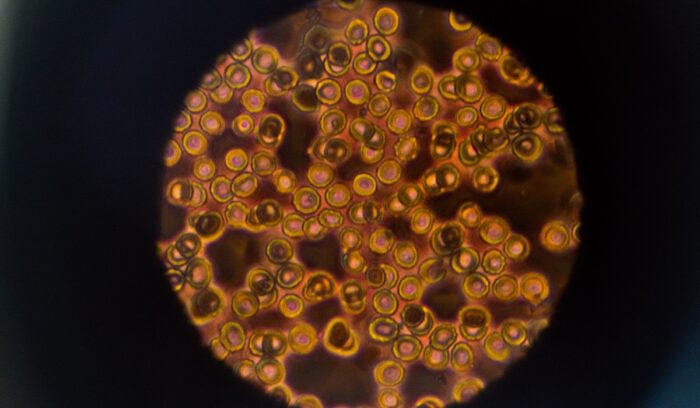
In 1665 C.E., a restless English scientist pressed a thin sliver of cork against a microscope lens and saw something no one had ever described before: tiny, walled compartments packed together like the cells of a honeycomb. Robert Hooke sketched them, named them, and published his findings — and biology was never the same.
Key findings
- Robert Hooke cells: Examining cork under a compound microscope, Hooke observed repeating box-like structures and became the first person to use the word “cell” to describe microscopic biological units.
- Micrographia publication: His 1665 C.E. book recorded nine months of observations across dozens of specimens — from fleas and mold spores to fossil shells — making it the first major work based entirely on microscopic observation.
- Cellular structure of plants: Hooke concluded these structures were unique to plants, a partial picture later expanded by Anton van Leeuwenhoek and generations of scientists who found cells throughout all living matter.
A mind built for curiosity
Robert Hooke was not a man who stayed in one lane. Born in 1635 C.E. on the Isle of Wight off the southern coast of England, he arrived in London as a teenager, studied painting briefly, then enrolled at Westminster School before moving on to Oxford. There, he became a laboratory assistant to Robert Boyle — the chemist behind Boyle’s Law — and began inventing at a pace that would characterize his entire life.
By the time he joined the Royal Society as its first paid curator of experiments in 1662 C.E., Hooke had already worked on watch springs, meteorological instruments, and theories of capillary action. The Royal Society required him to produce three or four experiments per week — an extraordinary demand that somehow suited him perfectly.
He improved or invented all five basic weather instruments of his era: the barometer, thermometer, hygrometer, rain gauge, and wind gauge. He designed a depth sounder for ocean navigation. He kept daily weather records years before anyone thought systematic weather prediction was possible. Hooke’s curiosity had no obvious ceiling.
What the microscope revealed
About 40 years before Hooke’s discovery, Galileo had invented an early version of the microscope. As curator of the Royal Society, Hooke acquired a commercial model and turned it on almost everything he could find — sand, mold, lice, mosquitoes, plant material. What he saw in cork stopped him.
The cork was divided into countless tiny compartments. Hooke thought they looked like the small rooms, or “cells,” used by monks in a monastery — and the name stuck. He believed these chambers had once held the living fluids of the cork tree and assumed they were a feature unique to plants. He was only partly right, but the act of naming and describing them was itself a revolution.
His findings appeared in Micrographia, published in January 1665 C.E. — the first book to describe a systematic series of observations made through a microscope. The volume included detailed illustrations, some attributed to the architect Christopher Wren, and covered everything from the structure of feathers to the compound eyes of flies. The Science Museum London holds it as one of the landmark documents in the history of science. Samuel Pepys, who read a copy in 1665 C.E., called it “the most ingenious book that ever I read in my life.”
Lasting impact
Hooke’s naming of the cell set in motion one of the most consequential research programs in human history. Within two decades, the Dutch microscopist Anton van Leeuwenhoek was observing living microorganisms — bacteria and protozoa — through far more powerful lenses he ground himself, expanding Hooke’s partial picture into something vast.
By the 19th century C.E., Matthias Schleiden and Theodor Schwann had formalized cell theory: all living things are made of cells, and cells arise only from other cells. That framework underlies every branch of modern biology, from ecology to genetics to medicine.
The discovery of cells is inseparable from the development of cancer biology — understanding that cancer is fundamentally a disorder of cell division required first knowing what a cell was. It is inseparable from germ theory, from the development of antibiotics, from every vaccine ever designed. When scientists today edit a genome or grow tissue in a lab, they are working in a conceptual space Hooke opened with a sliver of cork and a lens.
The Natural History Museum in London notes that Hooke’s broader contributions — to architecture, physics, geology, and meteorology — are still underappreciated relative to his more famous contemporaries. His rivalry with Isaac Newton, who delayed publishing Opticks until after Hooke’s death in 1703 C.E., may have contributed to the relative dimming of his reputation over the centuries.
Blindspots and limits
Hooke’s cell was not the cell of modern biology. He saw the walls of dead cork tissue, not the living, dynamic structures — with nuclei, membranes, organelles, and genetic machinery — that we now understand cells to be. His assumption that cells were exclusive to plants delayed a more complete picture by roughly two centuries. It would take microscopes orders of magnitude more powerful, and the work of dozens of scientists across Europe and beyond, to build what Hooke’s observation only sketched in outline. The history of the microscope also belongs substantially to craftsmen and lens-grinders — largely unnamed — whose technical skill made scientific observation possible in the first place.
Read more
For more on this story, see: ThoughtCo — Robert Hooke and the Discovery of Cells
For more from Good News for Humankind, see:
- Van Leeuwenhoek’s microscope reveals a hidden living world for the first time
- Novel AI model rapidly determines if an antidepressant will work
- The Good News for Humankind archive on the early modern era
About this article
- 🤖 This article is AI-generated, based on a framework created by Peter Schulte.
- 🌍 It aims to be inspirational but clear-eyed, accurate, and evidence-based, and grounded in care for the Earth, peace and belonging for all, and human evolution.
- 💬 Leave your notes and suggestions in the comments below — I will do my best to review and implement where appropriate.
- ✉️ One verified piece of good news, one insight from Antihero Project, every weekday morning. Subscribe free.


