
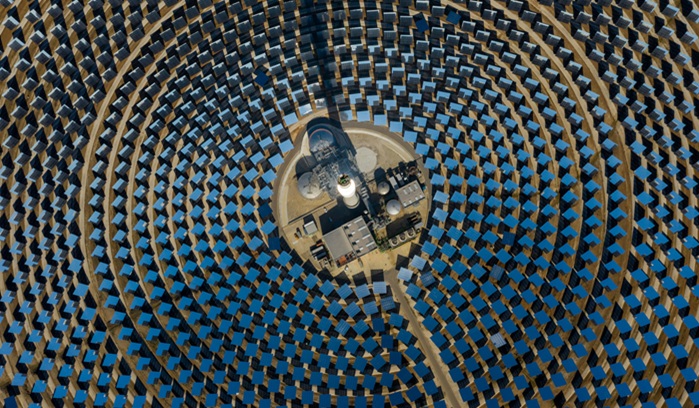
For the first time in history, renewable energy makes up nearly half of all the world’s installed power capacity. The International Renewable Energy Agency’s Renewable Capacity Statistics 2026, released April 1, confirms that renewables reached 49.4% of total global power capacity by the end of 2025 — up from 46.3% just one year earlier. That three-point jump in a single year reflects an energy system in structural transition, not incremental adjustment.
- Global renewable power capacity reached 5,149 gigawatts by end of 2025 after the addition of 692 gigawatts — the largest annual addition ever recorded — according to the International Renewable Energy Agency.
- Solar alone added 511 gigawatts in 2025 — more than the entire installed solar capacity of the world just eight years ago — accounting for roughly 75% of all new renewable additions. Wind followed with 159 gigawatts.
- Africa recorded its highest renewable capacity expansion on record in 2025, growing 15.9% and adding 11.3 gigawatts led by Ethiopia, South Africa, and Egypt, while the Middle East saw its fastest-ever annual growth at 28.9%, driven by Saudi Arabia.
Renewables also made up 85.6% of all new power capacity added globally in 2025 — meaning for every new power plant or installation connected to a grid anywhere in the world, more than six out of seven ran on clean energy. The other 14.4% was fossil fuel or nuclear.
Why 49% matters more than it sounds
Installed capacity and actual electricity generation are different things. Fossil fuel plants typically run at higher utilization rates than solar or wind, which generate only when the sun shines or the wind blows. So while renewables now make up 49% of global installed power capacity, they supply roughly 32% of actual electricity generated. That gap is real and important.
But the capacity figure still matters enormously. Capacity is what gets built. It is where investment flows. It determines what the energy system will look like in ten and twenty years as the existing fossil fuel fleet ages out. When renewables make up nearly half of installed capacity and 85.6% of new additions, the direction of the global energy system is no longer in question — only the pace.
The jump from 46.3% to 49.4% in a single year shows how fast that direction is moving. At that rate, renewables cross 50% of installed capacity during 2026.
What pushed the numbers this high
Solar photovoltaic panels drove the surge. The 511 gigawatts of solar capacity added in 2025 alone exceeds the total solar capacity that existed globally in 2017. The cost of solar has fallen more than 90% over the past fifteen years, making it the cheapest source of new electricity generation in history — cheaper than coal, gas, or nuclear in almost every market. Wind added 159 gigawatts. Together, solar and wind accounted for 96.8% of all new renewable additions.
A geopolitical crisis accelerated the shift. Escalating conflict in the Middle East sent fossil fuel prices climbing and exposed the vulnerabilities of countries dependent on imported oil and gas. IRENA Director-General Francesco La Camera said the contrast was visible in real economic data: “Countries that invested in the energy transition are weathering this crisis with less economic damage, as they boost energy security, resilience and competitiveness.” Renewable energy is homegrown. It has no fuel cost, no shipping route, no exposure to a tanker blockade or a pipeline disruption.
How the transition is reaching places it previously bypassed
The 2025 expansion was not evenly distributed, but it was broader than in previous years. Asia dominated in absolute terms, contributing 74.2% of new capacity — primarily China and, to a lesser extent, India. But Africa’s record 15.9% growth and the Middle East’s 28.9% expansion signal that the clean energy transition is beginning to reach beyond the handful of economies that have historically driven it.
Off-grid solar — the small installations that bring electricity directly to homes and businesses in areas without grid access — grew by 1.7 gigawatts globally. For communities in rural sub-Saharan Africa and South Asia, off-grid solar is often not a secondary option. It is the first reliable electricity a household has ever had. Solar panel imports into Africa rose 60% in the year to mid-2025, with 20 countries recording record orders. That number tells a different story than the gigawatt totals dominated by China.
The honest gap between progress and the finish line
The 49.4% milestone is real. So is the distance still to travel. IRENA notes that 2025 also saw a sharp rebound in non-renewable capacity additions, which nearly doubled compared to 2024 — driven largely by China adding 100 gigawatts of non-renewable capacity, most of it coal, partly to meet demand from AI data centers. The share of new capacity going to renewables actually fell slightly from 92% in 2024 to 85.6% in 2025 for this reason.
The COP28 commitment to triple installed renewable capacity to 11.2 terawatts by 2030 remains out of reach at current rates. The world sits at 5.15 terawatts. Hitting the target requires 16.6% annual growth, sustained every year through 2030. 2025’s 15.5% fell just short of that pace. Grid infrastructure, financing access in developing nations, and policy consistency are the binding constraints — not technology cost or availability, both of which have already been solved.
Still, the world’s power system crossed a threshold in 2025 that was barely imaginable a decade ago. Renewable energy is now the dominant form of installed power capacity on Earth. The question for the rest of the decade is not whether the transition happens — but how fast, and who gets to be part of it.
This story was originally reported by the International Renewable Energy Agency.
More Good News
-

Marie-Louise Eta becomes the first female head coach in men’s top-flight European football
Marie-Louise Eta, 34, was appointed head coach of Bundesliga side Union Berlin on April 12, 2026, becoming the first woman to hold the top coaching position at a men’s club in any of Europe’s Big Five leagues — the Premier League, La Liga, Serie A, Ligue 1, and Bundesliga. A Champions League winner as a player with Turbine Potsdam in 2010, Eta had already broken barriers as the first female assistant coach in the Bundesliga in 2023. She takes charge for the final five matches of the season as Union Berlin fights to secure top-flight survival, after which she was…
-
Renewables now make up at least 49% of global power capacity
Renewable energy reached 49.4% of total global installed power capacity by end of 2025, up from 46.3% in 2024, according to the International Renewable Energy Agency’s Renewable Capacity Statistics 2026. The world added 692 gigawatts of new renewable capacity last year — the largest annual addition ever recorded — with solar alone contributing 511 gigawatts. Africa recorded its highest renewable expansion on record, and the Middle East its fastest-ever growth. IRENA Director-General Francesco La Camera noted that countries investing in renewables are absorbing the current Middle East energy crisis with measurably less economic damage than fossil-fuel-dependent economies.
-

Global suicide rate has fallen by 40% since 1995
A landmark study published in The Lancet Public Health by researchers at the Institute for Health Metrics and Evaluation at the University of Washington found that the global age-standardized suicide mortality rate fell nearly 40% between 1990 and 2021 — from 15 deaths per 100,000 people to nine. The decline was driven by measurable interventions including restrictions on toxic pesticides, expanded mental health services, and national prevention strategies. Female suicide rates fell more than 50% globally over the period. Roughly 740,000 people still die by suicide each year, and rates have risen in parts of Latin America and North America,…
-
Rhinos are reintroduced back into Uganda’s wild after 43 years
The Uganda Wildlife Authority havetranslocated the first southern white rhinos to Kidepo Valley National Park — 43 years after the last rhino in the park was killed by poachers in 1983. The animals came from Ziwa Rhino Sanctuary, a breeding program established in 2005 with just six individuals that has grown Uganda’s total rhino population to 61. Four more rhinos will follow by May, with a separate group already relocated to Ajai Wildlife Reserve in January 2026. The reintroduction restores a key grazing species to one of Africa’s most remote savannah ecosystems and makes Kidepo the only national park in…
-

U.K. cancer death rates down to their lowest level on record
Cancer Research UK data published in March 2026 confirms that UK cancer death rates have reached their lowest level on record — around 247 deaths per 100,000 people annually between 2022 and 2024, down 29% from the 1989 peak of 355 per 100,000. The rate fell 11% in just the past decade, with stomach cancer deaths down 34%, lung cancer down 22%, and ovarian cancer down 19%. Cervical cancer death rates have dropped 75% since the 1970s, driven by NHS screening programs and the HPV vaccine introduced in 2008. Researchers caution that liver, womb, and gallbladder cancer death rates are…