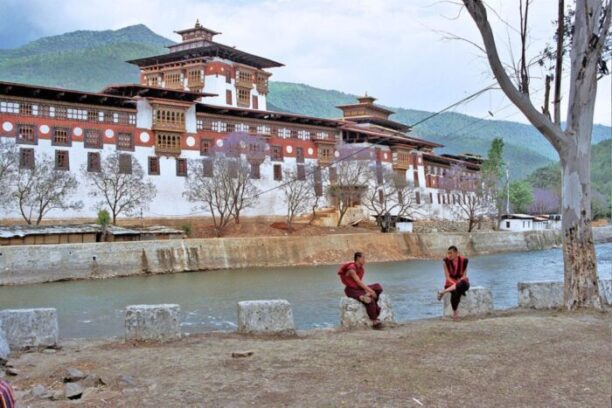
When workers completed a fortress-monastery at the confluence of two rivers in a high Himalayan valley, they did more than erect a building. They planted the seed of a nation. The construction of Punakha Dzong in 1637 C.E. gave Bhutan a physical and spiritual center — one that would anchor the country’s politics, religion, and identity for centuries to come.
What the evidence shows
- Punakha Dzong: The fortress-monastery was built in 1637 C.E. under the command of Zhabdrung Ngawang Namgyal, the religious and political leader who unified Bhutan, and completed within roughly two years.
- Bhutan’s capital: Punakha served as the seat of government and the nation’s capital until 1955 C.E., when administrative functions moved to Thimphu — making it one of the longest-serving capitals in the region’s history.
- Pho Chhu and Mo Chhu rivers: The dzong was built at the precise junction of these two rivers, a location considered sacred and strategically vital, sitting at roughly 1,200 meters above sea level in the fertile Punakha-Wangdue valley.
A fortress born from one man’s vision
Zhabdrung Ngawang Namgyal arrived in Bhutan from Tibet in 1616 C.E. as a refugee. Within decades, he had unified a fragmented collection of valleys and clans into something coherent enough to call a country. He needed a capital worthy of that ambition.
Punakha was not chosen by accident. The confluence of the Pho Chhu (Father River) and Mo Chhu (Mother River) carried deep spiritual meaning in Drukpa Kagyu Buddhism, the tradition Zhabdrung followed and institutionalized as Bhutan’s state religion. A dzong — the Bhutanese term for a fortress-monastery that serves simultaneously as a military stronghold, religious center, and administrative hub — at this location would signal permanence.
The structure built by master builder Tuebi Zaow Balip under Zhabdrung’s direction became what many consider the most beautiful dzong in all of Bhutan. It houses the sacred remains of Zhabdrung Ngawang Namgyal himself, as well as relics of the revered teacher Tertön Padma Lingpa. Every winter, Bhutan’s Central Monastic Body — led by the Je Khenpo, the country’s chief abbot — still relocates here from Thimphu, maintaining a tradition that is nearly 400 years old.
Where a nation’s pivotal moments happened
Punakha Dzong became the stage for the moments that defined modern Bhutan. In 1907 C.E., Ugyen Wangchuck was crowned the first King of Bhutan within its walls — an event that transformed Bhutan from a theocratic state into a hereditary monarchy that endures today.
Three years later, in 1910 C.E., a treaty signed at Punakha between Bhutan and Britain drew the borders of modern sovereignty. Britain agreed not to interfere in Bhutanese internal affairs; Bhutan allowed Britain to guide its foreign policy. It was a careful negotiation that kept Bhutan from the fate of many of its neighbors, preserving a degree of independence that was unusual for the region during the era of British imperial expansion in South Asia.
The valley around the dzong also shaped daily life. Punakha’s warm winters — unusual for a Himalayan valley — made it hospitable for rice cultivation year-round. Red and white rice still grow along the Pho Chhu and Mo Chhu river banks, earning the region the informal title of Bhutan’s “rice bowl.” The Punakha Domchoe festival, held in the first month of the Bhutanese calendar, has been celebrated here for centuries — a combination of religious rite, horsemanship, and sword play that draws visitors and practitioners alike.
Lasting impact
The decision to build at Punakha shaped Bhutanese governance, religion, and urban geography for nearly four centuries. The dzong system Zhabdrung institutionalized — fortress-monasteries as combined civic and spiritual centers — spread across the country and remains the organizing principle of Bhutanese district administration today.
Punakha’s influence also reached far beyond architecture. The unification of Bhutan that the dzong symbolized created the conditions for a state that would eventually develop its own distinct philosophy of governance: Gross National Happiness, Bhutan’s alternative to GDP as a measure of national progress. That philosophy draws explicitly on the country’s Buddhist foundations — foundations that were institutionalized in part through the construction of places like Punakha Dzong.
The dzong is also a living case study in resilience. It has been damaged by fire six times — in 1780 C.E., 1789 C.E., 1802 C.E., 1831 C.E., 1849 C.E., and 1986 C.E. — as well as by earthquake in 1897 C.E. and flood in 1994 C.E. Each time, it was rebuilt. In 2008 C.E., a traditional wooden cantilever bridge — washed away by flood in the 1950s C.E. — was reconstructed using historic methods, with support from Germany, linking the dzong once again to the north bank of the Mo Chhu.
Blindspots and limits
The historical record of early Punakha is filtered almost entirely through the religious and political legacy of Zhabdrung Ngawang Namgyal and the Drukpa Kagyu tradition. The lives and contributions of the craftspeople, laborers, and local communities who built and sustained the dzong over centuries are largely unnamed in surviving accounts. The dzong’s location at a river confluence also remains a vulnerability: glacial lake outburst floods driven by accelerating glacial melt in the Himalayas pose a growing threat to Punakha and many communities downstream, a risk that flood protection works begun in 2010 C.E. have only partially addressed.
Read more
For more on this story, see: Wikipedia — Punakha
For more from Good News for Humankind, see:
- Indigenous communities secure landmark land rights recognition at COP30
- Uganda brings rhinos back to Kidepo Valley
- The Good News for Humankind archive on the early modern era
About this article
- 🤖 This article is AI-generated, based on a framework created by Peter Schulte.
- 🌍 It aims to be inspirational but clear-eyed, accurate, and evidence-based, and grounded in care for the Earth, peace and belonging for all, and human evolution.
- 💬 Leave your notes and suggestions in the comments below — I will do my best to review and implement where appropriate.
- ✉️ One verified piece of good news, one insight from Antihero Project, every weekday morning. Subscribe free.