A mountain town in central Puerto Rico has switched on the island’s first cooperatively managed solar microgrid, giving residents and businesses a community-owned source of electricity that can keep the lights on through hurricanes, earthquakes, and grid failures. The project in Adjuntas, built by the grassroots organization Casa Pueblo with support from the Honnold Foundation and Oak Ridge National Laboratory, marks a significant shift in how Puerto Ricans think about energy — and who controls it.
At a glance
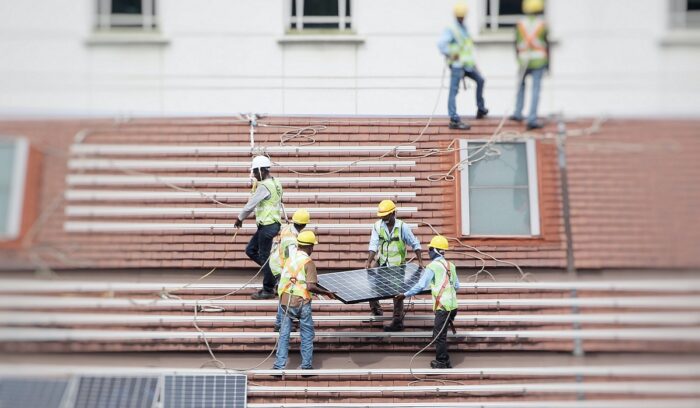
- Community solar microgrid: The Adjuntas system includes 700 solar panels mounted on seven buildings in the town’s central plaza, paired with a 1 MWh battery storage system capable of running 14 downtown businesses for up to 10 days during an outage.
- Casa Pueblo: The local nonprofit behind the project describes itself as a community self-management initiative committed to protecting natural, cultural, and human resources — and has been organizing in Adjuntas since 1980.
- Oak Ridge National Laboratory: Engineers from the lab developed an “orchestrator tool” that allows two separate battery storage containers on opposite sides of the plaza to share electricity and operate in concert, or independently if one is damaged.
Why Adjuntas, and why now
Puerto Rico’s electricity grid has long been a source of frustration and vulnerability. Most of the island’s power comes from thermal generating plants near the southern port city of Ponce, with electricity traveling over high-voltage transmission lines across a mountainous interior where peaks reach 5,000 feet. Those lines were devastated by Hurricanes Irma and Maria in September 2017 C.E., leaving much of the island without power, clean water, or medical services for months.
Six years on, the U.S. government has pledged $1 billion to bring 100% renewable energy to Puerto Rico. But many residents are wary of large, centrally controlled solar farms — particularly after seeing utility-scale projects near Guayama that locals say worsened flooding and consumed agricultural land. The Adjuntas project offers a different model: small, locally owned, and designed specifically to serve the community that built it.
Casa Pueblo has been organizing in Adjuntas since 1980 C.E., when it successfully halted a government plan to open mining operations across 36,000 acres in four municipalities. That history of community-led resistance gave the organization both credibility and experience in navigating complex stakeholder systems — skills that proved essential when it came to sorting out how the microgrid would work and who would operate it.
How the microgrid works
Technically, the Adjuntas installation is two smaller microgrids, with batteries divided between storage containers on opposite sides of the central plaza. The Oak Ridge orchestrator tool enables them to share information and electricity in real time. If one side is damaged, the other can still provide backup power — a resilience feature designed specifically for a region that faces recurring extreme weather.
“This is going to be our proof of concept,” Ben Ollis, an Oak Ridge engineer leading the project alongside colleague Max Ferrari, told Canary Media. “We’re trying to design it in such a way that it can be expandable to any number of microgrids” in Adjuntas and beyond. Similar tools are used at much larger scales on the U.S. mainland, but the Oak Ridge system is the first designed to operate at this localized, community level.
Business owners and residents will run the microgrid through a nonprofit called the Community Solar Energy Association of Adjuntas, which will sell surplus electricity to the commonwealth’s grid through a power purchase agreement. Revenue from those sales will support microgrid maintenance and fund new community projects.
A model for the island
“This is a first-of-its-kind project,” said Kate Trujillo, deputy director of the Honnold Foundation, which co-funded the work. “It’s amazing to see it all coalescing.”
The project has been in development since 2019 C.E., delayed by COVID-related supply chain disruptions, earthquakes, and hurricanes. Arturo Massol-Deyá, Casa Pueblo’s executive director, said it was difficult to align landlords, business owners, and other stakeholders around a shared vision — but the community held together.
“We’ve gone through a lot but we knew it was the right way to go,” Massol-Deyá said.
Alexis Massol González, Casa Pueblo’s founder, sees the Adjuntas microgrid as a reference point for the whole island. “There are many eyes on this project,” he told Energy News. “This is a top notch model. We Puerto Ricans are proud of having a project like this. May the Department of Energy come and study it.”
A federal study called PR100 found that renewable energy potential in Puerto Rico significantly exceeds total energy demand now and through 2050 C.E. — particularly if rooftop solar is prioritized. Alberto Colón of Comunidad Guayamesa, which installs and maintains solar panels for elderly residents in Guayama, put it plainly: “We have enough rooftops to generate three, four times what we need.”
The inauguration included a community-wide celebration and a festive “Marcha del Sol” through downtown. Massol-Deyá said he wanted the event to make “a political statement” to get more of Puerto Rico off fossil fuels. That goal still has a long way to go — the island remains heavily dependent on imported fossil fuels, and scaling community microgrids across dozens of municipalities will require sustained funding, regulatory cooperation, and technical capacity that hasn’t yet been assembled. But in Adjuntas, the panels are producing power. That, for now, is enough to build on.
For communities that have spent decades watching decisions about their land and their energy made elsewhere, local control of electricity isn’t just a technical upgrade. It’s something closer to self-determination.
Find out more about Casa Pueblo’s work in Adjuntas and across Puerto Rico.
Read more
For more on this story, see: CleanTechnica
For more from Good News for Humankind, see:
- U.K. cancer death rates drop to their lowest level on record
- Renewables now make up at least 49% of global power capacity
- The Good News for Humankind archive on renewable energy
About this article
- 🤖 This article is AI-generated, based on a framework created by Peter Schulte.
- 🌍 It aims to be inspirational but clear-eyed, accurate, and evidence-based, and grounded in care for the Earth, peace and belonging for all, and human evolution.
- 💬 Leave your notes and suggestions in the comments below — I will do my best to review and implement where appropriate.
- ✉️ One verified piece of good news, one insight from Antihero Project, every weekday morning. Subscribe free.