
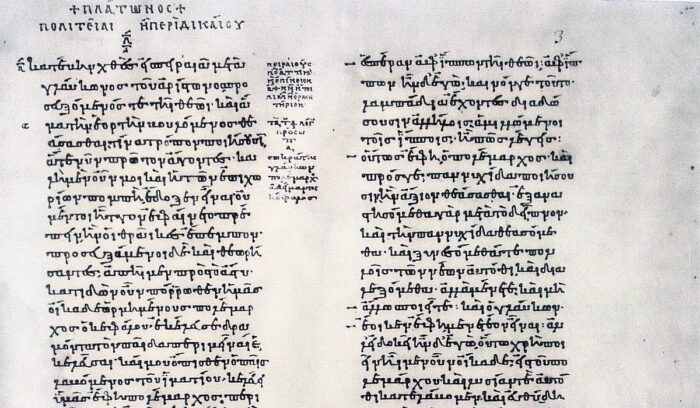
Around 380 B.C.E., a philosopher in Athens completed a dialogue that would become one of the most argued-over texts in history. Plato’s Republic asked a question that felt both simple and bottomless: what is justice, and what would a truly just society look like? The work was not a policy document or a legal code. It was a sustained, restless inquiry — and it changed what philosophy thought it could do.
Key findings
- Plato’s Republic: Written as a series of dialogues, the text uses conversation between Socrates and his interlocutors to explore justice, governance, knowledge, and the nature of the soul — making philosophical argument accessible and dramatic at once.
- Theory of Forms: At the heart of the work is the idea that what we perceive with our senses — beauty, justice, goodness — are imperfect reflections of eternal, unchanging ideals. Only reason, not sensation, can reach true knowledge.
- Form of the Good: Book VI identifies the highest form as the Form of the Good — the cause and condition of all other knowledge — placing ethics at the summit of Plato’s philosophical system.
A city in words
Plato structured his investigation around a thought experiment: build an ideal city from scratch, and you might see justice writ large enough to understand it in the individual soul.
The city he described — Kallipolis — was governed by philosopher-kings, people whose long training in mathematics, dialectic, and philosophy had brought them to knowledge of the Form of the Good. The three classes of his city — rulers, warriors, and producers — mirrored the three parts of the soul: reason, spirit, and appetite. Justice, in both city and soul, was the harmony of each part doing what it was fitted for.
It was a bold, strange vision. And Plato knew it. He has Socrates acknowledge that such a city may never exist — but that the attempt to describe it is itself worthwhile. The model matters even if the reality falls short.
The Republic also gave Western thought the Allegory of the Cave — the famous image of prisoners mistaking shadows on a wall for reality, unable to turn and face the light. It remains one of philosophy’s most enduring metaphors for the limits of ordinary perception and the difficulty of genuine knowledge.
A synthesis across traditions
Plato was not working in isolation. His philosophy wove together several strands of earlier Greek thought. The tension he tried to resolve — between Heraclitus’s world of constant change and Parmenides’s unchanging, eternal being — had preoccupied thinkers for generations. Geometry, particularly in the tradition of Pythagoras, gave Plato a model for the kind of certain, abstract knowledge he believed the Forms could provide.
It is also worth noting that Plato’s Athens was a city drawing on trade, contact, and intellectual exchange across the Mediterranean world. Egyptian priestly traditions, Persian philosophical concepts, and the accumulated knowledge of Babylonian astronomy and mathematics were all circulating in the broader Greek-speaking world. The history of ancient philosophy is increasingly understood as a conversation across cultures, not the output of a single civilization working alone.
Plato founded the Academy in Athens — often described as the first institution of higher learning in the Western world — where he taught and continued to develop these ideas. His student Aristotle would go on to challenge many of them, including the Theory of Forms, through what became known as the Third Man Argument. That disagreement between teacher and student generated centuries of productive philosophical argument.
Lasting impact
The downstream influence of Plato’s Republic is difficult to overstate. The philosopher Alfred North Whitehead famously described the history of Western philosophy as “a series of footnotes to Plato” — an exaggeration, but one with a core of truth.
Early Christian thinkers, particularly Saint Augustine, absorbed Platonic ideas deeply. The notion of the Forms was reinterpreted as thoughts in the mind of God, helping to shape Christian theology for over a millennium. Neoplatonism, developed by Plotinus in the 3rd century C.E., carried Plato’s metaphysics into a mystical framework that influenced both Christian and Islamic thought.
The Republic‘s political questions — about who should govern, what justice requires, how education shapes character — have never stopped generating responses. Thomas More’s Utopia, Rousseau’s social contract theory, and modern debates about deliberative democracy are all, in various ways, still answering Plato. Contemporary mathematical Platonism — the view that numbers and mathematical objects exist independently of human minds — draws directly on his Theory of Forms.
The Republic has also been a touchstone in education. Its insistence that justice is better than injustice even for the just person — not just instrumentally but intrinsically — gave moral philosophy one of its founding arguments.
Blindspots and limits
Plato’s ideal city has drawn sustained and serious criticism. Its rigid class hierarchy, its suspicion of democracy, its censorship of poetry and art, and its removal of children from families to be raised by the state have troubled readers for centuries — and rightly so. The philosopher-king concept, however nobly intended, has historically been used to justify authoritarian paternalism. Plato also wrote in a context that accepted slavery and the subordination of women; his text reflects those limits even when it occasionally transcends them. Reading the Republic well means reading it critically, not just admiringly.
The dating of the text is also not settled with precision. Most scholars place its composition between roughly 380 and 370 B.C.E. — the 383 B.C.E. date represents an early estimate within a range of legitimate scholarly debate.
Read more
For more on this story, see: Wikipedia — Platonism
For more from Good News for Humankind, see:
- Sushruta Samhita becomes one of history’s most advanced medical texts
- Timoto-Cuica people build Venezuela’s most complex pre-Columbian society
- The Good News for Humankind archive on the ancient world
About this article
- 🤖 This article is AI-generated, based on a framework created by Peter Schulte.
- 🌍 It aims to be inspirational but clear-eyed, accurate, and evidence-based, and grounded in care for the Earth, peace and belonging for all, and human evolution.
- 💬 Leave your notes and suggestions in the comments below — I will do my best to review and implement where appropriate.
- ✉️ One verified piece of good news, one insight from Antihero Project, every weekday morning. Subscribe free.


